What happened at first meeting of Reform-controlled council?

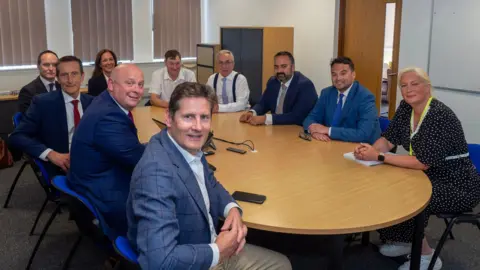 Norfolk County Council
Reform UK has gained control of another council, promising a "laser focus on value for money".
On its first day in charge at Norfolk County Council, it took aim at net-zero issues, pushing forward with an investigation into spending on climate-related projects.
While not having a majority, it did so by teaming up with a party headed by a staunch opponent of its leader, Nigel Farage.
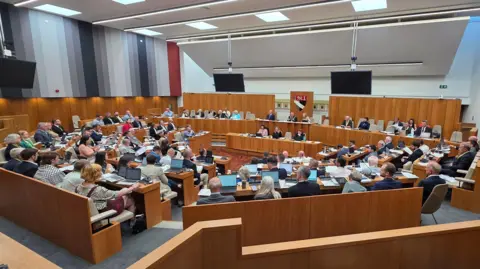
The first meeting of this new version of the council – featuring dozens of newly elected members - was bad-tempered at times, featuring jeering and taunting.
So what happened?
Reform is running the council, but without a majority?
Yes.
While it comfortably won the most seats in the local elections, it fell short of an overall majority.
However, the other parties were never likely to form a coalition and Reform's David Bick was the only candidate put forward to be council leader.
A vote still needed to take place, but with support from all the Reform members – and Great Yarmouth First (GYF) abstaining – he was elected.
That allowed him to select a cabinet to run the council, with its members responsible for many major decisions.
"We will have a laser focus on value for money and providing the best possible services," he told the council chamber in a short speech following his victory.
There are a lot of new councillors
Sixty-seven out of 84 members voted in earlier this month are new to the county council, which also features Liberal Democrats, Greens, Conservatives, Labour and an independent.
Thirty-eight of those new councillors are in Reform, nine are in GYF, eight are in each of the Lib Dems and Greens, three are in the Conservatives, and Labour's sole representative was elected for the first time at the elections.
 Paul Moseley/BBC
So what decisions did Reform make?
It put forward a motion for a review of "all current council spending linked to net-zero and climate-related initiatives" to ensure they provide "clear value for money".
Net-zero refers to a state in which the greenhouse gases going into the atmosphere are balanced out by those also removed.
The UK is legally committed to reaching net-zero by 2050 under a law passed by Tory Prime Minister Theresa May in 2019.
It means the UK must cut carbon emissions until it removes as much as it produces, in line with the 2015 Paris Climate Agreement.
Nationally, Reform has said it wants to scrap net-zero altogether, and that has been echoed at county councils it runs, including Essex and Lincolnshire.
Conservative Kay Mason Billig – who was the council leader before the elections – said the Reform move appeared to be because of "an edict from their master Nigel Farage".
She said the council's environmental policy did not use the phrase 'net-zero' and was already focused on efficiency.
"So if that's replacing a diesel vehicle with an electric one because it's cheaper to hire and because it's cheaper to run, then that's what we do," she said.
The Greens' Jan Davis said reducing energy use helped cut bills, while also warning that Norfolk was at particular risk from flooding and coastal erosion.
In response, Jason Butler, the new cabinet member for efficiency, insisted: "I will not be following ideology."
He added the review was "about balancing priorities, whether that's climate change or whether that's spending on essential services".
Reform's proposal was ultimately voted through with the support of GYF.
The two parties also voted together to cut three political assistant jobs at the council, to save about £164,000 a year.
 Paul Moseley/BBC
Do Reform and Great Yarmouth First get along?
GYF was set up by Rupert Lowe, the Great Yarmouth MP, who was in Reform before a bitter falling out with Nigel Farage and others.
Lowe continues to attack his former leader on social media and in interviews and the group is part of his national Restore Britain party.
Before the elections, Farage dismissed GYF as "a little local difficulty", but it won all nine seats it challenged for.
So, on the surface, you might not expect them to work together.
However, Bick said GYF's councillors "are very much on the same page as us on policy" and "have demonstrated a lot of collaboration and common sense".
A spokesman for GYF said the group was "elected to do what is right for the people of Great Yarmouth, and that is exactly what we are doing".
Bick denied a deal had been agreed between the two sides, but other parties pointed out that Reform handed GYF the chair of the scrutiny committee, arguably the most important committee on the council.
As the second-largest party, the Liberal Democrats would normally have expected to take on that role.
"I'm very disappointed. There appears to have been a deal done," said Lib Dem group leader Brian Watkins.
Mason Billig said GYF had "sold themselves out".
What was the atmosphere like at the meeting?
 Paul Moseley/BBC
Council meetings are usually fairly staid affairs, with people taking turns to talk.
This one was tense at times, with some jeers and jibes.
During one debate, after being accused of not knowing what they were voting for, Reform councillors began jeering.
Lib Dem councillor Lucy Shires told the chamber she was "really disappointed" by that.
"In Norfolk we do not behave like that - we allow people to speak," she said.
One Reform councillor replied: "Times are changing."
At a couple of points, Lib Dem and Green councillors took aim at Reform for saying little during the day's debates.
In response, Bick described them as "very rude" and said his members had already discussed matters with each other before the meeting.
"We're not going to react or be reactive just because somebody's put a motion on the order paper," he said.
"There's fundamentally much more important things to get done here."
Do you have a story suggestion for Norfolk? Contact us below.
Follow Norfolk news on BBC Sounds, Facebook, Instagram and X.
