'Lidos were incredibly popular, but now most are lost'

 Daily Herald Archive/SSPL/Getty Images
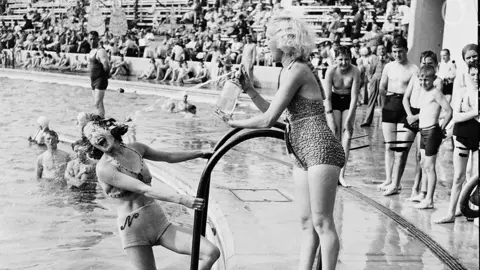
Open-air swimming pools were once a staple of the North West seaside holiday, but are now "just memories", an author who has researched the topic has said.
Tom Ford said South Shore Pool in Blackpool, Super Swimming Stadium in Morecambe and the Grange-over-Sands lido were once popular with families and holidaymakers before package holidays took off and they fell into decline.
"It's a bit of a tragedy that the county had these amazing pools in the 20s right the way up to the 70s and then they fell into a very sad state and one by one they disappeared," he said.
"Memories are now all Lancashire has."
'Bring the punters in'
The lidos, named after the Italian Lido di Venezia, were built by local councils as recreational facilities and were "colossally popular in the 20s and 30s and then after the war," Ford told BBC Radio Lancashire.
He said: "After the First World War there was a huge explosion of desire and longing to live and have more fun.
"Proper holidays came in as a result of trade union pressure and there was this leisure market and the seaside resorts were catering for that and they all felt 'we need a big swimming pool to bring the punters in'."
He said "the most expensive and the most magnificent pools in the country were built in Lancashire and Scarborough".
The al fresco public pools were popular with families and holidaymakers who visited them to cool off.
But the cold water and the uncertainty of sunshine meant that when the package holiday industry got going in the 60s, people began to look abroad, Ford explained.
"I came round and looked at the sites of all the old pools and I met a couple and I asked what happened, and the old guy said 'Benidorm' and that was the end of it," he said.
Another problem was maintenance of the reinforced concrete structures, which "looks amazing when it's first unveiled" but is "vulnerable to the storms and the winter weather".
"They required hugely expensive maintenance which they never got because the councils around them began to get financial pressures.
"They never had the money to keep them going and they just literally started falling apart," Ford said.
"Huge sums of public money were spent, and I think its fascinating to see the trajectory of popularity, and then holding on, and then this inevitable decline that sets in.
"It's very poignant walking round these spaces where the pools were and imagining all the fun and laughter that people had there."
Listen to the best of BBC Radio Lancashire on Sounds and follow BBC Lancashire on Facebook, X and Instagram. You can also send story ideas via Whatsapp to 0808 100 2230.
