US and Iran trade strikes after tankers hit in Strait of Hormuz
Renewed fighting has broken out in the Gulf region, in the worst exchange of fire between the US and Iran since the two nations signed an interim deal in June.
US Central Command (Centcom) said on Tuesday it had launched "powerful" strikes in response to attacks on three oil tankers in the Strait of Hormuz, hitting more than 80 targets including air defence systems, coastal radar and fast boats.
On Wednesday, Iran said it had targeted US military sites in Bahrain and Kuwait in retaliation to the US attacks.
Oil prices ticked up following the strikes, with a barrel of Brent crude rising by more than 3% to $76 (£56.88).
Nato chief Mark Rutte described the American strikes on Iran as "absolutely necessary", speaking at the military alliance's summit in Ankara, Turkey.
"I think it was absolutely necessary," Rutte said, arguing that Iran was "basically violating the ceasefire" given what "happened yesterday with ships being attacked".
"I think it is totally crucial that the US forcefully [reacts]."
The US also said it had revoked its temporary suspension of sanctions on Iranian oil sales. Iran's speaker Mohammad Bagher Ghalibaf accused the US of breaching their Memorandum of Understanding (MoU) on this issue, and others, including the attacks in southern Iran and "violating Iranian adjustments in the Strait".
"The era of bullying and extortion is over. It leads nowhere. We don't fold," he said.
The USstrikes hit Qeshm island, Bandar Abbas and Sirik, Iranian state media reported, where people have been injured by shrapnel.
Missiles and drones were launched at "85 key US military facilities" in the two countries, including a US Navy headquarters and an air base in Kuwait, the Islamic Revolutionary Guard Corps (IRGC) said.
Iranian media reported the first casualty of the strikes, with IRNA stating: "Guardsman Mohammadreza Khazini was killed while confronting enemy drones after being struck by shrapnel from a projectile."
Kuwait has also responded to the Iranian strikes on its country, lambasting the "repeated attacks".
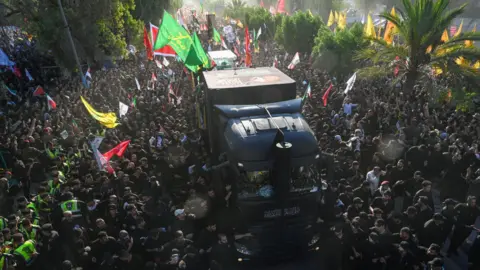
Talks on reaching a permanent deal have been on pause with funeral proceedings taking place for the late Ayatollah Ali Khamenei, killed on the first day of US-Israeli strikes on Iran.
Ceremonies are taking place in Iraq on Wednesday, with the final rites and burial set for Mashhad in north-east Iran on Thursday.
It is not clear when talks will resume after this latest round of strikes.

 Getty Images
Earlier on Tuesday, Iran's deputy foreign minister described the US attacks as a violation of the US-Iran memorandum signed last month, and warned Tehran would "take decisive measures".
The US had said there would be consequences to what it has called the "wholly unacceptable" attacks on the three tankers.
Centcom said in addition to 60 small boats, it had struck Iranian missile launch sites and command centres. It did not give locations of its targets.
It said the strikes were"to impose heavy costs for targeting and attacking commercial shipping crewed by innocent individuals in an international waterway".
Before the strikes, the US Treasury revoked a waiver that had temporarily lifted oil sanctions on Iran, and was part of the memorandum of understanding signed by Washington and Tehran last month.
Iran's foreign ministry called the move a breach of the memorandum and said it proved the "bad faith, inconsistency, and unreliability" of the US government.
It added that Tehran "will take whatever measures it considers necessary to safeguard its national interests and national security".
 Reuters
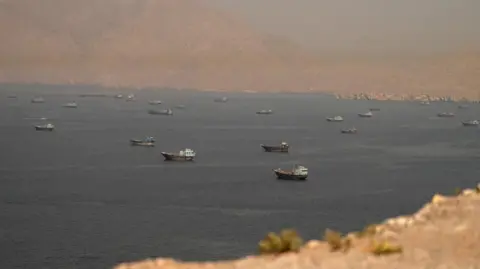
Qatar and Saudi Arabia also denounced the attacks, each saying a tanker from its country had been hit while transiting in or near the strait, and blaming Iran.
Qatar's foreign ministry spokesperson Majed Al Ansari said it held Iran "fully responsible" for an apparent targeted attack on a vessel called Al-Rekayyat as it transited near the strait.
In a separate social media post, Saudi Arabia's foreign ministry said Iran had targeted the Saudi tanker Wadyan as it crossed the strait.
Iran's foreign ministry spokesman Esmail Baghaei described Qatar's accusations as "contrary to the principle of good neighbourliness".
He added that commercial vessels using routes not co-ordinated with Iran or tampering with the ship's tracking face a risk of collision and disrupt Iran's efforts to "facilitate safe transit" in the strait.
The UKMTO said a tanker travelling through the strait had reported a fire after an unknown projectile hit an engine room on Monday.
In two separate incidents on Tuesday, a tanker reported being hit as it exited the strait but was able to proceed to its next port of call, while another tanker reported sustaining minor structural damage after being struck, the organisation said.
Speaking on the condition of anonymity before Centcom's announcement of fresh strikes, the US official insisted that US negotiators would continue to work in "good faith" towards a final deal with Iran.
Progress towards that came last month when the US and Iran agreed a 14-point memorandum of understanding, which was aimed at extending a ceasefire and ending conflict "on all fronts".
As part of the agreement Iran and Oman, which both border Hormuz, must hold talks "to define the future administration and maritime services" in the waterway with other Gulf states.
During the conflict Iran sought to assert its sovereignty over the strait, including by establishing the "Persian Gulf Strait Authority" which it said would manage "safe passage permits".
Iran's Fars news agency has reported that under the new deal with the US the strait would ultimately be managed by Iran in co-ordination with Oman, including possible "service fees" for ships to transit the waterway.
