PM backs council reforms but vows to listen

 Reuters
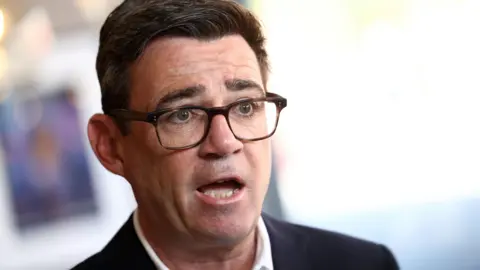
Andy Burnham has signalled his support for a major shake-up of local government, but has said he will look at the responses to public consultations.
Plans for the two-tiered system of councils to be scrapped and replaced with single, unitary authorities were announced in July under Sir Keir Starmer's government.
The proposals have faced criticism, but speaking in Ilkeston, Derbyshire, on Tuesday, the new prime minister said reform was necessary in order to grant more powers to local areas.
"It's obviously a change that's about improving the effectiveness of local councils and consolidating their resources," he said.
"It is a nettle, I would say, that's got to be grasped, because we have to get the building blocks in place across the country so that we then can use Number 10 North to devolve more power out of Westminster and Whitehall into a structure for local government in England that's the same across the board."
 PA
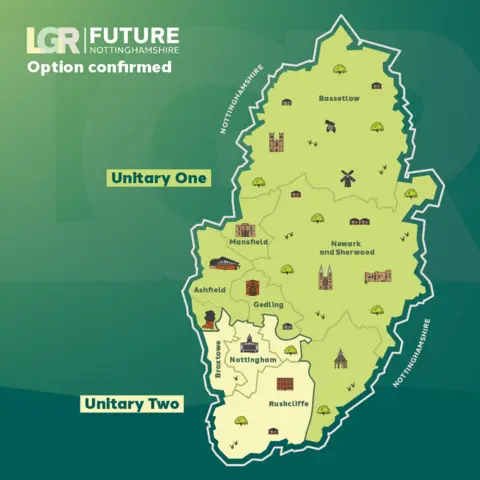
PAIn Nottinghamshire, the plans will see Nottingham city merge with parts of the surrounding boroughs of Broxtowe, Gedling, and Rushcliffe to form one unitary authority, with a second set to be established for the rest of the county.
The prospect of an expanded city boundary has divided council leaders.
The Labour leader of Nottingham City Council, Neghat Khan, argued it will better reflect the geography of the city and allow more people in its suburbs to have a say in how it is run.
But the Conservative leader of Rushcliffe Borough Council, Neil Clarke, called the move "political gerrymandering", and the Reform UK leader of Nottinghamshire County Council, Mick Barton, raised concerns it would leave the county financially imbalanced.
Likewise, in Leicestershire, hundreds of thousands of residents will join an enlarged Leicester unitary authority.
Labour city mayor Sir Peter Soulsby argued the move is needed to provide land for housing and reflects the reality that the affected communities are already part of Greater Leicester.
However, opponents have labelled the plan a "land grab" and "stitch-up", citing consultation results showing strong public opposition.
Conservative MPs, local councils and councillors from Reform UK, Conservative, Liberal Democrat and Green parties are campaigning against the changes, with some authorities considering legal action.
 LGRNOTTS.ORG
Derbyshire's political boundary is also set to be divided in two, with a north-south split.
Reform UK councillors have warned it risks creating an unfair settlement for residents in the north of the county.
Chris Emmas-Williams, Labour leader of Amber Valley Borough Council, which is set to be split between the two new councils, said he was "disappointed" at the decision.
But the Labour leader of Derby City Council, Nadine Peatfield, has said it "will deliver the greatest equity of the two authorities".
Speaking to the BBC's East Midlands political editor Peter Saull, the prime minister said he would consider people's concerns.
"I'm always prepared to look again at issues and coming in, three weeks in, I will take a look at the consultation and the responses, and I know sometimes these changes are not easy," he said.
He added the structure of local government in Greater Manchester, where he was the regional mayor before becoming prime minister, allowed him to "drive growth and change".
"If we want to give maximum devolved powers to all parts of the East Midlands, I think we do need to see reforms to local government," he said.
Shadow elections for the new councils are set to take place in 2027 before they are formally established the following year.
Listen to BBC Radio Derby on Sounds and follow BBC Derby on Facebook, on X, or on Instagram. Send your story ideas to eastmidsnews@bbc.co.uk or via WhatsApp on 0808 100 2210.
