'Despondent' coastguards protest pay cuts plans

 BBC
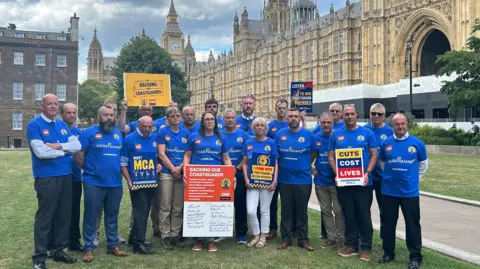
BBCCoastguard officers have said they feel "despondent" and "disrespected" over Maritime and Coastguard Agency (MCA) plans to make them volunteers rather than paid workers from later in the year.
Dozens of coastguard rescue officers (CROs) from across the country, including representatives for Hampshire and Dorset, gathered outside the House of Commons on Wednesday to demand emergency callout payments are reinstated.
MCA said in statement that their work was "deeply" valued and that it would be supporting them during the transition.
The coastguard is a statutory emergency service, like the police, fire or ambulance, whose officers carry out rescues and save lives around the UK's coast, including Scotland, Wales and England's south coast.
Their rescues are also carried out in inland water, such as lakes or floods, and assist in searches for missing people.
CROs are officially classed as volunteers, but can claim about £11 per hour for responding to callouts or undertaking training exercises.
But the MCA has now removed the payments, meaning they would be moved back to volunteer status and receive remuneration only for expenses and mileage.
The issue was raised in a Westminster Hall debate, brought by Alastair Carmichael, the MP for Orkney and Shetland, but was supported by Joe Robertson, Conservative MP for Isle of Wight East who held a CROs drop-in on Wednesday.
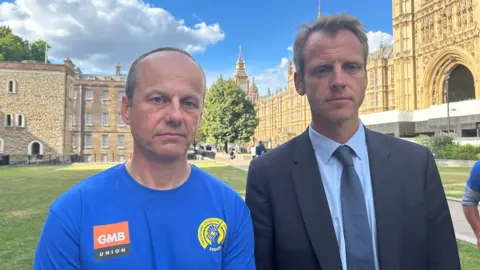
Andy Hunt, a CRO based in Bembridge on the Isle of Wight, said they were all "feeling despondent, disbelief that the MCA can think it's ok to do this".
"We feel disrespected, the feeling is very raw," he added.
He said most people on the service "are already losing money now with the pay, less than the living wage per hour".
"But even a little bit of money goes as long way to helping recruit or retain people."
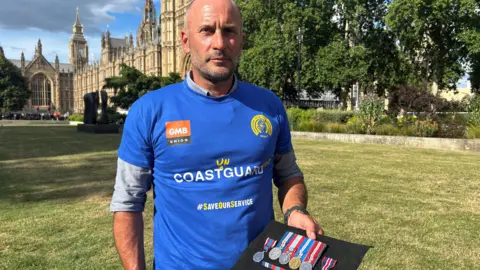
In November 2013, Ian Bugler who lives in Worth Matravers, Dorset, was awarded the Queens Gallantry Medal for attempting to rescue a 30-year-old woman trapped in Tilly Whim Caves.
He said he was worried CROs would have to "prioritise our paid employment because that's what puts food on our table".
"90% of CROs say they won't be able to commit the same amount of time if this change happens".
Robertson disputed the legal judgement was forcing the change.
"Senior management have been disgraceful, they are not listening to these 3,000 heroes that protect us.
"The MCA needs to accept these people are workers, not volunteers, and it's up to the government and them to accept that, pay them and the tax they owe".
The debate in Westminster Hall got cross-party support including from Labour MP for South Dorset Lloyd Hatton, who said he was deeply concerned about the plan.
"Ministers must bang heads together at the MCA and HMRC to find a fair solution"
An MCA spokesperson said the revised volunteer model had been chosen "after careful consideration" to "best protect the future of the service".
"This decision follows a legal judgment, which means we need to change how the service operates. This is not something we wanted to do but is a consequence of the Court of Appeal ruling.
"This new model protects choice, flexibility and the ability for people to volunteer alongside their primary employment."
The spokesperson added the MCA "deeply value and recognise the significant service" of CROs and would be "supporting them during this transition".
"The Coastguard Rescue Service will continue to maintain a robust, effective search and rescue response, ensuring the highest quality of service and levels of safety."
