The grieving family who say the coroners' courts aren't working

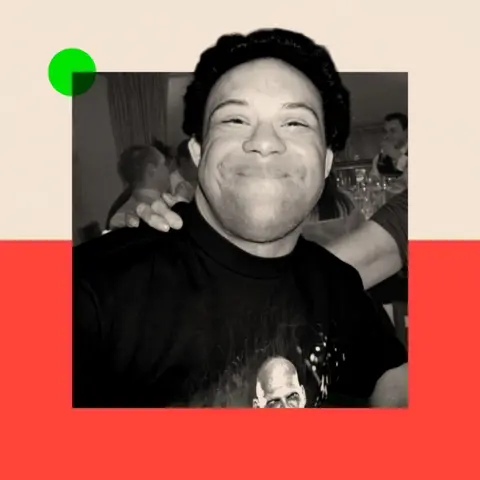 Daniel Lindsay
Sarah thought she knew what she was getting into when she attended a coroner's court in May 2024 to discuss the death of her second cousin.
Her day job as a murder detective meant she was used to courts, to judges, to legal argument. What she wasn't prepared for was a coroner's court. "I felt like I was on trial," she recalls of her first hearing, in Woking, Surrey. "I remember just feeling completely railroaded… It [was] far more hostile than I had ever expected."
Her cousin, Daniel Lindsay, died in 2023, aged 41. He had lived at a home in Surrey that specialises in caring for people with learning disabilities. Daniel also had Down's syndrome and type 1 diabetes.
As his death was unexpected, his case was referred to the coroner for an inquest.
What followed was one of the most stressful experiences of Sarah's life. She discovered new details about how her cousin lived, and his cause of death. The family initially thought Daniel died from a heart attack - but over the course of the inquest, they learnt that was wrong. She had expected the process to be emotional; what she didn't predict was just how complex and frustrating it would be, at times leaving her tearful and furious.
Coroners examine deaths that are not straightforward, like unexpected or violent deaths, or those that take place in state custody. Every year, thousands of British families rely on these courts for crucial answers. For many, an inquest provides the key interaction with the arms of the state at a time of trauma.
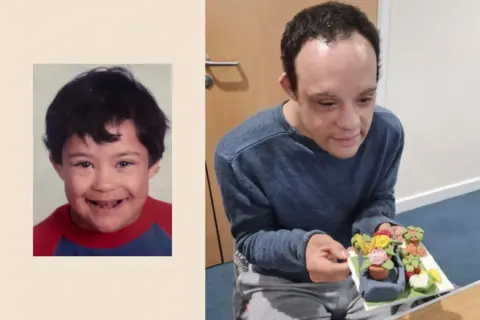 Lindsay family
But many observers, from MPs to legal experts, say the whole system is in peril. There are large backlogs in cases, as well as difficulties in carrying out post-mortems. As people live longer, caseloads are becoming more complex - but at the same time, resources are ever more limited, with little funding from government, regardless of party, say critics.
I've sat in various inquests over the last decade. In some, I couldn't hear the coroner through the noise of a busy train line, or because of poor acoustics in a vast room; in others, rooms became so hot that regular breaks were required.
"We're beyond crisis now," says Dr Georgia Richards, an epidemiologist at King's College London who studies the prevention of future deaths. "The government really doesn't realise the impact of the broken system."
Post-mortem delays
In photos of Daniel Lindsay, two things stand out: his big smile and black hair. His family say he only had three passions in life - Chelsea, TV wrestling, and trainers. Visitors who turned up at his care home in new trainers would have to take them off so Daniel could walk around with them.
Sarah and her sister, Laura Lindsay, were Daniel's next of kin and have spent the years since his death navigating the coronial system. "Every time that we end up in court it feels as though we've got another fight," says Laura.
Coroners' courts - which operate in England, Wales and Northern Ireland - set out to answer four main questions. Three of those questions – who died, where, and when - are usually quickly answered. It's the fourth, the cause of death, that's overwhelmingly the coroner's focus.
Last year, almost 148,000 deaths were reported to coroners in England and Wales, almost a quarter of which resulted in an inquest.
After Daniel's death, the first thing the coroner did was order a post-mortem. In that regard the family was fortunate – they only had to wait a fortnight to get the results. Other coronial areas aren't so quick. Despite coroners ordering post-mortems for 51% of deaths reported to them, a dearth of pathologists willing to work for coroners is leading to huge backlogs of up to a year. There aren't enough pathologists being trained, and the basic fee of £96.80 for carrying out a post-mortem for a coroner hasn't increased in well over a decade.
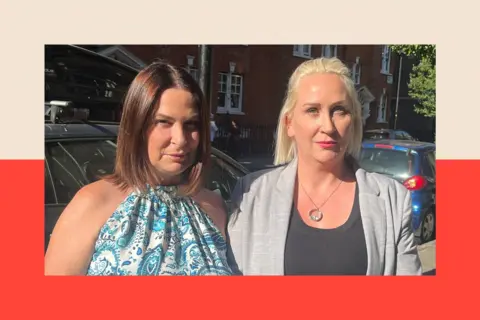 Lindsay family
Some pathologists say they get paid less than minimum wage because of the hours the work takes. "It's not just the examination. It might be reading files of hospital notes or talking to clinicians," says Dr Kathryn Griffin, an NHS pathologist in Leeds. "That's all supposed to be incorporated in the fee."
Due to the lack of pathologists, some coroners are turning to CT scanning. Popular with Jewish and Muslim families as they are non-invasive, the high-powered X-ray beams create a 3D image of the body, uncovering bone fractures or internal bleeding, for instance. "Post-mortem CT scanning [is] very good for trauma-related deaths, like a car crash," says Griffin. "It is less good for some of the reasons why people might die at home, like a clot in the lungs."
A CT scan will identify the cause of death in "about 70% of cases. [But] then you'll be left with very complex deaths and who's going to do those if you don't have well-trained autopsy pathologists?"
The government said it recognised the shortage of pathologists, but there was "no quick fix".
The merits of a post-mortem were starkly revealed in Daniel Lindsay's case. His family believed his sudden death was due to a heart attack. A phone call from the coroner's office changed all that: they were told Daniel had undiagnosed advanced oesophageal cancer, and that the main cause of death was an obstruction in his throat from some food. "So he had effectively choked," said Sarah, who didn't want to use her last name.
Acrimonious hearings
Of the 36,000 inquests held in England and Wales each year, only a small minority of families have legal representation; the restrictions on legal aid mean most families have to represent themselves. Institutions where people often die, such as NHS trusts or prisons, have ready access to state-funded legal teams, while many private companies choose to pay for lawyers. The new Hillsborough law should, however, make it easier for families to get legal support.
At the first court hearing, called a pre-inquest review, Sarah discovered that she was facing a legal team representing Ballater House, Daniel's care home. Feeling "railroaded" and "powerless", she left in tears and concluded the family would need their own lawyers if their questions about the care Daniel received were to be fully answered.
Daniel's family did secure legal representation through the law firm Leigh Day, after speaking to a charity. By the time his inquest opened in November 2025, they were one of several legal teams in the courtroom.
Inquests are officially meant to be inquisitorial - their aim is to find facts in a calm, sober way. But increasingly, as society becomes more litigious, they are adversarial; more like a courtroom TV drama. Despite being explicitly prevented from blaming any party for a death, hearings can often descend into a blame game, with barristers trying to save or sully an organisation's reputation. In part that's driven by lawyers realising they can use an inquest as a stepping stone to civil legal action; and by legal teams trying to ensure an organisation doesn't suffer reputational damage.
Alexia Durran, the chief coroner for England and Wales, told the BBC that coroners are seeing "increasingly complex cases" that are creating a "greater volume of work" and "greater stress" on staff.
The coroner, she says, "is not [there] to apportion blame, and so the coroner's inquest is a relatively limited one. It's not a surrogate public inquiry that is designed to answer every question."
She wants coroners to step in robustly if proceedings get too acrimonious. "The coroner should be ensuring that the family's understanding of the death is not being overtaken by advocates representing public authorities, [such as] hospitals, prisons [with] a desire to absolve themselves of responsibility, because ultimately that's not what it's about," she says.
After the revelation about Daniel's choking incident, his inquest then had to be abandoned on the second day. A former carer at the care home told the court that she had become worried about his "excessive vomiting" and had emailed her bosses about her concerns. The coroner was unaware of the email and felt further investigations would be needed.
In evidence to MPs in 2024, the former chief coroner for England and Wales, Thomas Teague KC, said the service "with very few exceptions, is chronically under-resourced and underfunded. There comes a point at which underfunding imperils the rule of law."
In a follow-up letter, MPs supported his sentiment and urged the government to invest; their pleas were turned down due to a lack of money.
'Coroners are humans'
One change that would not require any investment is the attitude that some coroners appear to show towards bereaved families. While I've seen some coroners check on the family daily, others have barely acknowledged them after the first day.
Daniel's family repeatedly described their coroner as being blunt and brusque, failing to put Daniel at the heart of the process. Laura said her cousin "got completely lost" in the process. The coroner who presided over the inquest, Caroline Topping, told us she was unable to comment.
Durran, the chief coroner, urges families to raise a hand or write a note if they have concerns. "Coroners are humans, they respond to human concerns."
The second inquest into Daniel's death started in June, and a month later the coroner delivered her conclusion. While finding that his care home had made some errors, she concluded that their actions had not contributed to his death. On the balance of probabilities, she ruled that Daniel had died of a choking incident caused by his undiagnosed oesophageal cancer.
Sarah and Laura were shell-shocked, and felt the conclusion had downplayed the failings in Daniel's care.
In a statement to the BBC, the care home said they respected the coroner's conclusion and extended "sincere condolences to Daniel's family", adding: "As aspects of the coronial process remain ongoing, it would not be appropriate for us to comment further at this stage."
Learning from deaths
Following the conclusion, the coroner said she was considering issuing a Prevention of Future Deaths (PFD) report. Such reports are written when a coroner thinks they have heard evidence that could prevent other deaths. Around 6,500 reports have been issued since the system was introduced in 2013 - but while coroners issue them, they have no power to monitor whether their recommendations are adopted.
Dr Georgia Richards, the epidemiologist, thinks those reports are too often ignored. She created and initially self-funded a "Preventable Deaths Tracker" - a system that aims to collate the reports to stop similar deaths. "The information is there, it's just not being used," says Richards. She wants coroners here to learn from her native Australia, where learning from every inquest is examined.
The Ministry of Justice says the government is considering how to strengthen the PFD system to improve oversight.
Coroners have been around so long that they're mentioned in the Magna Carta. Each day they make decisions that can help or hinder a family to understand how their relative died.
As Sarah says: "The coroner does this every day. We only do this once."
Remembering that lesson will surely help bereaved families through a process that many find bewildering at best; incomprehensible at worst.
Top image credit: the Lindsay family.

BBC InDepth is the home on the website and app for the best analysis, with fresh perspectives that challenge assumptions and deep reporting on the biggest issues of the day. Emma Barnett and John Simpson bring their pick of the most thought-provoking deep reads and analysis, every Saturday.Sign up for the newsletter here
