Breastfeeding may leave lasting imprint on genes

 Family handout
Breastfeeding may leave a lasting biological imprint on babies, scientists say, in findings welcomed by mothers.
Researchers from the University of Exeter in Devon identified traces in the blood of children who were exclusively breastfed that remained detectable years later in a global study involving thousands of children.
The traces are linked to epigenetic changes, which affect how genes behave without altering the genes themselves.
It is further evidence that breastfeeding helps healthy development, but the study also highlights nursing is just one factor that boosts childhood outcomes.
The study - also led by the Barcelona Institute for Global Health and the University of Bristol - followed almost 3,500 children from birth to age 12 in 11 countries, including the US, South Africa and Spain.
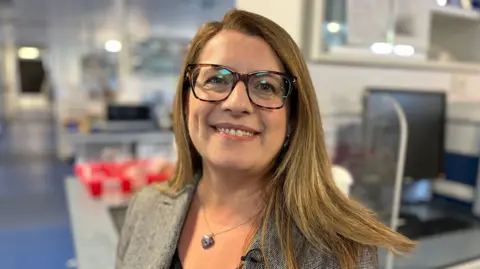
It is a "really significant study", according to Dr Doretta Caramaschi from the University of Exeter, who co-authored the research.
"We were able to identify differences in the children who were exclusively breastfed, even years after the experience of breastfeeding" she said.
"We now have a bit more evidence that there are some biological processes due to breastfeeding that are helping healthy development, particularly immunity and other developmental processes."
Rebecca, from Honiton, Devon, has three children who have all been breastfed, including six-month-old Levi, her youngest.
She said she felt lucky to have been able to nurse each child, because despite many women wanting to, breastfeeding is not possible for every mother.
"I've seen friends who haven't been able to, or have suffered, so I've been really fortunate that it worked out for me," she said.
"But each journey been different with my three."
'Breastfeeding can be hard'
Rebecca, who is on maternity leave with Levi, said the findings of the study would encourage her to continue to breastfeed.
She said: "Breastfeeding can be hard. It can be painful, you're tired and you don't want to do it.
"But this can spur you on to think: 'Actually, this is doing my baby good in the long term.'
"I think that it's brilliant that they're researching it [breastfeeding] and discovering that actually there may be big benefits to it."
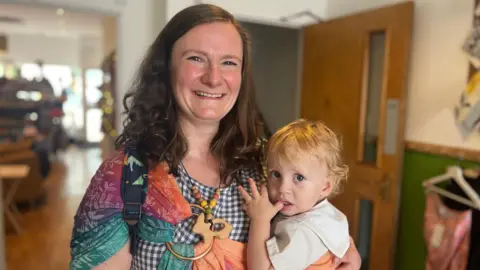
The study focused on children breastfed long-term - considered to be at least three months.
Kat, from Exeter, had planned to breastfeed her son Mattis until he was a toddler but is no longer insisting on a deadline.
She said: "There were definitely tricky bits.
"He lost a lot of weight straight after he was born, so I was pushed to top up, and I've had mastitis [swollen and painful breasts] and problems like that.
"But Mattis is 15 months now, and we're still going. It's fun, and it's getting funnier and funnier, because he's got his own mind - I won't be giving up anytime soon."
According to Unicef, an estimated 17% women in the UK exclusively breastfeed at three months - up from 13% in 2005, but still some of the lowest breastfeeding rates in the world.
The UN agency said 81% of babies were breastfed at birth, but recognised many considerations affected whether a mother continued, including latching issues, family support and personal choice.
The researchers behind the study stressed it had highlighted factors besides breastfeeding that contributed to a child's development.
Caramaschi said: "We were actually expecting to see more differences [between breastfed babies and not].
"This shows that there are many more factors involved in healthy child development.
"So, obviously, for mothers who can't breastfeed, there are many more ways that they can boost their child's immunity and their healthy development."
Follow BBC Devon on X, Facebook and Instagram. Send your story ideas to spotlight@bbc.co.uk.
