Survey to protect York Minster from climate change

 YORK MINSTER
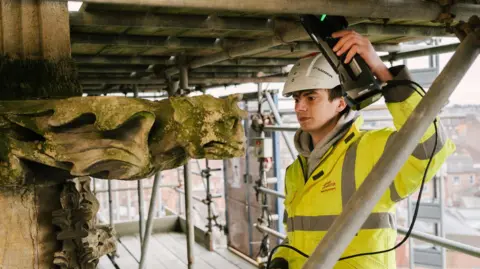
A team of surveyors at York Minster will digitally scan the entire building as part of efforts to preserve its original design for future generations.
The multi-year project will produce scans to show visitors how the building's many decorative "grotesque sculptures" have adapted and changed over time.
The operation, led by digital surveyor Luke Snell, has been partly motivated by studying the impact of climate change on the centuries-old cathedral.
Snell, 27, said adverse weather was a "big concern" which had accelerated the deterioration of the exterior of the building, making it harder for people to understand how it originally looked.
 YORK MINSTER
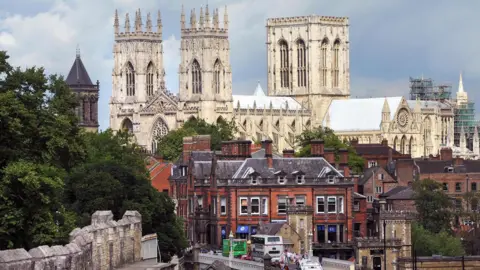
Snell said the Minster, which has stood in the heart of York for more than 1,400 years, has struggled to adapt to wetter winters and was not designed to cope with large amounts of rainfall.
Dry and hot summers, through recent heatwaves, have also had a negative impact - with the sun drying out the stones and drawing out certain salts which "accelerate" the weathering process, he said.
"The Minster almost has its own little ecosystem. If you're stood on the south side for example, it may be 10 times windier than on the north side.
"Sometimes you find yourselves a little bit more sheltered, in which case, the building is usually in a better condition.
"The south side of the building gets full sun all day, and as a result is in a worse condition that the north side."
Changes over time
For a building such as the Minster, which dates back to the 10th Century, its many design features have been in almost constant flux, with new generations adding their own touches or nature eroding the facades.
Snell said: "You can tell when certain parts have been added on at a later date, or renovations and restorations have happened, because the style does change.
"We can tell almost instantly when the Victorians have done something, because they actually used a different type of stone in a lot of areas.
"The grotesques are quite different from the Victorian period to the medieval period too."
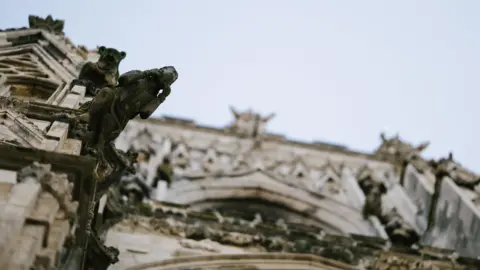
Grotesques are carvings, usually of demons, dragons or other mythical creatures, that were often used to decorate cathedrals and churches.
The carvings were intended to protect buildings from evil spirits.
Grotesques are sometimes confused with gargoyles, which look similar but contain a water spout through the mouth.
York Minster has, in the past, produced new grotesques created by skilled stonemasons.
Snell uses a 3D scanner to digitally record each fine detail of the cathedral.
"For us, it's hopefully going to create that archive so that in 200 years time, the next generations will be able to know exactly how [a design feature] looked.
"It takes out that little bit of guesswork and inference from other carvings around the building," he said.
Snell's work in digitally recording the grotesques has allowed them to be enlarged and adapted into public art pieces, recently seen around the city as part the Watchers of York trail.
Snell grew up in Scunthorpe, and went on to study archaeology at the University of York - though he never expected to work in the conservation of the Minster.
"You don't really get over working at somewhere like the Minster. You always walk in and get that same sense of awe and amazement.
"It's knowing that you're part of that long line of historical works, and hopefully that work will continue even after we've left."
Listen to highlights from North Yorkshire on BBC Sounds, catch up with the latest episode of Look North.
