Mum of five hopes for 'more time' after cancer diagnosis

 BBC
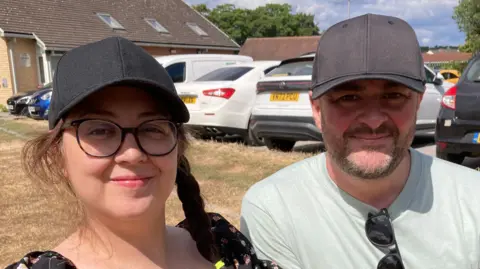
BBCA mother of five diagnosed with incurable brain cancer is hoping alternative treatments unavailable on the NHS will give her more time with her family.
Bryony Hill, from Selston in Nottinghamshire, found out she had a glioblastoma - an aggressive form of brain tumour - in May, days before her 40th birthday.
She was told most patients in her position had 18 to 24 months left, but her family are raising money to fund immunotherapy treatments that could prolong her life.
"For me it's about being around for that bit longer, with my family, with my children, my husband," Bryony said.
"I understand that it could be that my time is a lot shorter than we would ever hope for, but if this gives me a couple of years extra then that is amazing," she said.
'Don't take life for granted'
Bryony - whose youngest child is three and eldest is 16 - is currently undergoing chemotherapy which will be followed by radiotherapy through the NHS.
She and her husband James had been preparing for a holiday in Wales with their children when she suffered a seizure the night before they were due to travel, and was taken to hospital.
An MRI (magnetic resonance imaging) revealed she had a brain tumour.
In the months before her diagnosis, Bryony said she had been to her doctor due to headaches and worsening numbness in the right side of her body, which led to a deterioration in her mobility.
Initially, she believed the numbness, which first affected her foot, was related to a previous injury caused by an abseiling accident.
But as her symptoms worsened, she was left unable to walk without aides.
Despite the "sadness" around her diagnosis, Bryony said it also came with "relief".
She said: "If anything it kind of just put my mind to rest, I wasn't then just making it up in my own head, and it wasn't nothing.
"So, I guess a slight relief came with it, because I then had an answer."
 Natasha Rhodes
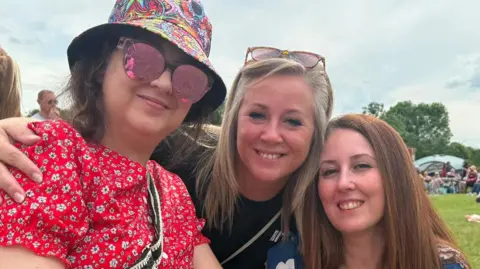
Bryony said she and her family were still "processing" the news.
"You know, you take life for granted and then something like this happens.
"Everybody needs to not take life for granted," she said.
As Bryony's mobility has deteriorated, she said she was unable to get up the stairs of her home or pick up her three-year-old daughter.
She said her family, including her children, were trying to adjust to a "new normal" as they awaited further assessment for what kind of support she needed at home.
"My youngest, she's oblivious to the main situation because she's only three.
"But she has noticed a change. At night time she now shouts for her dad instead of me," Bryony said.
For her older children, Bryony said the impact was more noticeable.
"It does sit on their hearts more and you can tell because they might hug more for longer or sit with me more," she said.
"They want to make the most of spending time with me, but at the same time, we're not dwelling on it. We still want to enjoy parts of life."
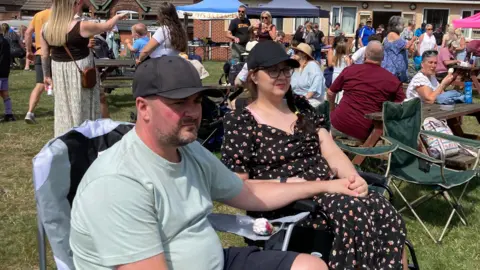
Since her diagnosis, Bryony said her family had been "rallying around" her and James to support them.
In July, one of her sisters decided to launch an online fundraising campaign, initially hoping to raise £500 towards the cost of any extra treatment.
But after an outpouring of support and donations, the target was increased and within a month, more than £14,000 had been raised.
Some of the money has already been used for Hyperbaric Oxygen Therapy (HBOT) - a non-invasive therapy to provide more oxygen to the body in an enclosed chamber, Bryony said.
Other options Bryony said she was considering after her NHS treatment included self-funded immunotherapy treatment in Germany or Lithuania.
On 1 August, a family friend also held a charity "fun day" in Jacksdale, to help raise more money.
Of the support she had received from family, friends and strangers, Bryony added: "It's amazing, honestly, it's just crazy, the kindness of others.
"It's just very overwhelming, but in the nicest way."
Bryony added she believed the "severity" of the illness warranted more funding and research around brain tumours for patients like her.
"For a lot of people with brain tumours and probably in a very similar boat to me, it does come across as a fight that we shouldn't be fighting.
"How severe the diagnosis is, you would hope that it would be higher up on a [priority] list," she said.
Calls for more investment
Dr Karen Noble, director of research, policy and innovation at Brain Tumour Research, said: "Bryony's story reflects the devastating reality faced by so many patients and families across the UK.
"With few options, some patients turn to treatments abroad, often unavailable in the UK and without any guarantee of better outcomes or improved quality of life, raising substantial funds to cover these costs.
"We urgently need government to increase the national investment in research and expand access to innovative trials here in the UK so patients are not faced with these difficult and costly decisions."
The Department of Health and Social Care previously said it was establishing a "national Brain Tumour Research Consortium" and announced a £13.7m investment to support research to develop new treatments.
The Rare Cancers Act - which aims to incentivise research and investment into the treatment of rare types of cancer - also became law this year.
However, earlier this week, Scottish swimmer Archie Goodburn told the BBC he believed the bill did not go far enough.
Goodburn has advocated for an increased focus on the disease since he was diagnosed with inoperable brain tumours about two years ago.
In an impassioned plea, he called for more money and resources to be put into brain cancer research while speaking on BBC Breakfast.
The 25-year-old said "give us a chance to fight for our lives" as he became emotional.
Prime Minister Andy Burnham replied to a video of Goodburn's message on TikTok and invited him to a meeting.
A government spokesperson said: "This is a heart-breaking story. Brain cancer kills more children and adults under 40 than any other cancer, and outcomes have barely shifted in decades.
"Our National Cancer Plan puts rare cancers front and centre, and we are appointing rare cancer national leads answerable for outcomes and for getting more patients into trials.
"But we know there is more to do, which is why the prime minister and the health secretary have this week committed to work with campaigners to strengthen our response to brain cancers, and ensure the voices of those suffering with them are heard."
Listen to BBC Radio Nottingham on Sounds and follow BBC Nottingham on Facebook, on X, or on Instagram. Send your story ideas to eastmidsnews@bbc.co.uk or via WhatsApp on 0808 100 2210.
