'Forever chemicals' airport clean-up needs £16.5m

 BBC
BBCA government has been asked to approve up to £16.5m to remove and treat "forever chemicals" in soil at an airport.
Perfluorooctane sulfonate or (PFOS) is part of a group known as "forever chemicals" because they break down very slowly, have previously been linked to serious health conditions and are known to cause environmental risks.
The Guernsey States' Trading Supervisory Board said funds would be used to dig up the 15,000 tonnes of polluted soil, transport it off-island, clean it properly using a specialist process and cover additional costs including expert advice and unexpected expenses.
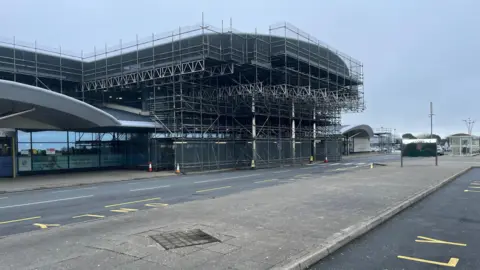
Officials said the current containment measures at Guernsey Airport were not a long-term solution.
The States said the contaminated soil had been excavated from various locations around the airport in 2012, and at the site of a freight plane crash in a field alongside Forest Road.
It was put into "specially designed containment cells" within the raised grass areas at the entrance of the airport.
The States' Trading Supervisory Board (STSB) President Deputy Mark Helyar said the temporary containments had been "effective" in preventing the contaminated soil from entering the environment but that a permanent solution was now needed.
He said: "We have been through a thorough evaluation of all currently available options, and identified the most appropriate solution.
"We now need to progress that, given the evidence that the membrane containing the soil has reached its end-of-life and is beginning to fail."
The STSB said: "Exporting the contaminated material for soil washing in the UK remains the only solution to fully and permanently deal with the existing pollution and therefore remove any future liability on the part of Guernsey Ports and the States of Guernsey.
"It is considered the most cost-effective option, has high efficacy, and has been approved by the waste license regulator as meeting the legal requirement."
The board said the project aimed to eliminate pollution risk and future liability for the states.
Work is expected to begin in early 2027, subject to states approval in June.
Follow BBC Guernsey on X and Facebook and Instagram. Send your story ideas to channel.islands@bbc.co.uk.
