More housing needed in Exeter - party candidates

 BBC
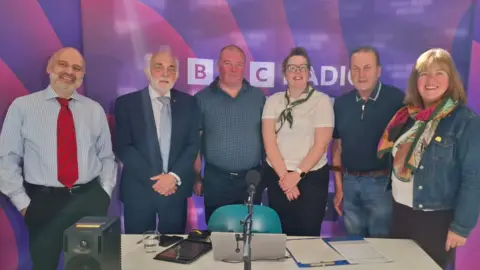
BBCAhead of the local elections, five political party representatives from Exeter have come together to debate key issues.
People in Plymouth and Exeter will get to vote on 7 May - and for just a third of the seats on each of the city councils which are currently controlled by Labour.
Ian Baldwin (Conservatives), Diana Moore (Green leader), Phil Bialyk (Labour leader and leader of the city council), Michael Mitchell (Liberal Democrat leader) and Siam Bharyo (chairman of Reform UK Exeter) discussed a range of topics.
Housing and parking were among the key issues, with candidates stating more homes were needed in the city.
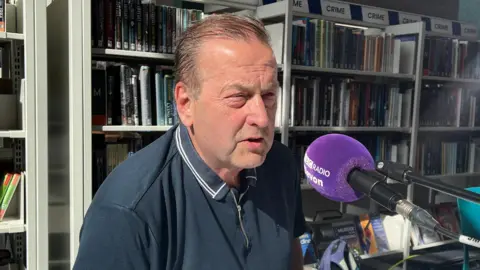
During the debate at Exeter Library on Thursday, hosted by BBC Radio Devon's Caroline Densley, Bialyk said the demand for housing in the city was "greater than the supply".
"We're in a programme of building 500 council homes in this city, we've delivered 35 already," he added.
It comes after plans to build accommodation on the Mary Arches Street car park site were given the go ahead.
When asked about parking in the city and plans to demolish the car park, Bialyk said it was "falling down".
"Do we spend millions upon millions to replenish it?," he said.
"We've got to work with bus companies and hopefully, if our plans for unity goes ahead, we'll be able to have some better control over buses and pricing and fares and routes that come into the city."
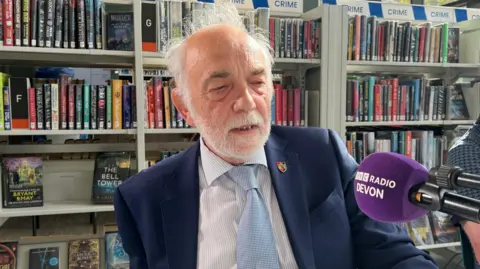
Lib Dem leader, Michael Mitchell, said tens of millions of pounds needed to be spent to bring the city's infrastructure up to date.
"The problem at the moment is because we're not a unitary authority, we control the car parks, Devon County Council control the on-street parking.
"On one side you've got the need to get income, on the other side you've got the problems of pollution and congestion what all of us want to cut down."
He said a strategy was needed to reduce traffic into the city, but to encourage visitors.
When asked about housing, Mitchell said Exeter was "growing" but "restrained".
"I believe we need a series of sustainable balanced local community," he said. "What we don't [need] is this massive sort of student enclave.
"People who want to live in a more permanent home are forced to the peripheral parts of Exeter."
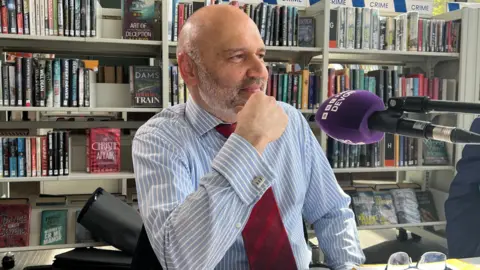
Bharyo said "proper provisions" were needed for cars in the city.
"I think there is clearly, and has been for several years, an ideologically driven anti-car agenda and that is damaging. It's detrimental to people's day-to-day lives," he said.
"With all the best will in the world, car will be the dominant form of transport."
He said families needed to be encouraged to move permanently back into the city, in a bid to grow stronger communities.
"That will also create a more diverse and a more resilient local economy," he said.
"Building more purpose built student accommodation will just result in Exeter being filled with buildings that are unsightly and uninhabited. Already, we're at a point where about 30% of student accommodation is not occupied."
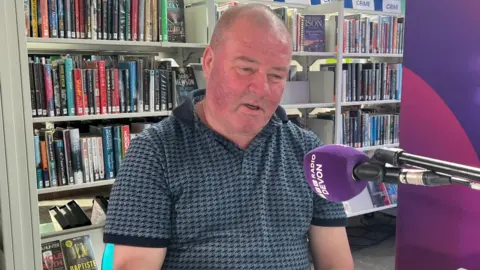
Baldwin said some traders were "petrified" of the city's parking spaces disappearing.
"You want to get rid of the car parking spaces but you're not getting people in by other means," he said.
"The rural people have got no chance. I'm of the opinion we do have to have car parking in the city centre until things change dramatically which I can't see happening."
Baldwin agreed there was "far too much" student accommodation in the city.
He said scrapping stamp duty would be a "very good idea" to help young people get on the property ladder.
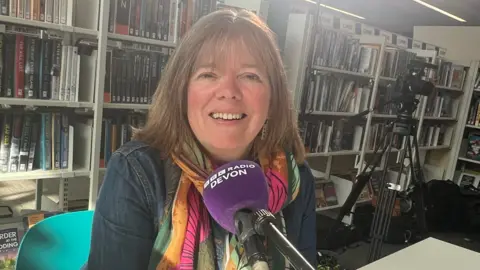
Moore said bus fares were "extortionate".
"We've not had more funding for our council services and that's what we really need," she said.
She said buses should be brought back into public service so prices could be reduced.
Moore said there were opportunities for the council to partner with housing associations to build affordable homes across the county, adding co-living was "a really poor solution".
"It's not a long-term or affordable solution," she said.
BBC South West political reporter, Miles Davis, said a huge change was on the way for Exeter.
"Whatever happens in the elections on 7 May, the city council is going to be abolished, along with the county council and all of Devon's district councils as part of a massive re organisation of local government," he said.
"We don't know what's going to replace Exeter City Council, we'll find that out in July, but the new authority is due to take control from April 2028."
Labour has a huge majority on Plymouth City Council and will still be in charge whatever happens on 7 May.
BBC political reporter Miles Davis' analysis
Following the hustings, Miles Davis said: "With a week to go until polling day the pressure is mounting on all of the politicians who came out to represent their parties in elections where it's all to play for.
"It was interesting to hear for the first time the current council leader describe the cancelling - and resurrection - of these elections as "a fiasco".
"Housing is a huge issue in the city and there are clearly divisions over whether the high numbers of student flats and studio apartments - known as co-living spaces - are what Exeter needs.
"It was also fascinating to hear the core messages of the politicians when given a chance to summarise their views at the end of the hustings.
"The Conservative spoke about the effect of high taxation on businesses, the Greens want to restore hope. Labour referred to investing in public services and housing, the Liberal Democrat talked about working with communities and Reform UK said they offer a change from the current situation.
"With the potential for Labour's role as the biggest party to come to an end, behind the scenes the conversations are about what might happen the morning after the elections, with talk of deals being done to decide who might run the council in the event of no party having overall control."
Follow BBC Devon on X, Facebook and Instagram. Send your story ideas to spotlight@bbc.co.uk.
