Former miner urges speed in Orgreave inquiry

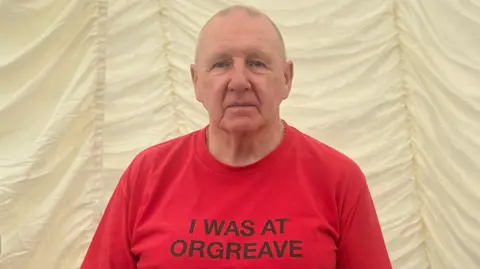 BBC/Molly Smith
A former miner has urged an ongoing inquiry into the Battle of Orgreave to progress as quickly as possible.
Violence broke out between police officers and miners outside the Orgreave coking plant in Rotherham on 18 June 1984 - one of the pivotal moments of the 1984–85 miners' strike.
Robert Young, 83, was a miner and local trade union leader at Comrie Colliery in Fife who travelled to join the picket lines at the site in South Yorkshire.
Speaking at Durham's Miner Gala on Saturday, which celebrated its 140th anniversary, Young said: "If we don't do this quickly, there won't be many of us left who were at Orgreave."
Young, who attended the gala with the Coalfields Regeneration Trust - a charity which supports deprived former pit villages - said he started working as a miner at 14, before losing his job after the strike.
It pitted thousands of miners and their trade union against then prime minister Margaret Thatcher and her Conservative government, which supported plans to shut 20 coal pits.
About three-quarters of the country's 187,000 miners went on strike to oppose the pit closures, which were expected to mean 20,000 job losses.
The miners' eventual defeat paved the way for the privatisation of more nationalised industries and utilities, and almost all of the UK's underground coal mines were shut within the next 20 years.
It caused lasting unemployment and poverty in former mining areas.
 PA
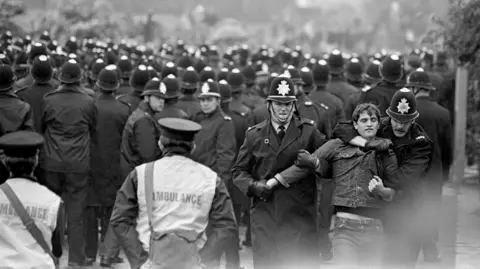
PAAt Orgreave, the striking miners wanted to stop lorries carrying coke to fuel the Scunthorpe steel furnaces as they thought disrupting production would help win their fight against pit closures and job losses.
But more than 100 picketers and police officers were injured, and 95 men who had been picketing were arrested and faced trial on riot and unlawful assembly charges.
However, the case against them collapsed in court due to allegations that South Yorkshire Police had falsified evidence.
It is still considered one of the most violent episodes in British industrial history.
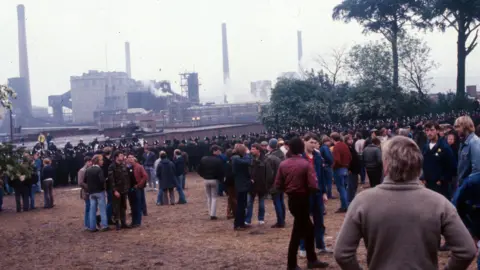
Young, who was in his early 40s, said he joined the picket lines at Orgreave at around 07:00 BST, after travelling from Scotland by bus with around 50 other miners.
He said he was given a police escort into the site on what was a "lovely morning", unaware of how the day would unfold.
"I had shorts on, a t-shirt, and a pair of flip-flops," he recalled.
"I wasn't dressed for the war that was to follow, we didn't realise the mess and the fights we were going to get into down there.
"It was the first time in my life I've been frightened of anything, I was frightened when the horses charged us and the police dogs had a go at us - it was a horrendous day and well-organised against us."
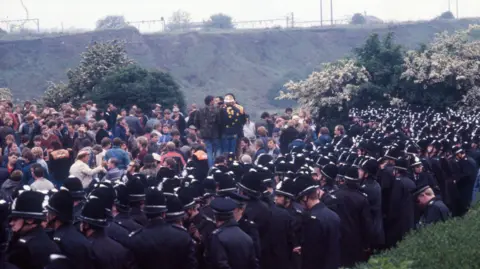
An independent inquiry has launched into what took place, chaired by the Bishop of Sheffield the Rt Rev Dr Pete Wilcox.
Also speaking at Durham Miners' Gala, he said: "For most of the people here, this inquiry really matters because it's a once-in-a-lifetime opportunity to tell the truth about what happened."
He said the inquiry, which began in March and is expected to report its findings in 2028, had a "strong start".
"There's an understandable level of anger about what happened back then, frustration for how long it's taken for an inquiry to be launched, and ongoing trauma for the people who were present.
"These aren't surprises, but they're really important emotions to surface - and I hope the inquiry will help to resolve some of those feelings."
