Ebola risk raised to 'very high' in DR Congo

 Reuters
The public health risk from the current Ebola outbreak in the Democratic Republic of Congo has been raised from "high" to "very high" by the World Health Organization (WHO).
In an update on Friday, WHO head Dr Tedros Adhanom Ghebreyesus also said the risk in the wider region in Africa was "high", but it remained "low" globally.
The rare species of Ebola, known as Bundibugyo, has no proven vaccine and kills about a third of those infected. So far, the outbreak centred on DR Congo has resulted in 177 suspected deaths and 750 suspected cases.
It comes as scientists at Oxford University in the UK are developing a new vaccine that could be ready for clinical trials within two to three months.
Based on the same technology they developed for the AstraZeneca Covid vaccine, there are no guarantees it will prove effective and it will take animal research and trials on people to know if it will be.
The BBC understands animal testing is already under way in Oxford.
The Serum Institute of India is lined up to mass produce the Ebola vaccine once Oxford can supply medical-grade material.
A separate experimental Bundibugyo vaccine is also in development, but it is expected to take six to nine months for any dose to be ready for testing.
Dr Vasee Moorthy, WHO's research and development adviser, described that vaccine as "the most promising" earlier this week.
He said it would be the equivalent of Ervebo, which is already in use for the more common Zaire species of Ebola.
Speaking at Friday's news briefing in Geneva, Tedros said: "We are now revising our risk assessment to very high at the national level, high at the regional level, and low at the global level."
He said that "so far, 82 cases have been confirmed in DRC, with seven confirmed deaths".
Tedros added the situation in neighbouring Uganda - where there have been two confirmed cases of the Bundibugyo species and one death - was "stable", with both cases from people who had travelled from neighbouring DR Congo.
Ebola is a rare but deadly disease caused by a virus. Although less deadly than other Ebola species, the rarity of Bundibugyo means there are fewer tools to stop it.
Ebola viruses normally infect animals, typically fruit bats, but outbreaks among humans can sometimes start when people eat or handle infected animals.
On Sunday, the WHO declared a public health emergency of international concern, but said it was not at pandemic level.
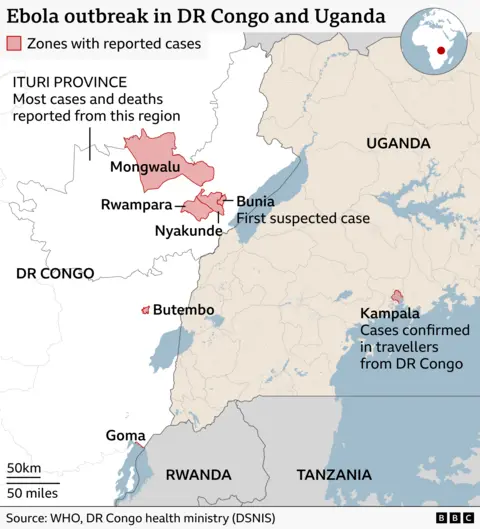
The WHO chief also said on Friday it was crucial to build trust, warning that violence and insecurity in the war-ravaged region were hampering the response to the Ebola outbreak.
Some Ebola cases have also been confirmed in rebel-held areas of the DR Congo.
Tedros was speaking after angry relatives set fire to a hospital in the eastern DR Congo after health workers had refused to release the body of a patient, because of the risk of contamination.
"They started throwing projectiles at the hospital," local politician Luc Malembe Malembe told the BBC about the scene he witnessed at Rwampara General Hospital.
"They even set fire to tents that were being used as isolation wards."
In the chaos, police fired warning shots to disperse the crowd.
The body of a dead Ebola victim is highly infectious and the authorities need to ensure safe burial to stop the spread of the virus.
Medical workers at the hospital, located near the city of Bunia in Ituri province, where almost all of the cases have been reported, were placed under military protection as the police moved in to restore order.
Fear has gripped Ebola-hit areas in eastern DR Congo as the suspected number of deaths continues to rise.
"Ebola has tortured us," a young taxi rider in Rwampara told the BBC. "I am scared because people are dying very fast... we are really afraid."
Fred Kiza, another Rwampara resident, told the BBC that such fear was "normal when there's a disease like this."
