Heatwaves linked to record groundings of young swifts

 Kasia Szczypa
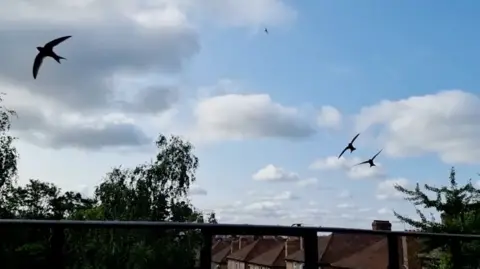
Summer evenings at Cholmley Gardens in West Hampstead come with a screaming party overhead.
A colony of swifts will swoop at dusk most days over the balconies.
Juliet Rix, who lives there, said: "We sit out here and they come zooming past our ears."
Her neighbour, Keith Mofitt, said he has watched up to 40 at once, darting through the sky.
"I don't think I've seen so many in all the years I've lived here," he added.
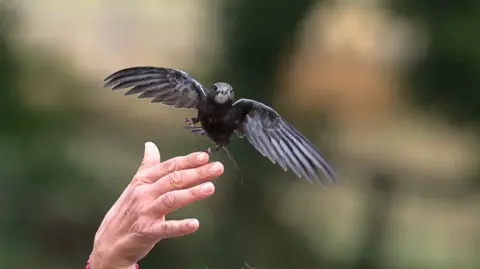
Swifts are having the best - and worst - year. The hot weather means lots of insects to eat, but a rescue volunteer network has had more grounded fledglings than ever before.
"During the really hot weather we were getting 50 a day, and that is unprecedented - we've never had as many as that before," said Graeme Bowd, who helps to run Swift SOS.
 Juliet Rix
Swifts are medium-sized brown birds that live in Africa but make a perilous journey north every year to breed in cooler climes.
They are unique migratory birds because they spend their entire life on the wing, except when rearing their chicks.
Swifts need to fly straight into their nest sites and favour the nooks and crannies of our old buildings.
Modern renovations tend to seal them off and this is one reason numbers have declined by 60% since the mid-90s, putting them on the UK's Red List of Birds of Conservation Concern.
But there is another threat to these resilient birds: the heatwaves.
"They nest under roof tiles in very hot parts of houses, and sometimes they just can't cope with the heat," said Graeme Bowd from Swift SOS.
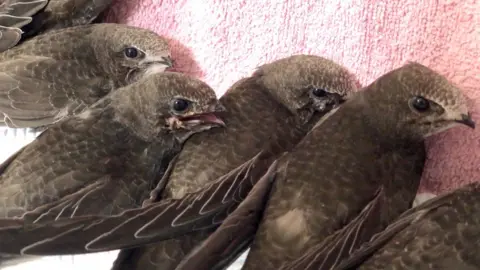
"In the really hot weather that we've had recently, we're finding that the young swifts, not quite ready to fly yet but ready to move around - they've been jumping out of their nests prematurely, ending up on the ground."
"This year we've dealt with almost 800 casualties."
That number is UK-wide, but a lot are in London and the Home Counties because swifts nest here in large numbers.
 SOS Swifts
Swift SOS is a network of volunteers who can offer specialist care for young swifts.
The rehabilitation of a grounded fledgling takes two to three weeks, where the birds are rehydrated and fed crickets to bulk up their weight and strength.
When they weigh 40 grams, they can be launched back into the air.
"These birds can be helped if they get to the right person," said Bowd.
"It's a really intensive task. You can only feed them on insects, and you have to know when they're ready to go."
The popularity of the social media page is a testament to people's love of these birds, and Bowd said that the Swift SOS services are as much for those who find them as for the birds themselves.
"Suddenly you find a bundle of feathers in your hand from the ground, and you don't know what to do, and you want to do the right thing."
Found a grounded swift?
- Do not throw the bird into the air
- Do not feed it
- Put the bird in a secure, ventilated box somewhere warm, dark and quiet
- Offer hydration via a cotton bud
- Do not take the swift to the vet
- Contact Swift SOS as soon as possible
For many bird lovers, swifts bring summer and hope when they arrive in May each year.
"There's just something magical about them," said Bowd.
The Cholmley Gardens residents agree.
"It's astonishing that they will fly from here to Africa - but they just come here for a few short weeks," said Rod Standing.
"We love them," said Juliet Rix. "I'm always so happy when they come back - and a bit sad when they go."
Listen to the best of BBC Radio London on Sounds and follow BBC London on Facebook, X and Instagram. Send your story ideas to hello.bbclondon@bbc.co.uk
