What's next in the US government shutdown, as situation eases at airports?
Wait times in US airport security queues eased somewhat on Monday after President Donald Trump signed an order instructing his administration to find a way to pay airport security workers.
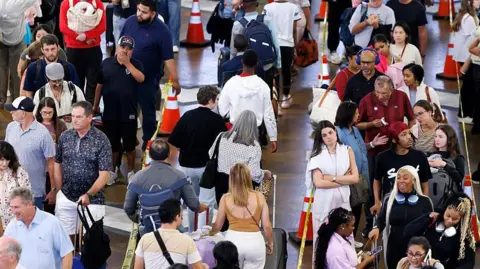
Travellers have reported waiting in hours-long queues at security checkpoints after a partial government shutdown left Transportation Security Administration (TSA) workers working without pay and many called in sick or quit.
Trump's direction meant many received pay on Monday, but the shutdown is dragging on, as Congress failed to provide funding for the Department of Homeland Security, which includes TSA, before heading out on a two-week break.
Here's what we know about the current situation.

 Bloomberg via Getty Images
Why aren't TSA agents being paid?
The Department of Homeland Security (DHS), which oversees the TSA, has been unfunded since February, after Congress failed to reach a budget agreement.
This triggered a partial government shutdown.
TSA agents are considered essential workers and are required to work without immediate pay during a federal shutdown.
Their salaries are dependent on congressional appropriations, which are tied to a funding agreement in the DHS budget.
Democrats are refusing to agree a funding deal without reforms to the US Immigration and Customs Enforcement (ICE) agency.
With fewer TSA officers at airport security checkpoints, wait times surged nationwide.
Compounding the strain, more than 450 TSA workers have quit since the partial shutdown began.
The TSA has around 50,000 agents who screen passengers.
How long have the waits been?
Travellers have been experiencing the longest wait times ever in the TSA's 24-year history, the agency's acting chief, Ha Nguyen McNeill, told a congressional oversight committee on Wednesday.
Some of the worst delays were reported in Houston, where security wait times have stretched beyond four hours. At some major airports, queues have stretched as far as parking areas.
Last week, nearly 40% of the security staff at the George Bush Intercontinental Airport in Houston did not show up for work - the highest such rate in the country.
On Thursday evening, a BBC correspondent returning from honeymoon via Houston airport reported that after waiting about two hours in a winding queue across one floor, frazzled travellers went up an escalator thinking they had reached the end - only to find another long queue stretching towards security.
The airport is currently operating just one-third to 50% of its TSA checkpoints, said Jim Szczesniak, director of aviation for the Houston Airport System.
Major international airports like those in New York, New Jersey, Maryland and Illinois also faced significant disruptions.
By Monday morning, wait times at some airports appeared to be shorter. At Houston's airport, where travellers previously waited hours, wait times were under 10 minutes at some points.
When could TSA agents get paid again?
TSA agents were slated to begin receiving pay on Monday, DHS acting assistant secretary Lauren Bis told BBC News.
"Most TSA employees received a retroactive paycheck today that included at least two full paychecks," Bis said on Monday. She said some pay may be delayed but the administration is "working aggressively" to make sure everyone is compensated in full.
It was initially thought that TSA agents would get paid once the government reopened and funding to the DHS restored, but Trump's order directed they be paid immediately.
Agents missed their first full paycheque more than two weeks ago, but they were required to keep working because they are considered essential workers for public safety, even though there is no money to pay them. They missed their second paycheque on Friday.
Bis said working without pay "forced more than 500 officers to leave TSA and thousands were forced to call out".
Lawmakers in Washington have not been able to agree to a funding path forward in the weeks since they partially shut the government down.
Can Trump order the TSA to be paid?
Trump said in a social media post on Thursday that he would sign an order instructing newly confirmed Homeland Security Secretary Markwayne Mullin to "immediately pay our TSA Agents in order to address this Emergency Situation".
He signed the order on Friday.
While Trump's order could provide temporary relief, it is unclear what authority the White House could invoke for such a move.
"It is not an easy thing to do, but I am going to do it!" he wrote on Truth Social.
But such payments could face a court challenge.
"I haven't seen any plausible assertion of a legal basis for paying TSA agents," Josh Chafetz, a professor of law and politics at Georgetown University, told the BBC.
"It seems to me pretty clearly a violation of the Antideficiency Act, which prohibits spending money that has not been appropriated by Congress."
Invoking the National Emergencies Act could free up funds for temporary TSA pay, the Wall Street Journal reported.
Why have immigration agents been sent to airports?
The Trump administration said last week that hundreds of ICE agents had been sent to 14 airports in cities including New York, Atlanta and Houston to help fill the void left by absent TSA agents.
While TSA agents are not currently getting paid, ICE agents are because they are funded through a different appropriations package that Congress passed last year under Trump's One Big Beautiful Bill Act.
The president on Wednesday touted the success of the decisions, saying ICE was doing "an unbelievable job" at airports.
He also indicated he was considering sending the National Guard to airports "if we need to" in order to help the TSA and ICE.
Additional reporting by Christal Hayes
