Trump hopes sanctions will topple Iran's regime - its leaders are betting otherwise

 EPA
EPAThe US says it has launched an "economic onslaught against Iran's financial connections around the globe". Treasury Secretary Scott Bessent said sanctions included digital assets, technology, gold, aviation and shipping. Any nation financially partnering with Iran would be isolated.
However, Bessent's announcement of what he termed an "economic D-Day" may have sounded more dramatic in Washington than in Tehran.
Shortly after the announcement, Iran's Economy Minister Ali Madanizadeh called it "the same old talk" and said Iran was ready for "every scenario". He said Tehran had expected the measures and had plans to deal with them.
His reaction points to the main question Iranian leaders are likely to be asking: What can the US do now that it has not already tried?
Bessent has threatened wider secondary sanctions against countries, banks and companies that continue doing business with Iran. But the basic policy is not new. Iran has faced US sanctions for years, including penalties against foreign companies trading with it.
What matters to Tehran is whether Washington can enforce sanctions more widely than before.
The US blockade has already made a difference. It has reduced Iran's ability to export as much oil by sea as it did before and made it harder to import goods and equipment. Iran has long land borders with seven countries and years of experience using them to bypass sanctions. But land routes cannot easily replace trade by sea, especially oil exports.
The pressure could therefore become much more serious if Washington manages to close channels that survived previous sanctions, particularly those involving China and Iran's neighbours. That is a big ask. China's foreign ministry said on Tuesday that it firmly opposed the sanctions, calling them illegal.
If the sanctions fail, Bessent's announcement could strengthen those inside Iran who oppose a deal with the US.
They could argue that Washington has returned to economic pressure because its other choices are limited. A new military campaign carries risks, while years of sanctions have failed to force Iran to accept US demands.
Washington has also left little room for diplomacy.
Although Pakistan and other mediators are still trying to revive talks, the US has not ruled out further strikes. The renewed threats could weaken Iranian officials who favour a deal.
It was already in deep trouble before the war, with high inflation and a rapidly weakening currency, and has deteriorated further since the fighting began with US and Israeli air strikes on 28 February.
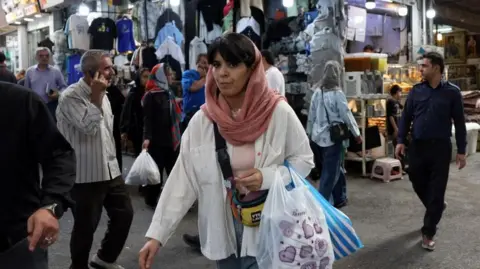
The weakening of the Iranian currency, the rial, is felt sharply and widely. Imports cost more, businesses struggle to plan, and people's savings lose value. Restrictions on oil exports also reduce the government's access to foreign currency.
Negin - not her real name - is a 34-year-old woman who says her monthly income is now about $100 (£73). She told the BBC: "I don't go to the cinema, theatre, or concerts. I don't buy gifts for anyone. I don't attend birthday parties. I can only buy meat with the government subsidy voucher; otherwise, I wouldn't be able to afford it."
Mona, a housewife with two kids, says her husband has been out of work since the beginning of the war. She adds: "We feel scared, especially after the sanctions that began yesterday. Ever since the war, my spouse has not gone back to work. He used to work on ships."
She adds: "We're trying to manage our expenses as best we can, but we've definitely had to cut back on all of our extra spending and small luxuries."
Iran may believe time is working against US President Donald Trump. Further disruption in the Strait of Hormuz could push oil and petrol prices higher, add to US inflation and become a political problem before the US midterm elections in November.
That gives Tehran an obvious date to watch, but relying on American elections is a gamble.
Iran's economy could be much weaker by then.
And beyond the midterms lies another problem. With Trump not seeking re-election in 2028, his outgoing administration may feel it has more freedom to continue the confrontation with Iran and accept the costs.
Iran is, therefore, watching two clocks.
One is political and runs in Washington. The other is economic and runs inside Iran. Every month of lower oil exports, disrupted trade and pressure on the rial makes waiting for a deal to end the war more expensive.
That leaves Iranian leaders with a difficult choice. Making concessions now could look like surrendering under pressure and strengthen hardliners who say Washington will only demand more.
Waiting could improve Iran's position if Trump's strategy runs into political or economic problems. But Tehran could also find itself negotiating later with a weaker economy.
Much now depends on what happens outside Iran.
If Chinese banks, regional trading partners and companies start pulling back because they believe Washington will punish them, Bessent's campaign may change Tehran's calculation.
If they do not, the opposite could happen. Those Iranians arguing against compromise will say Washington has played another supposedly decisive card without changing the balance and that Iran should continue to wait or resist.
