Alleged murder of Aboriginal girl highlights Australia's deep inequalities
Warning for Aboriginal and Torres Strait Islander readers: this article contains references to and images of someone who has died. This note has been added to respect cultural beliefs of these readers during mourning.
In the past few weeks, flowers, messages and cuddly toys have grown like a creeper on the chain link fence at the entrance of Old Timers town camp in Australia's Northern Territory.
A little girl gets out of a car with her brother and mother to add to the pile, laying a bright pink cuddly toy on the ground - a tribute to Kumanjayi Little Baby, the five-year-old who went missing in April from this Aboriginal community, and whose body was found five days later.
An Aboriginal man was subsequently charged with murdering her.
"The whole community is numb," another mourner says. This is a sentiment felt by much of this small town of fewer than 30,000 people, many of whom joined the search for Kumanjayi Little Baby, as she's now known for cultural reasons, in the days after she disappeared.
"In some ways you could say we've actually seen some of the best of the community in the absolute worst of times," says Asta Hill, the mayor of Alice Springs.
As well as bringing the town together, Kumanjayi Little Baby's death united Australians across the country in grief and outrage.
Condolence motions were passed in parliament, and even Prime Minister Anthony Albanese weighed in, saying "it breaks your heart".
"For the very first time this story brought to the surface how deeply Aboriginal and Torres Strait Islander people love and care for their children," says Catherine Liddle, CEO of SNAICC, a peak body that represents Aboriginal and Torres Strait Islander children and their families.
But the circumstances of Kumanjayi Little Baby's alleged murder also laid bare the deep inequalities that still exist in one of the world's wealthiest countries with many asking how this could happen, and prompting authorities to promise a review into the territory's child protection system.
Faced with a painful, often traumatic history of policies that have targeted generations of Aboriginal communities and their children, navigating the aftermath of this tragedy is fraught with sensitivities.

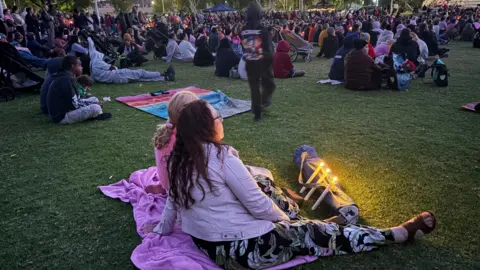
A beloved little girl
Kumanjayi Little Baby was a Warlpiri girl whose traditional lands are in the northwest of Alice Springs, in the Tanami Desert.
Her mother described her as a "princess" in a statement read out at a vigil held for her at Alice Springs.
She painted a picture of a beloved little girl that felt relatable to parents everywhere. A five-year-old who loved cartoons and computer games. A little sister who liked hanging out with her brother. A young student excited about starting school.
"My heart is broken into a million pieces," her mother wrote to those attending. "I want you to know that I am having trouble knowing how I can repair it and how I can live without my little baby."
This part of Australia is remote - the nearest city is Darwin, a 15-hour drive north. All around it is arid desert.
Aboriginal people make up about 3% of Australia's population. In Alice Springs, that number is closer to 20%. But since colonisation, communities have been kept apart.
The Old Timers town camp, also known as Ilyperenye, where Kumanjayi Little Baby was put to bed by her mother the night she went missing, is a few kilometres south of Alice Springs, one of 16 around the town.
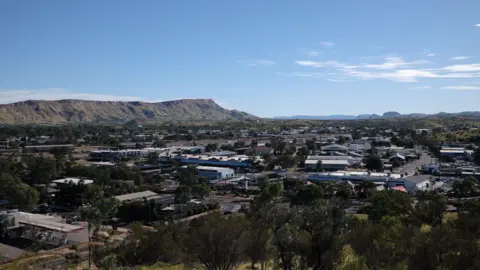
They first sprang up in the 1880s when Aboriginal people were displaced from their traditional lands by European settlers, but were only formalised in the 1970s after their residents asked for proper homes and basic services like electricity and piped water.
For decades prior to 1960 Aboriginal people had also been barred from entering Alice Springs which was predominantly white. There are camps in the north, south, east and west of the town – each with people speaking distinct languages and connected to different remote communities.
The camps are classified as social housing, but are effectively tiny hamlets comprising several homes. They suffer from overcrowding and residents complain of underfunding, leading to poor facilities and bad infrastructure. There are no shops, residents are sometimes left with no electricity on hot days, there is little public transport, limited internet, and roads are often bad with poor street lighting.
Experts say the poverty of the camps is a key contributor to the cases of alcoholism and domestic violence that have been reported there, adding to the pressure on their residents.
"Heavy things happen in this town and as a non-Indigenous Australian I think the colonisation story is still really present," said Nina Lansbury, who attended last week's vigil at the ANZAC Oval in Alice Springs.
Lansbury is an associate professor at the University of Queensland who's been working in Tennant Creek, 500km from Alice, on public health research and housing. She says it's clear that Kumanjayi Little Baby was not living in a house that supported her family, health and safety.
"I have a report from 1978 that I use in my research that's from the Northern Territory that was citing all these same things – coming up to 50 years. It's a big issue, it's 2026 and this is still happening. Let's hope this is a turning point."
Sorry business
Since Kumanjayi Little Baby was found dead, many in the community here have been in what's known as "sorry business". This is a period of grieving among Aboriginal and Torres Strait Islander peoples that involves cultural practices and ceremonies and can last days, weeks or even months.
Her family has asked that her death is respected during sorry business – and that none of what has happened be politicised.
But already, politicians across the board have been reflecting on how this happened and why a vulnerable little girl and her family weren't sufficiently protected.
Liberal Party Senator Jacinta Nampijinpa Price said Kumanjayi Little Baby was a relative of hers, and broke down in Parliament, pleading for an "honest conversation" about the failures of child protection.
But other leaders point to repeated policy failures - both at a federal level and in the Northern Territory - when it comes to addressing systemic issues facing their communities.
Indigenous Australians are three times as likely to be unemployed compared to their non-Indigenous counterparts; have significantly lower life expectancies; make up 37% of the prison population and are more likely to suffer or perpetrate family violence than non-Indigenous Australians.
"The simple truth is that all governments of all persuasions over generations have not done enough to deal with what are generational challenges," Albanese told parliament this week.
Traumatic past
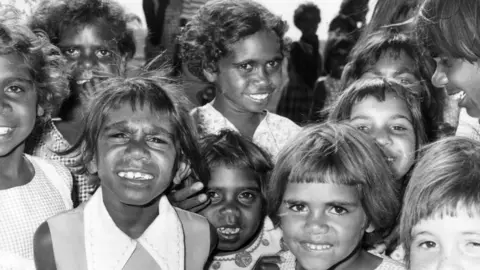
The Stolen Generation is perhaps the most infamous example of failure – a shameful, decades-long national chapter that lasted until the 1970s, in which tens of thousands of Indigenous children were forcibly removed from their families as part of policies aimed at assimilation.
In 1997, a landmark report called Bringing Them Home estimated that as many as one in three Indigenous children were taken and placed in institutions and foster care where many suffered abuse and neglect.
A decade later, a federal government initiative known as the Northern Territory Intervention was brought in, to address sexual abuse of Aboriginal children in communities. But after 15 years it was scrapped and the policy was widely seen as a failure.
The most damaging thing to come out of this Intervention was the trauma put upon Aboriginal men, says Liddle.
"Men stopped bathing babies, they stopped helping out because what they heard was if you do those things, you're a paedophile and you're going to get locked up and your children are going to get taken away," she says.
"[There was] fear of even going to authorities for innocent reasons because you're scared that you're going to be told that you've done something wrong," she says.
Last week the Northern Territory Child Protection Minister Robyn Cahill announced that there would be a review into the territory's child protection system, as well as reforms.
"I will not be a minister who abandons yet another generation of Territory kids," Cahill said when the details of the review were announced. "The reality is we have kids in really difficult situations and for a long time people have been paralysed by the fear that they will be accused of [creating another Stolen Generation]. Children deserve to be safe - every single child in our community has a right to expect that."
But Aboriginal organisations have criticised this. In a joint statement from Aboriginal Peak Organisations Northern Territory (APONT) and SNAICC, they said that it would "deepen an already devastating crisis, with consequences for generations of Aboriginal Territorians".
They are particularly concerned about weakening what is known as the Aboriginal Child Placement Principle - a framework designed to keep Indigenous children connected to family. If that happens, they said, it would be tantamount to "a race-based attempt to blame Aboriginal families for conditions created by government failure".
 Getty Images
Aboriginal leaders say there needs to be a holistic approach that will help solve the deep social inequalities in the territory.
"When you look at the prison system in the Northern Territory, it is nearly always 100% Aboriginal children and nearly every single one of those children came out of the child protection system," says Liddle.
Children as young as 10 can be jailed in the Northern Territory after the government there lowered the age of criminal responsibility in 2024. Its justification is that it will ultimately protect children - despite doctors, human rights organisations and Indigenous groups disputing that.
"It's like paving a road - it's like putting down pavers and saying here you are this is going to be your journey and by the way we're going to lock you up at the age of 10 when something goes wrong."
She admits that difficult conversations need to be had - but these should also encompass failures in social policy, housing, the prison system and the justice system.
"Those conversations needed to be led from community because the answers to this sit with community, they don't sit in parliament," argues Liddle. "You have to find out what's actually going on and that will change depending on which community you're sitting in, what state you're sitting in. You also need to ensure that you're investing in the services that we need and investing in the services that were designed by us for us."
There's no denying there are complex social issues that need tackling.
Generations of disenfranchisement - Aboriginal people were, for example, not granted full voting rights until 1984 - have significantly contributed to the vicious cycle of poverty, crime and worse social outcomes for some. In Alice, many sports fields and homes are fenced off to prevent youth-related crime including burglary, assault and alcohol-fuelled anti-social behaviour.
Liddle says while delinquency happens, and is not okay, it means funding is not always targeted in the best way. "There have been a lot of fences go up instead of what we really, really need, and that is the investment into ensuring that people are safe."
For some Alice residents, there needs to be a reframing of how Aboriginal communities are seen - and supported.
"People fall through the cracks and this little girl was beloved by her family and community but obviously lived in poverty and was vulnerable," says vigil attendee Jonathan Hermawan.
But he thinks in talking about what happened to Kumanjayi Little Baby, there's a danger of victimising Aboriginal communities.
"Every system has its failures when you homogenise a group that's very diverse," he says.
"The notion of Aboriginality is like comparing a white person and saying every white person is affected. We are far more diverse than that, we are far more complex than that."
