Controversial road revamp could be changed again

 Charlie Stubbs / BBC
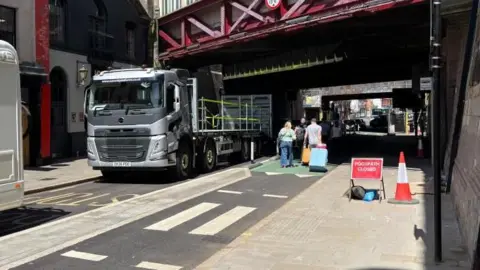
A controversial multimillion-pound gyratory system could be changed to relieve traffic problems.
In October, work was carried out to change the roads near Shrewsbury railway station which included a new cycle path on Castle Foregate, taking the road down to one lane.
However, they have led to congestion problems and a petition to change it back was signed by nearly 7,000 people.
A group of Shropshire councillors have recommended the cycle lane on the pavement is reopened, either to two lanes or one for buses, bikes and emergency services.
People using the road said they have regularly seen traffic jams up to a mile long.
Peter Metcalf lives near the street and said he had had to break up fights between angry motorists.
"Every day I look out my window and there are lines of traffic, so it's been really bad for the town," Metcalf said.
"I'm afraid it hasn't worked. It's made the town a lot more congested, so it was a good idea to make it more accessible for cyclists, but it was a good idea badly executed."
 Charlie Stubbs/BBC
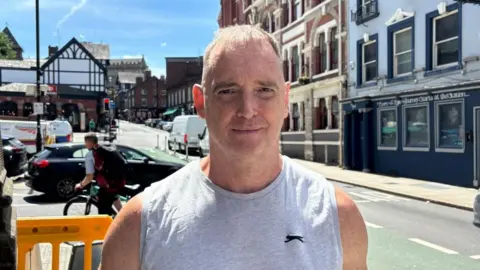
Clifford Webb said he regularly used the cycle lanes and would be disappointed if Shropshire Council changed what it was used for.
"I like cycle lanes, I'm just waiting for them to finish the rest of it instead of whatever they're doing at the moment," Webb added.
"[If they change it], you might as well not have a cycle lane then because I'd still have to go up the middle because it'd be full of buses."
Emma and Paul Nuttall live in the Battlefield area of Shrewsbury and said a journey to the Royal Shrewsbury Hospital took them about an hour and 20 minutes.
"It's just adding time on to your journeys, like simple journeys into town or going through town, it's adding like an extra 20 minutes on at least every time," Paul Nuttall said.
"We said we could have got to Manchester in that time, like it's just a crazy amount of time."
The authority said it needed to "move quickly to understand the full costs" with the recommended works and will start to focus on what it could do to "tackle Shrewsbury traffic and congestion".
In the council's economy and environment overview and scrutiny committee meeting, its members weighed up what the effect of the changes would be.
They included how they could protect cyclists and direct heavy vehicles.
Rob Wilson, the council's portfolio holder for transport and regeneration, said it was a matter of "high public interest and it was the right thing for scrutiny to look at it".
He added that the authority would need to check the ramifications because "we can't afford for there to be financial claw back".
A spokesperson for Shropshire Council said if either of the options were agreed on, the "floating island would be removed" and "the bus stop would revert back to its former location" on the path.
The deputy leader of the council Alex Wagner added the scheme had been a "real wake-up call" in how the authority managed contracts and large projects.
"We need now to move quickly to understand in full the costs that could be associated with recommended works and changes, and start to focus more on what we can do long-term to combat Shrewsbury traffic and congestion," he added.
Follow BBC Shropshire on BBC Sounds, Facebook, X and Instagram.
