Yemen's Houthis attack Saudi tanker as US launches more Iran strikes

 Shine Samuel Abraham/Handout via REUTERS
Yemen's Iranian-backed Houthi movement has said its forces attacked two Saudi oil tankers in the Red Sea that had "violated" its blockade of Saudi ports, as the US carried out a 12th consecutive night of strikes on Iran.
The official Saudi news agency confirmed that one tanker was hit late on Wednesday, causing a fire.
US President Donald Trump warned the Houthis on Thursday that if they did so again, the US would inflict "major military punishment" upon both them and Iran.
Iranian state media said two people were killed in US strikes on Wednesday night, while Jordan and Kuwait intercepted missiles and drones launched by Iran.
Iran's Islamic Revolutionary Guard Corps (IRGC) warned the UK that any base used to attack it was a "legitimate target" following reports that US long-range B-1 bombers used in the strikes on Iran overnight had flown out of RAF Fairford in Gloucestershire.
In its response, the UK government said: "Our Armed Forces are ready to keep the United Kingdom safe from any kind of attacks, whether it's on our soil or from abroad."
The statement added that new Prime Minister Andy Burnham "was notified of the decision taken last week to extend the existing agreement for the US to use UK bases in the collective self-defence of the region, including US defensive operations to degrade the missile sites and capabilities being used to attack ships in the Strait of Hormuz".
The IRGC also said a tanker caught fire following an explosion in a mined route in the Strait of Hormuz, a vital waterway in the Gulf that is effectively closed.
Oil prices increased sharply following the latest developments in the region, with the cost of a barrel of Brent crude hitting $100 - the highest level since the end of May.
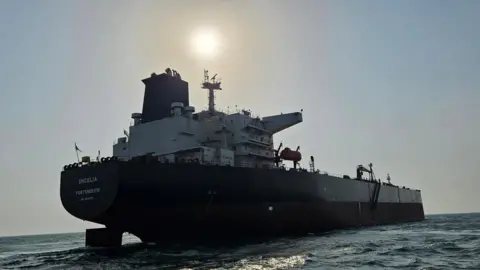
Houthi military spokesman Yahya Sarea said the group targeted the Saudi-flagged tankers Encelia and Layla with missiles and drones.
Sarea added that the Houthis would "continue their naval operations against the Saudi enemy" and "persist in enforcing the 'siege for a siege' equation".
Early on Thursday, the Saudi Press Agency confirmed that the Encelia was "targeted while sailing in the Red Sea, resulting in a fire at the bow of the vessel".
Citing an unnamed official source at the Saudi Transport General Authority, it described the attack as a violation of international laws and conventions. All of the Encelia's crew members were safe, it reported.
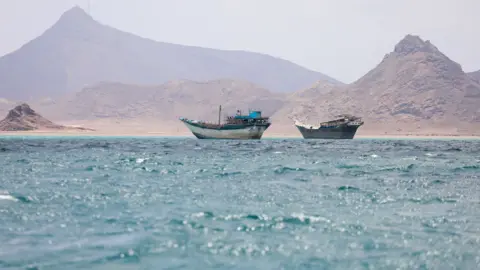
The UK Maritime Trade Operations agency reported that an "unknown projectile" struck a tanker about 130km (70 nautical miles) south-west of al-Shuqaiq, on Saudi Arabia's Red Sea coast, at 20:00 GMT (23:00 local time). The attack caused a fire on board but no casualties, it said.
 Reuters
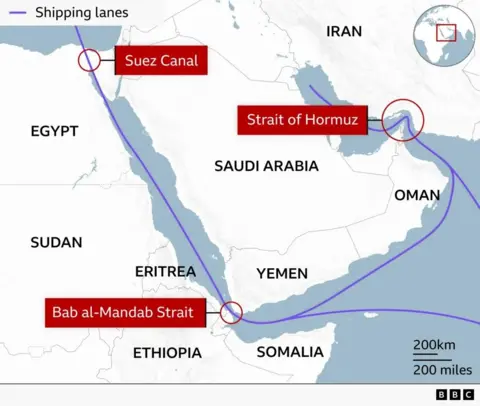
Data from MarineTraffic shows Encelia departed the Saudi port of Yanbu on Monday and sailed south, briefly pausing close to the port of Jeddah before continuing towards the Bab al-Mandab Strait, the narrow waterway off Yemen's south-western coast that connects the Red Sea to the Gulf of Aden, according to BBC Verify.
Shortly after 19:11 GMT on Wednesday, the tanker began to slow down and sail east. At 20:11 the ship reported being "Not Under Command" before coming to a complete stop just before 22:30 close to the Farasan Islands, about 80km south-west of al-Shuqaiq.
There has so far been no confirmation of an attack on the other Saudi-flagged tanker, Layla.
Data from MarineTraffic shows it departed Yanbu on 14 July and reported its destination as the Saudi port of Jizan, with an estimated arrival date of 16 July. Layla last broadcast its location on Friday about 90km east of the Farasan Islands.
A number of other oil tankers in the Red Sea and Gulf of Aden have been changing course since the Houthis announced a "maritime embargo on Saudi Arabia on Monday. Sarea claimed the Houthis had "forced approximately 10 ships to retreat and return".
The Houthis said the blockade was in retaliation for a Saudi blockade of ports and airports in the territory they control in north-western Yemen, as well as an air strike on Sanaa airport last week that they blamed on the kingdom.
The blockade and tanker attacks have the potential to widen the war between the US, Israel and Iran, and to further disrupt global energy supplies and maritime trade.
With the Strait of Hormuz effectively closed because of Iranian attacks, Saudi Arabia has used its east-west oil pipeline to increase exports via the Red Sea in recent months.
Soon after the start of the Gaza war in October 2023, the Houthis began attacking merchant vessels in the Red Sea and Gulf of Aden with missiles, drones and small boats, saying they were acting in support of the Palestinians.
Four ships were sunk, nine crew members were killed, and commercial traffic through the Bab al-Mandab Strait hit a record low as shipping companies stopped using the Suez Canal and rerouted their vessels around southern Africa instead.
Although the Houthis paused their attacks in response to the Gaza ceasefire last October, the number of ships moving through the strait has yet to return to previous levels.
Trump wrote in a post on Truth Social that the Houthis had "acted very responsibly" since the start of the US-Israeli war with Iran.
"Unfortunately, now they are starting up again, shooting at two Saudi Arabian ships last night," he added.
"Please let this TRUTH serve to represent that if they do this again, the U.S. will hold Iran responsible, in that the Houthis are a Surrogate and/or Proxy of Iran, and major military punishment will be inflicted upon Iran and, of course, the Houthis, themselves."
US Secretary of State Marco Rubio said earlier that the Houthis "apparently have gotten themselves suckered into this" by Iran, adding: "I hope they will de-escalate."
Mediator Oman said it was working to resume talks between the Houthis and Saudi Arabia.
Not long after the Encelia was hit, the US military's Central Command (Centcom) said it had launched another wave of strikes on Iran at Trump's direction to further degrade the country's "ability to attack civilian mariners and commercial vessels" in the Strait of Hormuz.
The strikes targeted "Iranian military targets, including maritime capabilities, missile and drone storage facilities, coastal surveillance sites and air defence assets," it added.
Iranian state media reported that two people were killed in a US missile strike on the Shalamcheh border crossing with Iraq, and that a military target was hit in the southern province of Bushehr, the location of Iran's only commercial nuclear power plant.
Iran's armed forces said they had targeted US military facilities in Kuwait and Jordan in response. Both countries said they had intercepted Iranian missiles and drones overnight.
Iran's military said the Strait of Hormuz was "completely closed" and that three tankers had attempted to transit the waterway using what it described as a mined and unsafe route.
One of the tankers caught fire after an explosion and two others turned back, it added.
It came after Trump had promised in another social media post that "any time the Islamic Republic of Iran shoots at a ship in the Strait of Hormuz... the United States will bomb and destroy one bridge or power plant".
