Football initiative marks 25 years promoting unity

 University of Brighton
A football programme started by the University of Brighton which aims to promote harmony among divided communities is marking its 25th year.
Football 4 Peace was founded in 2001 and began by bringing together Israeli and Palestinian children.
The university said that it had since expanded to work with more than 8,000 young people and 600 coaches across four continents, including those from The Gambia, South Korea, Colombia and Northern Ireland.
Co-founder Dr Gary Stidder said the initiative used a "values-based coaching" model built on principles, including "respect, inclusion and responsibility".
Stidder added: "This approach also helps develop interpersonal skills and encourage appreciation of diversity in socially fractured societies."
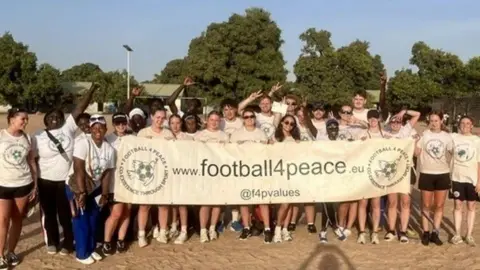
University staff and students are currently delivering the programme in The Gambia, working with young people from a range of ethnic backgrounds.
The scheme aims to promote leadership and build relationships across communities, the university said.
'Extremely powerful'
Participants said the programme had a lasting impact.
James Clarke, a former volunteer when the programme took place in Israel in 2003, recalled his experience of seeing how Football 4 Peace united people.
"On the first day, the young players from the different communities weren't even able to look at each other, let alone communicate and play as a team," he said.
"By the end of the week, they overcame problems. They were communicating, smiling and valuing each other as people."
He added that the moment was "extremely powerful" and an insight into how "powerful football could be".
Follow BBC Sussex on Facebook, X, and Instagram and listen to BBC Radio Sussex on Sounds. Send your story ideas to southeasttoday@bbc.co.uk or WhatsApp us on 08081 002250.
