How CSI tactics are fighting the fly-tippers

 Gabby Colenso/BBC
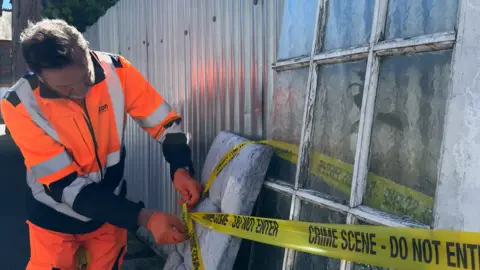
Yellow tape marked "Crime scene – Do not enter" seals off part of a residential street.
Investigators wearing protective clothing and gloves are searching among the black bags, broken furniture and scattered waste for clues.
Is this the scene of a violent crime?
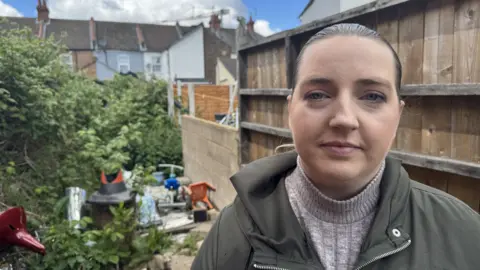
"I've seen tape go across with cones, looking like someone's been murdered here," says Laura Haydon, who lives nearby.
"It's not – it's just a mattress."
 Gabby Colenso/BBC
Last September, Luton Council began trialling a new approach to tackling fly-tipping: treating dump sites as conventional crime scenes and employing enforcement officers to search through waste for evidence – a torn delivery label, a prescription slip, an address hidden inside a cardboard box – that could identify who is responsible.
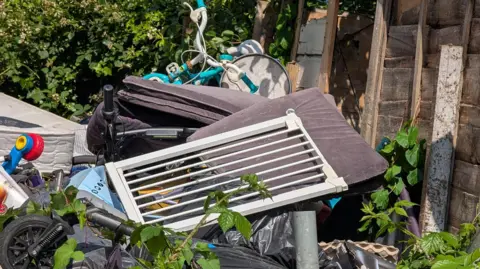
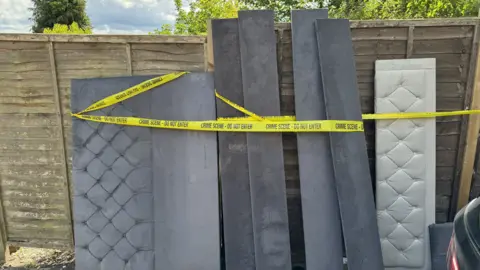
In this instance, the waste is a discarded bed frame and other furniture, dumped on a street of redbrick terraced houses off the town's Dallow Road.
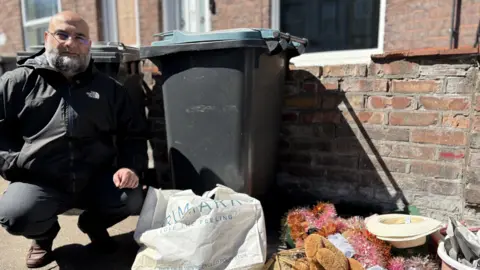
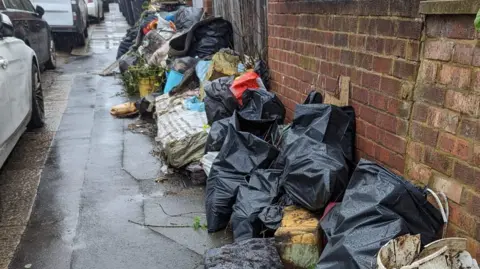
Nearby are bins overflowing with rubbish, and waste including sofas, toys and prams blocks the pavement.
 Gabby Colenso/BBC
Dealing with fly-tipping has become a "constant battle" for Naveed Shakoor, who has lived in the neighbourhood for most of his life.
"There are syringes, dead rats and mice everywhere," he says.
"It feels like leaving your back door open. You don't know what could come into your house.
"When you're trying to work hard and provide for your children, living like this completely drains you mentally."
 Supplied
Luton, roughly 30 miles (50km) north-west of London, has the highest number of incidents of illegal dumping in the East of England.
James Taylor, the council's outgoing Labour portfolio holder for regeneration and inclusive growth, says a new approach was needed.
"What we were doing before, we were just picking up off the street, and people were thinking it's almost like a free service.
"Some local officers said, 'We're doing the same thing over and over but we're getting the same results. Let's try something different.'"
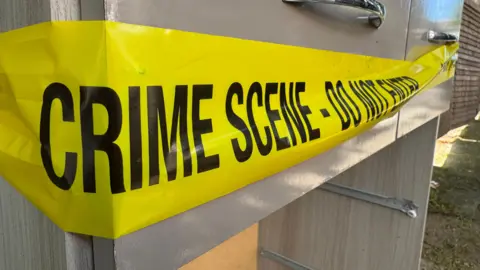
Under the new strategy, dumped rubbish is left for three days with what the council calls "CSI tape" around it, or stickers to show it is being investigated. Black bin waste containing food is cleared away quicker.
CCTV has also been installed in hotspot areas.
 Supplied
Luton's issue reflects a wider national trend.
Local authorities in England dealt with 1.26 million fly-tipping incidents in 2024-25 – a 9% increase on the previous year, according to the Department for Environment, Food and Rural Affairs (Defra).
Most incidents involved household waste, with many equivalent to a small van load.
Fly-tipping carries wider consequences beyond the visual impact, including risks to public health, damage to wildlife and significant clean-up costs for councils and landowners.
Some residents in Luton suggest charges for bulky waste collection as a possible contributing factor.
For Taylor, the causes are often more complex.
"One thing that hasn't helped is we are quite a constrained town," he says.
"Housing is a bit of a premium. We've seen an increase in HMOs (Houses in Multiple Occupation) and we know when people are more transient in an area, they treat it with less respect."
He says other factors, such as illegal waste operators dumping rubbish for profit and confusion over legal responsibilities, contribute to Luton's problem.
 Gabby Colenso/BBC
The use of "crime scene" tape has been trialled elsewhere in England. In Newham, east London, research carried out with the environmental charity Keep Britain Tidy found the approach reduced fly-tipping significantly at some targeted sites.
Other councils, such as Leeds and Lewisham, have similar enforcement teams.
During the trial, incidents fell by as much as 73% at fly-tipping hotspots in Newham while the tape remained in place.
Dr Anna Scott, of Keep Britain Tidy, says the intervention is based on behavioural science and challenges the perception that fly-tipping is low-risk and quickly cleared without consequences.
"By leaving rubbish visible and marking it as under investigation, councils aim to signal enforcement activity and increase the perceived likelihood of being caught," she says.
But it is not a "silver bullet", she stresses, adding that such measures are more likely to have greater impact when used with wider enforcement, public awareness campaigns and accessible waste disposal services.
In Luton, the council believes it is working. It issued 200 fixed penalty notices in 2025/26, compared to 90 the year before.
It also says it has increased fines to up to £1,000. If offenders do not pay, they could be prosecuted.
The council says the number of fly-tipping collections fell from 11,639 in 2024-25 to 9,352 in 2025-26, a reduction of about 19%.
It says increased monitoring and visibility of the scheme has helped prevent some incidents, with about 12% of fly-tipping either stopped before collection or removed by those responsible.
However, some residents say they have yet to see a lasting improvement.
 Gabby Colenso/BBC
The government recently announced tougher national enforcement measures as part of its wider Waste Crime Action Plan.
Under the proposals, courts in England would be able to issue between three and nine penalty points on driving licences per fly-tipping offence.
Repeat offenders who accumulate 12 points could therefore face disqualification from driving.
Ministers say the measures are intended to target the vehicles, particularly vans, commonly used in waste crime.
Other proposals include expanded powers for councils to seize and crush vehicles linked to fly-tipping, increased use of CCTV and automatic number plate recognition technology, and requirements for offenders to contribute towards clean-up costs.
The government says it is aiming for "zero tolerance" of waste crime.
What do residents think?
Haydon says fly-tipping is still widespread across the town.
"You see it across Luton – it's not going down, it's getting worse," she says.
"The rubbish is still there. You just haven't taped it yet."
Shakoor says the dumping often resumes just hours after the waste is cleared and the tape comes down.
"The rubbish goes – and then it comes straight back," he says.
Follow Beds, Herts and Bucks news on BBC Sounds, Facebook, Instagram and X.
