Trump tariffs could reduce NI exports to US by 15%, new research finds

 EPA
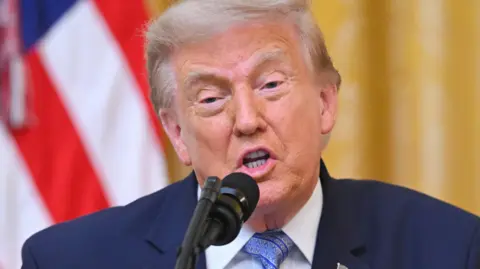
EPANew research suggests President Trump's tariffs could knock 15% off expected growth in Northern Ireland's exports to the US.
The study, commissioned by Stormont's Department for the Economy, finds the biggest impact would be felt in the pharmaceutical sector.
Pharmaceutical exports could end up 18% lower compared to a scenario without tariffs.
Tariffs are essentially taxes placed on imported goods, designed to protect domestic manufacturers.
President Trump has imposed a 10% baseline tariff on most UK goods.
However UK-produced pharmaceuticals currently face a 0% rate under temporary exemptions.
Economists warn that if those exemptions expire after 2029, the long-term drag on Northern Irish manufacturing could be substantial.
On Tuesday Trump warned that from 2028 he would start imposing 100% tariffs on generic drugs from countries that do not have a deal with the US.
He would then double that tariff to 200% in 2029.
Generic drugs are off-patent or unbranded medicines. They are widely used in the US and the majority of them are imported.
The new study, by Dublin's Economic and Social Research Institute (ESRI), also suggests NI's transport equipment sector is facing a significant impact.
That sector includes things like the manufacturing of aircraft parts.
Exports of these products could be 14% lower compared to a scenario without tariffs.
The overall long run impact on all NI goods exports to the US would be a 15% reduction compared to a zero tariff scenario.
That in turn would reduce Northern Ireland's economic growth potential by 0.4%.
 Getty Images
'Sensitive to changes in global trading'
Stormont's Economy Minister Caoimhe Archibald said the research confirms that increased trade barriers are likely to have negative consequences for economic growth, trade and employment.
"As a small, open economy with strong trading links to both Britain and the European Union, the north is particularly sensitive to changes in the global trading environment," she added.
The report comes as President Trump has escalated his trade dispute with neighbouring Canada.
He announced a 50% tariff on a wide range of Canadian imports, in retaliation for what he called "unequal treatment" of US cars, dairy products and alcoholic drinks.
Consumer items such as hockey sticks and industrial goods like cement are among the goods targeted.
However, several key exports will be spared, such as energy, critical minerals and fish.
Canadian Prime Minister Mark Carney responded by saying he stood ready to "intensify" trade talks with the US in the coming weeks.
The White House said the tariffs would take effect in 30 days.
