Campaign 'far from over' as minister rules out cervical screening inquiry

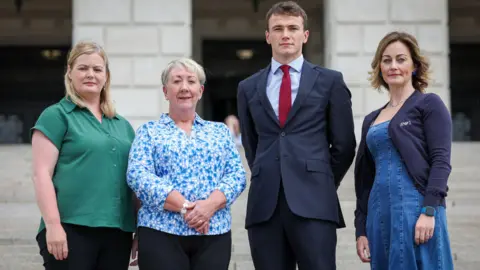 Ladies with Letters
Campaigners are considering legal action after the Health Minister, Mike Nesbitt, ruled out a public inquiry into failings in Northern Ireland's cervical screening service.
The Ladies With Letters group have consistently called for a statutory inquiry into what went wrong at the Southern health trust, which led to about 17,500 women being approached to have their smear test results rechecked and eight women developing cancer.
After a further independent review was published on Thursday, Nesbitt said that it and previous reports had already answered the questions a public inquiry would cover.
But one woman said the campaign was "far from over" and would not be "swept under the mat".
The health minister said he recognised the decision "would be disappointing for many".
"I want to reassure them that lessons have been learnt and we will continue to make developments to improve our cervical screening programme in Northern Ireland," he said.
The campaigners said that while they were "really disappointed" by the announcement, they were not surprised.
Tracey Bell from the group said: "The sequence of reviews and reports into reports has been carefully orchestrated to give the impression that no stone has been left unturned by the Department of Health and (Southern) trust's investigations into these events.
"But we are going to call this what it is – a blatant refusal to uncover the truth."
Bell described the outcome of the latest review as an insult to the women who have "suffered as a direct result of their smear tests being misread".
"Even more so, the families of two beautiful young mothers who tragically died – Lynsey Courtney and Erin Harbison – it's rubbing salt in an open wound."
She said the campaign was "far from over" and would not be "swept under the mat".
Bell said the group felt that no one had "taken ultimate accountability for what went wrong".
Leona Patterson was diagnosed with cervical cancer in 2021 and had to undergo a hysterectomy after three misread smear tests.
Speaking to BBC Radio Ulster's Evening Extra programme, she said the latest report offered "little comfort or clarity to those, including myself, that are directly impacted".
Patterson said this was not a reflection on the efforts of Prof Sir Frank Atherton who undertook the review, but that there was "no restoration of any confidence to the cervical screening programme".
"It's been put on us that we have to fight for the truth recovery in this, we have to fight for the answers, we have to fight for somebody to open up and be truthful and honest," she said.
A solicitor for the group said it was considering several potential legal routes.
 PA Media
Weaknesses in screening and management
Last November, three reports detailed weaknesses in screening and management at the trust and were intended to provide future learning across the entire healthcare system.
While many of the details were already known, the reports reaffirmed that individual screeners underperformed and that leadership and oversight were lacking when things were going wrong.
The reports found that some women who had been diagnosed and treated for cancer had been retraumatised after they were again contacted by the Southern Trust about abnormalities discovered during an audit of their cases.
At that time, Nesbitt decided to commission a review into the findings of all reports into the cervical screening service at the Southern Trust rather than opt for a public inquiry.
That review undertaken by Sir Frank - former chief medical officer for Wales - found that while there was "clear management and governance failings within" the Southern Trust and the Public Health Agency (PHA), it would be inappropriate to seek further sanction against individual screeners.
Sir Frank said any cervical cancer programme in the UK or globally would be subject to "false negative" results.
"It is an inherent feature of screening programmes that false negative results will occur and some of these will be attributable to human error," he said.
However, he said the fact that the Southern Trust made a number of "variations" in its screening programme had led to "unintended consequences".
It meant the performance of screeners was not properly monitored and "undermined the performance management process".
Sir Frank said while available data from last November's reports could not point to harm having occurred either to some women or none at all, it was "unlikely large numbers of women [had] been adversely affected and come to harm".
While he said "no individual or organisation set out to deliberately cause harm or to provide a poor service", any underperformance should have been identified and corrected.
He added that while future risk was lessened by the centralisation of the new HPV (human papillomavirus) screening service within the Belfast Trust, there needed to be close monitoring of that programme to ensure any issues were identified and dealt with at an early stage.
He told BBC News NI that this new HPV service meant there was "a great degree of confidence that the system is safe".
 Getty Images
Sir Frank said he heard from affected women and their partners that a public inquiry was necessary to "assign accountability", and from healthcare officials that an inquiry would be "time consuming, risk re-traumatisation, further delay resolution, involve significant expense...".
"I believe that it is highly unlikely that a statutory inquiry would be able to make further progress on unravelling the technical aspects of the programme failure," he said.
Mike Nesbitt said he had thought long and hard about ruling out a public inquiry.
"I acknowledge that this has been a particularly difficult and challenging time for the women and their families who have been impacted by cervical cancer. I want to pay tribute to their determination and acknowledge the profound effect these events have had on their lives," Nesbitt said.
In a statement, the Public Health Agency said that reviews into the failings had provided "important direction" for improving services, and their recommendations had either been implemented or were in the process of being implemented.
The PHA also apologised to those affected.
'Whistleblowers need to be heard'
Whistleblowers continue to have a powerful role within the health service and Atherton's findings confirm that.
In 2022 a whistleblower from the Southern Health Trust contacted BBC News about fears that women's smear tests had been misread by screeners with some going on to develop cancer.
The whistleblower had raised concerns about governance to management, but no one listened.
At the heart of this story are women – two died while others went on to have surgery as their smear tests had been misread for more than a decade.
More than four years ago, the whistleblower told me the programme was flawed and their spreadsheets and copious amount of digging into records proved that.
While today is about listening to the women affected, it also highlights that whistleblowers need to be heard as well.
Political reaction
Social Democratic and Labour Party health spokesperson Colin McGrath said the decision not to hold a public inquiry would "leave many feeling that their voices have once again gone unheard".
Democratic Unionist Party health spokesperson Diane Dodds said serious questions remained for both the trust and the Public Health Agency.
Alliance health spokesperson Nuala McAllister said changes to the screening programme were welcome.
"But we cannot expect the thousands of women who were impacted by this scandal to just draw a line under this and move on without proper closure," she added.
