Are parties being upfront about Scotland's finances?

 BBC
BBCThe Scottish Parliament election has been typically packed with promises to spend money on new policy ideas.
But there has also been talk of cutbacks, with many parties promising to reduce the number of "quangos" and rein in the size of the public sector.
Holyrood's annual budget hit £68bn this year and is forecast to grow over the coming years, with both the "block grant" from Westminster and tax revenues controlled from Holyrood set to rise.
However it's also under huge pressure - from growing demands for services and benefits, bumper public sector pay deals and an ageing population.
Economic experts have suggested that the budget to be set at the end of the year will be a "horror show" for whoever becomes Scotland's new finance secretary.
Are any of the parties being realistic about the scale of the challenge ahead?
What are the pressures?
The Scottish government's own projections in its medium-term financial strategy suggest that spending is on track to exceed available funding by £4.8bn in 2029-30.
That is what headlines frequently refer to as a "black hole" in the budget which needs to be plugged somehow.
The social security budget in particular is swelling - it was £7.4bn this year and is forecast to hit £9.2bn by 2030-31.
More than half of this is spent on the Adult Disability Payment, and the Scottish Fiscal Commission (SFC) forecasts that one million Scots will be in receipt of a disability payment of some kind by 2031.
There is also particular pressure on health and social care, with the Accounts Commission watchdog warning that "radical change" is needed due to a widening gulf between demands and available funding.
Public sector pay made up 55% of the Scottish budget last year.
The workforce has been growing since the pandemic, but a bigger issue than headcount is pay.
The SFC says Scotland's public sector workforce is "relatively larger and better paid than in the rest of the UK", with median pay £1,500 higher than in other parts of the country.
And pay is continuing to rise. In 2025-26, the Scottish government budgeted for a total of 9% in public sector pay rises across three years, with employers free to spread this out as they pleased.
But two years of bumper settlements followed.
Resident doctors agreed a deal totalling 8% over two years, leaving only 1% within the current budget for the following year.
That follows a national trend - the SFC calculated that deals for 2027-28 will need to average out at 1.1%, well below the rate of inflation.
What does this mean for the next government?
Watchdogs and think tanks alike have warned that whoever becomes Scotland's finance secretary will be faced with a series of challenges.
Both the Institute for Fiscal Studies (IFS) and the Fraser of Allander Institute (FAI) previously suggested that an emergency mid-year budget might be needed in light of pay deals.
The need to make cuts elsewhere to "top up" the health budget may have been averted by extra funding flowing from Westminster - Holyrood's share of new money committed to schools in England.
However, that would just push the problem down the road a few months to the 2027-28 Scottish budget, to be drawn up in December.
Prof Mairi Spowage from the FAI described this budget as a "horror show", between the pressures already listed and global events like the conflict in Iran driving inflation and higher debt costs.
Pay talks are also going to be difficult this year, with the current policy only leaving enough money for a below-inflation settlement.
Would a newly-elected government have the stomach for a showdown with unions?
There is a large potential saving there though - David Phillips from the IFS suggested that allowing public sector pay to shrink back in line with levels in the rest of the UK could save almost £2bn a year.
 Getty Images
How would parties raise revenues?
The SNP has maintained a policy of raising more from from higher earners since setting up a distinctive income tax structure in 2016.
It has also made use of "fiscal drag" by freezing the thresholds at which higher tax rates kick in - meaning that as pay goes up, more earnings are taxed at higher rates.
The SFC estimates that the number of people paying at least the higher rate of income tax has doubled over the past decade - from around 300,000 in 2016-17 to 600,000 today - and that it could surpass 1m by 2030-31.
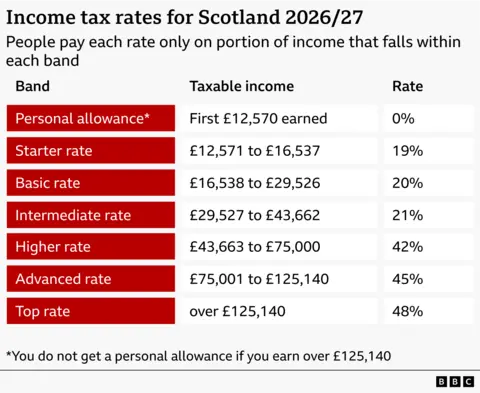
John Swinney has pledged not to increase rates or introduce any new bands next term.
But the SNP leader has left the door open to further fiscal drag, because that promise does not extend to thresholds.
Other parties have suggested raising or reforming other taxes - or introducing new ones.
The Scottish Greens in particular included a wide range of tax ideas in their manifesto, including increases to land and buildings transaction tax (Scotland's version of stamp duty), business rates targeting large companies, and levies on frequent fliers and domestic flights.
The IFS welcomed that the party recognised that higher revenues were needed - but said the plans set out were "unlikely" to cover the scale of spending also proposed.
Is anyone planning to cut services?
Most parties seem to agree that the size of the state in Scotland needs to shrink.
The Scottish government's spending review implied real-terms cuts to local government, education and justice were priced in for the years through to 2028-29.
Ministers also identified £1.5bn of "efficiencies" to be delivered over that period, chiefly from "back office" functions of public bodies.
The savings parties have proposed in their manifestos will stack on top of those.
Several, including the SNP, have suggested cutting the number of "quangos" - arm's length public bodies.
The Conservatives said they would reduce the number of them by a quarter, while Labour said they would cut them by a third.
Reform UK actually suggested suspending all 132 of them until they can justify their spending, which the party said was around £6.5bn.
The FAI noted that this would include bodies like the Scottish Funding Council, which delivers £2bn of state support for colleges and universities, the Scottish Prison Service, and Scottish Rail Holdings, which runs ScotRail.
 Getty Images
Some parties have also set out cuts to specific services - like the Scottish Conservative proposal to restrict eligibility for Adult Disability Payments where people claim for mental health reasons without having a medical diagnosis.
The party says this could deliver £1.8bn of savings annually by 2030-31, given about 40% of ADP claims are categorised under mental or behavioural disorders.
However the FAI pointed out that this might lead to more people going and getting formal diagnoses, making any savings "inherently uncertain" in practice.
Do the spending plans stack up?
Every party included spending promises in their manifestos.
The SNP proposed an expansion of funded childcare costing £540m - and the IFS warned that this figure could run higher if takeup is higher than estimated.
Reform UK Scotland proposed tax cuts costing £2.3bn by the end of the next Holyrood term.
However the IFS pointed out that the party had claimed this would be paid for "four times over" by £8bn of potential economic growth over the coming decade - apparently without realising that £2bn a year for 10 years equals £20bn of spending.
The Scottish Conservatives meanwhile acknowledged that "tax rises or spending cuts will be required to balance the books" in the next parliament, and set out plans for £6bn of cuts by 2031-32.
However, the party then allocated almost every penny of those savings to new spending, chiefly on tax cuts, and pledged to hand back any budget underspends to taxpayers.
Perhaps the least radical manifesto was proposed by Scottish Labour, with the party chiefly focused on improving existing services rather than drawing up new ones.
However the IFS said even this "relatively restrained" approach would "still probably require some combination of cuts to other services, increases in taxes or improvements in public sector productivity".
 Getty Images
For other parties, manifestos are not really designed to be delivered in full.
The Lib Dems set out a series of relatively small spending proposals in their manifesto, like £100m on an emergency insulation programme, and £50m to hire an extra 2,000 pupil support assistants for schools.
Ultimately the party is looking ahead not to governing in its own right, but negotiating with a larger party over budget deals.
The same could be said of the Scottish Greens, although their policy proposals were potentially more expensive - like free bus travel for all, a huge expansion in GP numbers, smaller school class sizes and a four-day working week.
The six parties have offered a wide range of answers to the questions facing Scotland's finances.
But experts say none sought to actually address the "black hole" already forecast for the coming years.
David Phillips said this is perhaps understandable when parties are seeking votes.
"When you're in an election you want to be saying new stuff," he said. "But voters obviously care about the quality of existing stuff. How do you move from a debate about new things to making sure that the things you currently get are up to scratch?"
Or as Mairi Spowage put it: "Absolutely nobody is dealing with the fact that what we spend now on services is not sustainable."
Additional reporting by Aimee Stanton.
