Around the island in 48 days: White-tailed eagle goes on Irish grand tour

 National Parks and Wildlife Service
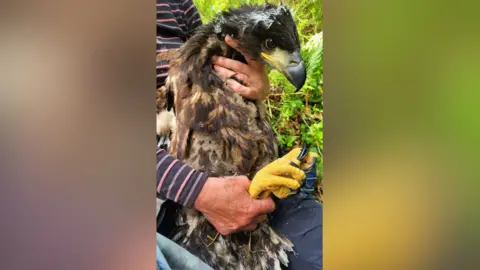
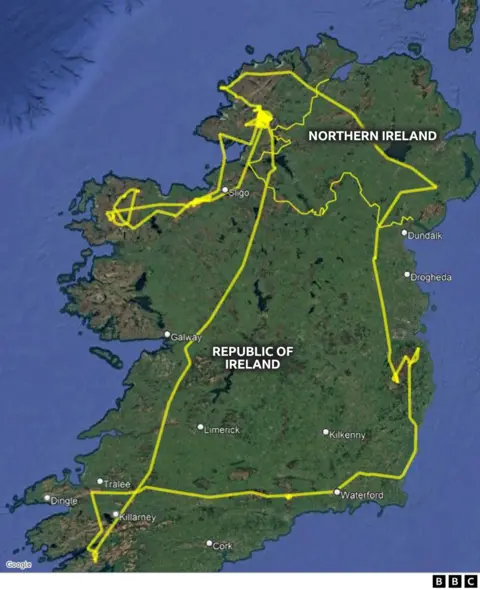
A young white-tailed eagle has been on a grand tour of the island of Ireland, flying through 26 counties in 48 days.
Aspen, a bird hatched last year in Glengarriff Nature Reserve in County Cork as part of a reintroduction programme, set off from its birthplace on 22 March.
Over the following seven weeks a satellite tracker recorded its movements, revealing an aerial odyssey that took it through Leinster, Ulster and Connaught, before eventually returning to its native Munster.
During its time in Northern Ireland, the animal - which belongs to the largest bird of prey species in the UK and Ireland - visited counties Armagh, Down, Tyrone, Londonderry and Fermanagh.
A different relationship
Since the white-tailed eagle reintroduction programme started in 2007, Clare Heardman, an ecologist with National Parks and Wildlife Service (NPWS), has helped to track and monitor countless birds.
At present, she keeps an eye on about 90 eagles.
Still, she said she has a special relationship with Aspen - the headline-grabbing eagle that recently completed a circuit of Ireland.
 National Parks and Wildlife Service
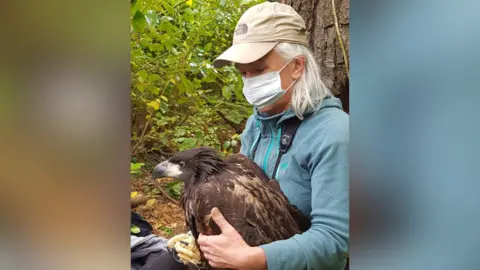
"I helped tag her when she was eight weeks old, then she fledged when she was 13 weeks.
"Since then, she has shown that she definitely isn't a home bird. On her first solo flight, she did a massive loop of Munster, which isn't unheard of but proved that travelling is in her personality," said Heardman.
It is relatively rare for an eagle to be named, but Aspen took hers from an unusual type of tree that was found growing near her nest.
"All eagles are equal but because Aspen was named, because she completed this interestingly neat loop of the country, and mostly because she is the offspring of a local pair who I watched grow from tiny chicks, I do feel like I have a different relationship with her than other birds," said Heardman.
Since the map of her travels was posted on social media the public have taken to her as well.
"I think it's because her route around the country touched so many counties. It has helped people relate to her."
 National Parks and Wildlife Service
Sometimes referred to as sea eagles, and flying barn doors on account of their up to 2.5m wingspan, white-tailed eagles went extinct in the UK and Ireland during the late 19th and early 20th centuries.
Efforts over recent decades to reintroduce the species using eagles from Norway have been successful.
In 2024 a pair of white-tailed eagles in County Fermanagh became the first to breed in Northern Ireland in more than 150 years.
Mating populations have also been confirmed in Kerry, Cork, Clare, Galway, and Donegal.
 Dr Eimear Rooney
Dr Eimear Rooney from the Northern Ireland Raptor Study Group (NIRSG) said while the movements of Aspen shown on the map did not surprise her, "there is still something amazing about seeing the way these birds range".
"This time of year, it is common for white-tailed eagles to go wandering. They get on a hot air current and because of their size, they can cover miles and miles in a very short space of time," said Dr Rooney.
White-tailed eagles feed on fish and marine life, which Dr Rooney said explains why the satellite tracker showed the bird at times "hugging the coast and crossing wetlands".
They are also known to scavenge, an instinct that draws them inland and toward higher ground.
"Carrion - which means dead animals - makes an easy meal for a white-tailed eagle, so when you look at the map and see the time this bird spent circling around Donegal, that's probably what was going on. It was surveying hilltops, searching for something to eat."
'Never too sure where they'll end up'
White-tailed eagles usually begin breeding at about four or five years old.
Adolescence, explained Dr Rooney, can be a dangerous time for them.
"The people tracking these birds during this part of their lives are biting their nails constantly.
"There are a lot of threats, not least the risk of poisoning that comes with their scavenger nature."
In May 2023 it was confirmed that two white-tailed eagles found dead in County Antrim had been poisoned.
During the same year, according to the National Parks and Wildlife Service (NPWS), in South Donegal alone three white tailed eagles were killed by wind turbines.
Other dangers include storms and bird flu.
"At the age this eagle is at, it's just trying to find its way in the world: Ranging, looking for food, security and other eagles.
"What it really wants is somewhere to settle down and breed when the time comes.
"Just because it was released in Cork doesn't mean it'll stay in Cork.
"A very common path we see these birds follow takes them to the Antrim Hills, Rathlin Island, onto the Mull of Kintrye, then they'll spend some time in Scotland before coming back.
"The point is, you can never be too sure where they'll end up," added Dr Rooney.
