Dali ship operator charged over deadly Baltimore bridge collapse

 Getty Images
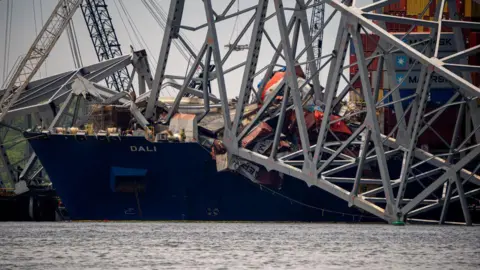
Federal prosecutors have filed criminal charges against the owner of the cargo ship Dali, two years after it struck Baltimore's Key Bridge, causing its collapse and killing six people.
Synergy Marine, the company that operated the ship, along with one of its employees, has been charged with conspiracy, obstruction and misconduct resulting in death, among other offences.
Prosecutors allege the company misled investigators about conditions on the ship and failed to disclose hazards and other safety concerns to the US Coast Guard.
The company said it "will defend against these allegations with vigor". Separately, Synergy and Maryland settled a civil case over the collapse for $2.25bn (£1.7bn).
"DOJ is criminalising a tragic accident," the company said in a statement to the BBC. "The allegations in the indictment are baseless and have nothing to do with the DALI's allision with the Francis Scott Key Bridge."
Allision is a maritime law term for a vessel striking a stationary object, such as a bridge.
In a statement on Tuesday, Acting Attorney General Todd Blanche said the collapse of the span was "a preventable tragedy of enormous consequence".
"This indictment is a critical step toward holding accountable those whose reckless disregard for maritime safety regulations caused this disaster," he said.
The charges, unsealed on Tuesday, involves the company's Singapore- and India-based operations. The Dali's technical supervisor, Radhakrishnan Karthik Nair, also faces criminal charges.
In the early hours of 26 March, the M/V Dali container ship crashed into the landmark Francis Scott Key Bridge, sending several vehicles plunging into the river and killing six construction workers.
The collapse also caused significant economic disruption as shipping was brought to a standstill.
The city is still working to reconstruct the bridge, which is expected to take years and cost billions of dollars.
The National Transportation Safety Board has identified multiple factors, including the loss of electrical power from a faulty cable, problems with a fuel pump on the ship and a lack of counter measures to reduce the bridge's vulnerability.
In the court filing, prosecutors say the Dali struck the bridge because the vessel lost power two times in a four-minute span.
The first power outage, prosecutors say, was caused by a loose wire in a switchboard. They allege the second blackout occurred because the crew was relying on a flushing pump to supply fuel to two of the ship's generators.
Prosecutors said the vessel had not been approved to use a flushing pump for its generators, as the pump was not designed to automatically restart after a blackout.
If the crew had used "proper" fuel supply, the vessel would have regained power before hitting the bridge, they added.
In its statement to the BBC, Synergy said the vessel's use of the flushing pump was "wholly irrelevant to the cause" of the crash.
The indictment also states that Synergy employees knew about the improper use of the flushing pump and "took steps to hide the use" on the Dali and other vessels.
Prosecutors also allege the company falsified safety records.
Meanwhile, in a separate civil case, Maryland announced on Tuesday that the state had reached a $2.25bn settlement with Synergy Marine over the bridge collapse.
It resolves a lawsuit the state brought against the company in 2024 for damages related to the destruction of the bridge, environmental harm, lost toll revenues and other economic losses for Maryland and its residents.
The vessel's owner has already paid the justice department over $100m to settle a civil claim over the damages to the bridge, as well as $350m to the state of Maryland's insurance company.
