England legend to run marathon for eye charity

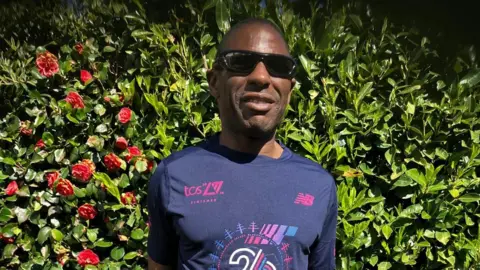 Darren Harris
England's most capped and decorated blind footballer is set to run the London Marathon to raise awareness about eye cancer.
Darren Harris, from Wolverhampton, was diagnosed with bilateral retinoblastoma at just 15 months old and as a result of the treatment he lost his vision.
He did not let the impairment stop him, and went on to become a Paralympian and was recently inducted into the National Football Museum's Hall of Fame.
On Sunday, he will run 26-miles for the Childhood Eye Cancer Trust.
The 52-year-old, made his debut for the country's blind team in 1996 and went on to make 157 appearances, scoring 34 goals while winning 10 world and European medals.
"The truth is, living with constant uncertainty about your health—while trying to build a career, relationships, and a future—takes a toll that's hard to put into words," he said.
"It can feel like a ticking time bomb. Today, that reality is also what drives me."
Aiming for personal best
The Wulfrunian's friend and former teammate Robin Williams died from the condition in December last year, prompting the footballer to take up the challenge to raise awareness.
It's not the first time he has lined up for the legendary race, but 29 years later he has a bigger ambition.
In 1997, he completed the gruelling 26.2 miles (42 kms) challenge in four hours and 27 minutes. This time around, he plans to lop an hour off that time.
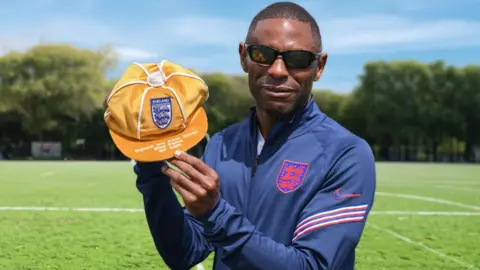 Darren Harris
Speaking about the challenges blind runners face, he told BBC Radio WM: "Everybody wears headphones and when you're running behind someone and trying to give them some information to warn them that you're approaching, they are not paying any attention.
"At the feeding stations, people just veer off left and right - there's no indicators so they run the risk of tripping you up.
"There's a lot for my guide to take on board and look out for when he's running with me."
Harris has set a goal of raising £10,000 for the charity.
"I want to help ensure that families facing RB today and in the future have the support, information, and hope they deserve," the footballer added.
"Their work supporting children, survivors, and families affected by retinoblastoma is vital—from diagnosis, through treatment, and long into adulthood."
Follow BBC Wolverhampton & Black Country on BBC Sounds, Facebook, X and Instagram.
