'I was happy to pay £110 for a GP to come to my home'

 BBC
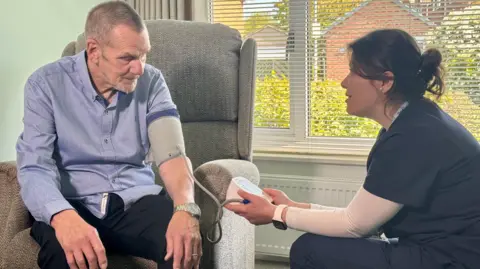
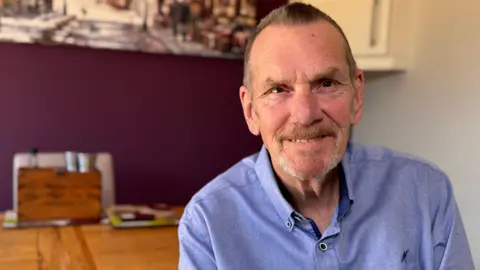
BBCWhen he fell ill on a Sunday morning, David Clayton said the last place he wanted to go was A&E, but after searching online for doctors he had a private GP visiting him in his home two hours later.
"[They] spent 40 minutes and checked me over so thoroughly, gave me advice. It was brilliant," said the 76-year-old from Radcliffe-on-Trent in Nottinghamshire.
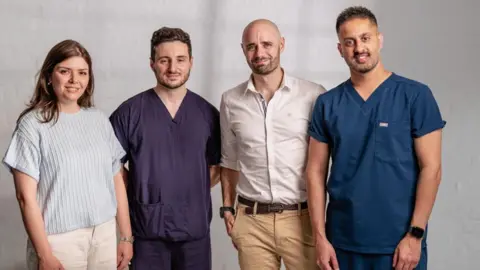
He made the appointment through a new service, which describes itself as unique as it is owned by 10 Nottinghamshire-based GPs who work privately alongside their NHS roles.
David paid £110 for the appointment, which he said was "money very well spent" as it stopped him taking up another space up in A&E which he was "anxious to avoid".
DocSelect was launched as an app-based service six months ago, offering home visits seven days a week, between 08:00 and 23:00.
The firm said it had got 1,000 sign-ups and provided more than 200 appointments so far.
Founder Dr Adeel Khan said the aim of the practice was to make booking a GP visit "quick and easy" and as straightforward as "ordering a taxi".
"Our big offering is local care that comes to your house," said Khan.
"You can go on the app, download it, see the doctors in your local area and within a few clicks... the GP turns up at the door."
He said there was "no hiding the fact that we are a paid service", but added the important thing was the convenience.
"It's providing that care at your doorstep and being able to get the services that you need from a local doctor," Khan said.
The DocSelect model is the latest variant of private provision of GP services in the UK, a sector in which there are now numerous competing providers, each with their own pricing structures and booking systems.
Virtual appointments are a feature of many of these companies, but DocSelect emphasises its clinicians are locally based, and promotes the availability of home visits as one of its key selling points.
These visits were more commonplace in the NHS years ago but are now largely reserved for patients in the health service who struggle to get to their surgery.
There is long-running political debate about how private practice sits alongside the NHS. Clinicians who work in both the NHS and the private sector are required to keep the two roles clearly separate. An NHS GP would not typically be allowed to see one of their own NHS-registered patients in a private capacity.
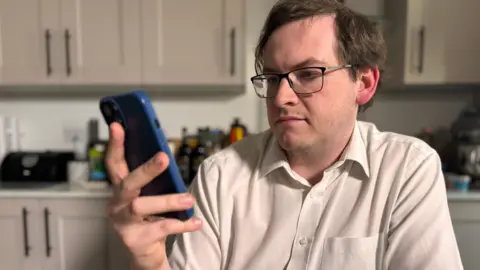
Matthew Rainbow, from Ruddington in Nottinghamshire, said his GP surgery told him it was too busy to offer him an appointment when he was feeling unwell in February.
He said: "I struggle with anxiety... so I thought what other options are there?"
The 30-year-old said he used the app to book an appointment with the private firm for £100 and a GP came to his home a few hours later.
"For me personally, I thought it was value for the money just because it was very quick, very good advice that he gave on the issue and it solved the concern that I had," he said.
 Supplied
Private healthcare remains a significant but relatively small market compared with the NHS. Nevertheless, some campaigners are concerned whenever they see new private provision springing up.
The co-chair of Keep Our NHS Public and retired consultant paediatrician Dr John Puntis said the growth of private GP provision was a symptom of "underfunding and relentlessly increasing work pressures" in the NHS.
He argues that "in a well-funded and properly resourced NHS, patients would not need to use private healthcare - effectively paying twice for an essential service that should already be provided".
Michael Wright, chief executive of the Local Medical Committee representing GPs in Nottingham and Nottinghamshire, said the impact of the DocSelect model on NHS practices was yet to be seen.
He warned it could be "counter-productive if it increases overall workload", but "helpful if it assists practices by absorbing some demand".
Wright said the DocSelect team were likely to understand local health protocols and guidelines, but he stressed patients should understand such services do not replace their registered NHS GP practice, but operate as an alternative route for access.
 Getty Images
According to the British Medical Association (BMA), the private GP market is growing because patient numbers are rising while NHS GP capacity is not.
According to their figures, more than 63 million people were registered with GP practices in February 2026, up almost 14% since 2015, but the number of fully qualified full‑time equivalent GPs has fallen.
In the Midlands, the average practice has 2,276 patients per GP, well above the aspirational figure of 1,000.
A spokesperson for the BMA, which represents doctors working in both the NHS and the private sector, said: "Persistent pressures on the NHS, including long waits for care and high demand in general practice, are increasingly shaping how patients access services.
"Many people are struggling to get an appointment at a time that works for them, and this is inevitably leading some to look at private options.
"One of the main draws of private GP services is the ability to see the same doctor and have clear clinical responsibility for their care - something patients consistently value. However, it is important that people are not placed in a position where they feel they must pay, or take on debt, to get treatment."
The independent health thinktank charity The King's Fund research fellow Beccy Baird said: "It is really good for patients to have choice and I don't think anyone would think that was a bad idea, but I do think with the rise of private general practice, we should really think carefully about why that's happening and what we might do to make the NHS provision of general practice better for both staff and patients, because in the end we have a system founded on equity rather than ability to pay."
Khan disputes that private practice could create a two-tier level of healthcare for patients who cannot afford to pay to see a GP.
He said by "increasing capacity", patients were able to see doctors in their local area.
"They reduce the stresses on A&E, they reduce the stresses on GP services, so we're really seeing this as a complimentary service to the NHS - not a competition," he said.
Dr Aston Cresswell, a full-time NHS GP who works flexibly for the firm on days and evenings off, said: "The patients are already accessing private services, the point of what we're trying to do is make that a little more seamless and mean that you are still getting NHS guidance care in your private appointment.
"Not everybody is going to want to access it, that's OK, but we're giving options to people who do."
Listen to BBC Radio Nottingham on Sounds and follow BBC Nottingham on Facebook, on X, or on Instagram. Send your story ideas to eastmidsnews@bbc.co.uk or via WhatsApp on 0808 100 2210.
