How Royal Pavilion became WW1 hospital for troops

 Royal Pavilion & Museums
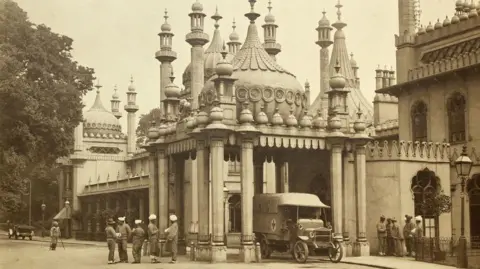
Experts have given an insight into how Brighton's Royal Pavilion was turned into a hospital for Indian soldiers during World War One, in a little-known chapter of Sussex's history.
More than 4,000 patients were treated in the former seaside palace after it was repurposed to care for injured troops.
Davinder Singh Dhillon, chair of the Chattri Memorial Group which commemorates the Indian soldiers treated in the city, said the building played "a key role" during the war.
Originally built for the Prince Regent, later George IV, the pavilion had been used as a civic space before being handed over for military use.
Decorative interiors were removed or covered.
Beds, medical equipment and operating theatres were installed, and Indian soldiers wounded at battles including Ypres, Neuve Chapelle and La Bassée were brought to Brighton.
Kevin Bacon, heritage collections manager at the University of Sussex, said the injuries ranged from bullet wounds to shrapnel injuries, reflecting the realities of trench warfare.
"Some of what was happening here was not simply treating the man, but actually understanding what these new medical conditions were, and how they could best be treated," he said.
 Royal Pavilion & Museums
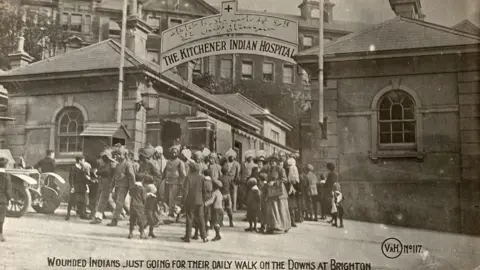
The hospital was adapted to meet cultural and religious needs, with separate kitchens created for Hindus, Muslims and Sikhs.
Arrangements were also made for prayer and daily routines, military historian Tom Donovan said.
Soldiers were able to explore the town and meet local residents, with some invited into Brighton residents' homes.
"They would be invited to people's houses to have tea or to eat or to meet the family and to chat, and they would be taken out to see the sights by local people," he said.
Letters sent home by soldiers described the care they received, Dhillon told Secret Sussex.
One soldier wrote: "We get very good food and I cannot sufficiently praise the building.
"It is a very splendid building."
Another said: "We are very well looked after.
"Our hospital is in the place where the king used to have his throne. Men in hospital are tended like flowers."
Professor Santanu Das, from the University of Oxford, said it was part of Britain's propaganda effort to show soldiers were treated well, but said: "As a result they are also getting quite a high degree of medical attention and care."
The pavilion closed as an Indian hospital in January 1916, before later reopening to treat wounded British soldiers.
Today, the building's role during the war is recognised alongside its Regency past as part of the city's history.
Follow BBC Sussex on Facebook, X, and Instagram and listen to BBC Radio Sussex on Sounds. Send your story ideas to southeasttoday@bbc.co.uk or WhatsApp us on 08081 002250.
