AI cameras have 'more capability' than officers

 Suffolk Police
A police force using AI cameras to detect traffic offences said they had "considerably more capability" than human officers as a trial detected more than 5,300 offenders in a month.
In the summer, Suffolk Police trialled the technology on the A12 where they caught drivers without seatbelts and using mobile phones.
The force said half of the offences had been dealt with so far, resulting in 1,705 people completing awareness courses and a further 1,003 people paying fixed penalties.
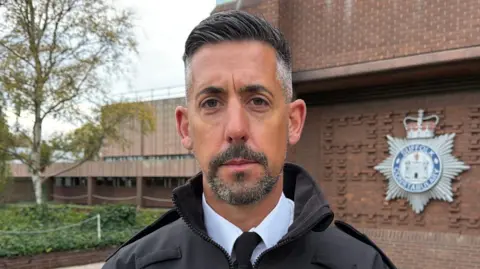
The cameras were deployed again on the A14 on Tuesday and Ch Insp Gary Miller said the "sheer volume" of offences during the trial highlighted the need for them.
The high definition cameras are able to take clear images at night and day before AI algorithms analyse them to identify potential offences.
Those images are then verified by several officers before offenders are contacted.
The A12 trial at the end of July identified 5,327 offences across 28 days, which averaged at about 190 offences a day.
The force said 3,008 offences were drivers not wearing seatbelts, four offences involved a child travelling without a seatbelt restraint - and 2,313 offences were drivers distracted from the road, mainly because of a mobile phone.
Use of a phone can result in a £200 fine and six penalty points, while not wearing a seatbelt can result in a fine of up to £500.
 Suffolk Police
The BBC asked the force if it could say how many offenders the cameras would catch compared to a human officer in a day, and if the cameras would free up officers to conduct other work.
"AI cameras are used as a complementary means of enforcement alongside that conducted by police officers & the Safety Camera Team," a spokesperson said.
"A stationary camera running for 24 hours a day and focused on specific offences has considerably more capability to detect offences – the equivalent would be to have officers stood doing the same thing for the same time period."
The spokesperson highlighted that a recent case of a lorry driver being jailed for causing a fatal crash on the A14 showed the serious consequences of using a phone while driving.
Christopher Cooke failed to bring his HGV to a stop while driving in 2023, crushing a van in front and killing the driver, 53-year-old Paul Cobbold.
He was found to have been playing a game on his phone.
 Suffolk Police
The force's own post on social media about the trial prompted a large reaction from people, with concerns raised about whether the cameras would actually save lives and if police efforts should be focused elsewhere.
The force said not wearing a seatbelt and using mobiles while driving were two of the "Fatal 4" driving offences that caused serious or fatal crashes.
The other two were drink/drug driving and speeding.
According to police data from across the country, more than half of fatal crashes in 2023 were assigned to at least one of the Fatal 4 factors.
Data from Suffolk Police for this year also showed that 12 serious or fatal collisions had involved mobile phone use, while seven had involved not wearing a seatbelt.
The government has allowed police forces to make use of AI for image identification and classification.
 Richard Knights/BBC
On Suffolk's trial of the AI cameras, Miller said: "The figures from the first trial are staggering and amount to an average of 190 offences detected per day.
"This underlines our concerns about the number of people still continuing to take unnecessary risks such as not wearing a seatbelt and not being in proper control of their vehicle."
Tim Passmore, Suffolk's Police and Crime Commissioner, added: "If these cameras encourage people to think twice about using their phones and ensuring they wear a seatbelt on every journey, then they have the potential to save lives."
Do you have a story suggestion for Suffolk? Contact us below.
Follow Suffolk news on BBC Sounds, Facebook, Instagram and X.
