Balaclava boys on electric bikes: How to tackle the problem?

 BBC
BBCFrom the Pentland Hills near Edinburgh to the streets of the country's biggest cities, a common menace is causing irritation, alarm and in some cases even death.
The sight of young men, their identities hidden by black balaclavas, tearing around on electric bikes or scooters is becoming a familiar one.
The picture above was taken by a man who posted on social media about "morons on electric bikes" scaring a nearby horse as they rode illegally on public footpaths.
Aside from being showered with gravel churned up by the "gobby" miscreants, no one came to harm that day, but others have not been so lucky.
Earlier this year, a court was shown distressing dashcam footage of the moment a masked 18-year-old on an electric motorbike ploughed into a woman on a pedestrian crossing in Sunderland.
Gloria Stephenson, 86, died at the scene. The rider - Billy Stokoe, who had taken cannabis and was using his mobile at the time of the crash - was jailed for more than six years for causing death by dangerous driving.
Few would dispute that illegal e-bikes and scooters are a growing problem, but what can be done about it? Here are some of the options.
Seize and destroy illegal bikes
The term e-bike is often used loosely to cover a range of different vehicles.
Strictly speaking it refers to an electrically assisted pedal cycle (an EAPC) where an electric motor kicks in to take the strain off the rider while pedalling.
By law, the motor cuts out at 15.5mph (25km/h) and its continuous power is capped at 250 watts.
But these safeguards are easily bypassed by "tuning kits" or software hacks that make them capable of running much faster, sometimes in excess of 40mph.
A quick search of online marketplaces reveals all sorts of modifications on offer, often shipped from eastern Europe, including motorbike-style twist grip throttles which allow the rider to accelerate without pedalling.

Then there are electric dirt bikes from manufacturers such as Sur-Ron which look like mountain bikes but which are capable of about 50mph - and 70mph or more if modified.
Unlike legal e-bikes they require a licence and insurance to be used in public spaces or on roads.
E-scooters are also popular - despite it currently being illegal to ride them on public roads or pavements except in certain rental zones.
What they all have in common is that they are expensive, ranging from a few hundred to several thousands of pounds, and modifications can cost hundreds more.
Seizing and destroying them represents a significant penalty.
A new law and rules introduced this summer gave police in England and Wales greater powers to seize illegal vehicles, and with no formal warning required if they are being used in an anti-social manner.
They can also now be crushed within 48 hours.
In Scotland, ministers say they are in favour of increasing police seizure powers, although they point out bikes can already be seized under certain circumstances.
Dedicated police teams
Catching the offenders is a problem for the police - it's a crime where its very nature means the suspects have a fast and highly manoeuvrable method of escape.
A patrol car can easily be evaded by heading down a narrow alleyway or through bollards. David Kennedy from the Scottish Police Federation says more dangerous tactics are also employed.
"These individuals on these bikes will come up one-way streets the wrong way so there's no way a police officer in a car or even on a motorbike would be safe to follow them," he told BBC Radio Scotland Breakfast.
 Metropolitan Police
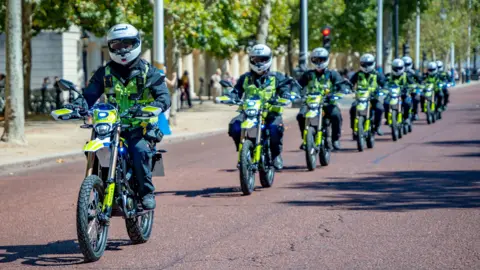
Some forces across the UK have responded to the challenge by setting up specialised units backed up by drones
In parts of inner city London, Metropolitan Police officers have been equipped with a fleet of 25 Sur-Ron dirt bikes - partly funded with proceeds of crime money.
As part of a crackdown targeting mobile phone thefts - which in London often involve such bikes - they claim it has helped cut offences by 13,000 in a year.
A number of forces have successfully used drones to track illegal e-bike riders rather than engaging in risky pursuits.
Officers monitor suspects from above, then their colleagues are directed to move in on foot to make seizures and arrests.
In Devon and Cornwall officers have also sprayed illegal riders and their bikes with SmartWater - a forensic marking product that contains a unique chemical code which becomes visible using ultraviolet light.
Action on face coverings
One of the most sinister aspects of e-bike misuse is that riders often wear black balaclavas or "ballys".
Whether it is a practical attempt to hide their identity or part of a youth sub-culture, there is no doubt that many people find the sight of masked youths intimidating.
The debate about the appropriateness of wearing balaclavas in public places goes wider than e-bikes, encompassing anti-social behaviour, crime and some anti-immigration protests.
 Danni MacRae
New restrictions introduced just this week under Operation Reclaim in Nottingham give police and council officers the power to order people to remove face coverings, backed up by £70 fixed penalty notices.
Exemptions apply for religious, medical and certain other legitimate reasons.
David Kennedy from the Scottish Police Federation said there was definitely "more to do" on face coverings although he cautioned that localised enforcement might simply see youths moving elsewhere.
He added: "If you are on an e-bike and you are wearing a face covering, the concern I have got is you are not wearing a helmet.
"I don't see many people travelling about the city centre on e-bikes wearing helmets."
Target the parents or sellers
Many parents are unaware that knowingly allowing their child to use an illegal e-bike or an e-scooter in a public place could land them with a fine or points on their driving licence.
Under the current law, e-scooters can only be used legally on private land.
The only exceptions are a number of rental trial zones, all of them located in England, yet some parents regard e-scooters as legitimate toys.
Riders of legitimate electrically assisted bikes must be at least 14, and any illegal modification means they qualify as a motor vehicle/moped, requiring registration, a driver licence, tax and insurance.
If an under-18 is stopped by the police, their parents could potentially be accused of "causing or permitting" a driving offence with a possible £300 fine and six penalty points.
And even a child too young to drive can have points added to a "ghost licence" which can transfer to their provisional when they eventually apply for one.
 Fubar News
Some argue the problems needs to be addressed earlier, before a young person gets hold of an e-bike or e-scooter, by targeting the point of sale.
This could range from clearer warnings about the rules, to a mandatory buyer information and registration scheme which would make it easier for police to trace vehicles used in crime or anti-social behaviour.
Last year an all-party Westminster inquiry called for action to close a legal loophole that allows illegal vehicles to be sold under the guise of off-road use.
The MPs also suggested that online marketplaces be held accountable for unsafe products such as the modification kits that are sold on their platforms.
Offer young people something better to do
Moral outrage at the behaviour of young people is nothing new and predates the invention of e-bikes by a considerable margin. Historians have found texts bemoaning declining standards dating back 4,000 years to ancient Mesopotamia.
Some might argue the e-bike scourge is just the latest manifestation, and that rather than demonising the "bally boys" a better approach is to try to understand the boredom and frustrations that underpin the trend.
In Aberdeen, alongside police enforcement action, one go karting centre is offering free sessions where e-scooter and e-bike riders can use them in a legal and safer environment.
But given the scale of e-bike misuse, can such schemes make an impact?
The backdrop is a long-term decline in services for young people and financial pressures on local authorities and charities that provide them.
A report from the YMCA last year found council-funded youth services in England and Wales had fallen by more than £1bn since 2010 with hundreds of youth clubs shutting and youth worker posts disappearing.
Youth Scotland, citing research by Unison, paints a similar picture.
Whether the answer is drones, dedicated police units or creating more positive ways in which young people can fill their day, the common denominator is fresh thinking and - arguably the biggest challenge - extra resources.
