Beaver activity found ahead of brook restoration

 Getty
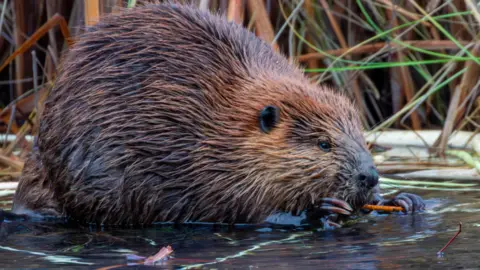
Signs of beaver activity have been found by a river as the once-extinct animals continue their return to a county.
Beaver feeding signs have been recorded along Semington Brook at Hurst Farm, near Worton in Wiltshire, where organisers of a wildlife restoration scheme hope to create better conditions for the animals to thrive.
It is another indication that beavers are becoming established in Wiltshire after disappearing from Britain centuries ago.
Dr Gabriel Connor-Streich of consultants Greenshank Environmental, which hopes to get housing developers to fund habitat upgrades at Hurst Farm, said: "The opportunity is to improve the conditions that allow these species to establish and spread."
The first official confirmation of a free-living beaver population at Semington Book, a tributary of the Bristol Avon, came last year.
Since then evidence of their return, such as gnawed trees, has grown.
Housing developers building in the area are able to contribute to environmental efforts under a biodiversity scheme agreed with the local landowner.
Funds from that scheme will pay for 30 years of wildlife habitat improvements at the farm, including work on about a mile of Semington Brook and its tributaries to allow water to flow more naturally.
Grassland, species-rich hedgerows and an existing lake will also be improved, according to the Local Democracy Reporting Service.
Dr Connor-Streich added: "Developer payments will support river restoration and better habitats in a landscape where beavers are already feeding and water voles have been recorded nearby."
 Greenshank Environmental
Wiltshire Wildlife Trust has said free-living beavers are present in the Bristol Avon and parts of the Hampshire Avon.
In April, a beaver was filmed swimming in the river near Bradford on Avon.
There is also evidence of their spread further east too, with beavers recorded on and around the Kennet and Avon Canal.
A wildlife event in Newbury earlier this year heard that camera-trap footage and field signs suggested the Kennet population was already in double figures, raising the prospect of the animals eventually spreading upstream towards Marlborough.
Follow BBC Wiltshire on Facebook, X and Instagram. Send your story ideas to us on email or via WhatsApp on 0800 313 4630.
