Interest rates hold expected but Bank of England facing tough choices

 Getty Images
Policymakers at the Bank of England are expected to keep interest rates unchanged despite price rises accelerating due to the prolonged conflict in the Middle East.
The nine-member Monetary Policy Committee (MPC) has been meeting amid a backdrop of increasing global energy prices and interest rate rises around the world.
Economists expect the MPC to hold the benchmark Bank rate at 3.75% for a sixth consecutive meeting but analysts are more divided on whether the rate will need to go up before the end of the year.
The Bank rate is crucial in setting the benchmark for banks and other lenders in setting interest for individuals and businesses borrowing and saving money.
The latest interest rate decision will be announced by the Bank at 12:00 BST on Thursday.
Following its previous meeting at the end of July, the MPC indicated it could raise the Bank rate if the Iran war escalated.
Bank of England governor Andrew Bailey told the BBC at the time: "If we get a continuation of this conflict going on and oil prices stay above $100 a barrel... the odds are that interest rates will have to go up higher."
Oil prices moved above the $100 (£74) level on 9 September, and have remained there since, and there are few signs of a lasting truce in the Iran war.
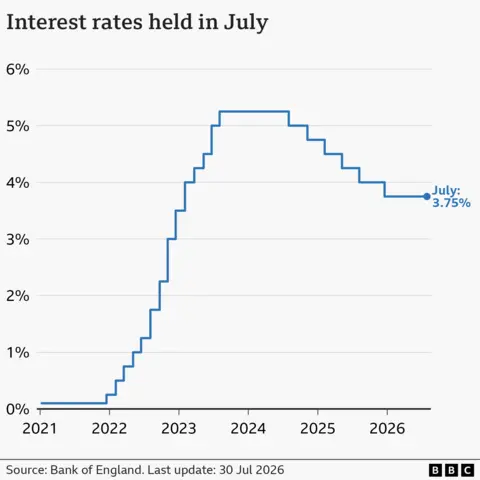
The Bank uses interest rates to control inflation, which charts the rising cost of living. It aims to keep inflation at a target rate of 2%.
However, official figures released on Wednesday showed the Consumer Prices Index (CPI) measure of inflation had risen to 3.1% in August from 2.9% in July, pushing it to its highest rate in six months.
The acceleration was driven by rises in the cost of petrol, diesel and airfares.
Economists expect that higher global energy costs will feed through to food and fuel prices paid by consumers, meaning the inflation rate is yet to peak.
The MPC will be aware that, citing the Middle East conflict and warning inflation was "set to remain well above" its 2% target for some time, the European Central Bank recently raised interest rates to 2.5%.
In addition, the US Federal Reserve raised its interest rate to 3.5%-3.75% for similar reasons on Wednesday.
However, MPC members will also be keen not to put pressure on employers and further lower the prospects for those seeking a job.
Households feel the impact of a rising Bank rate through higher borrowing costs, but can benefit from more generous savings rates.
Given the global picture, and market expectations of a higher Bank rate, a host of major lenders have already increased the cost of new fixed-rate mortgages in recent days.
Andrew Montlake, chief executive of mortgage broker Coreco, said that the latest data showed that "the inflation dragon has not been fully slain".
"If inflation proves sticky, lenders' funding costs stay under pressure, which makes cheaper mortgages harder to deliver," he said.
"We are already seeing lenders reprice upwards, so this will do little to calm things down. Borrowers should not panic, but anyone approaching the end of a fixed rate should start looking early, secure an option and keep reviewing it."
The average two-year fixed residential mortgage rate is at its highest since 11 May, at 5.77%, while the average five-year is at its highest since 8 November 2023, at 5.83%, according to financial information service Moneyfacts.
Savers may be offered more generous returns, but the spending power of their savings could be eroded by the rising cost of living.
"It's almost impossible to time things just right, so I would urge households to focus on what's best for them now, in the medium term and in the longer term," said Harriet Guevara, chief savings officer at Nottingham Building Society.
"For savers, regularly check that your savings are earning a competitive return and that you have the right balance between easy access and money you can afford to put away for longer."
