The woman with an 'up to 100% chance' of developing cancer

 BBC
Hannah Simpson has been told by doctors that she has an "up to 100% chance" of developing hereditary cancer.
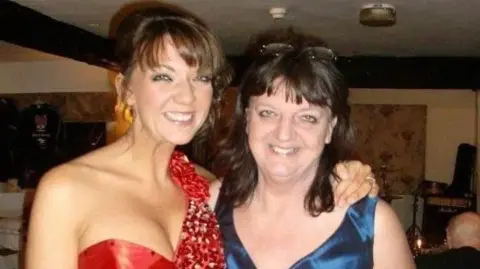
The 32-year-old lost her mum Jeanette Simpson to the disease in 2022, and her late granddad Terry Cook also had hereditary cancer.
She said: "It's hard enough losing somebody, but then to have lost that person to something that was caused by the same mutation that you carry, it kind of hits you again."
Trying to make light of her situation, Hannah now jokes each year with her consultant that it might be time to have "that chat" with a surgeon, and undergo life-altering surgery to save her life.
 Supplied
Her family carries a mutation in the APC gene, which causes familial adenomatous polyposis (FAP), a condition affecting about one in 8,000 to 10,000 people in the UK.
"In basic terms I am at an extremely high risk," Hannah said. "They say up to 100% chance if I don't have any surgery, of developing bowel cancer, and I'm also at a much higher risk of any other gastrointestinal cancers."
Hannah, from Rocester in Staffordshire, is one of scores of people touched by cancer who have lent their voices to BBC Radio Derby's It Starts With You Choir, whose song was debuted on BBC local radio stations across England on Sunday.
She said the story of breakfast presenter Becky Measures, who shared her own experiences of hereditary cancer for the It Starts With You campaign, led her to sign up for the choir.
 Supplied
In 2004, Becky became the youngest woman in the UK to have a preventative double mastectomy at the age of 24, after discovering she carried the BRCA1 gene mutation.
Having this mutation meant Becky had a significantly increased risk of developing breast cancer and ovarian cancer.
Her mum, Wendy Watson, also had the operation in 1992. Wendy is thought to have been the first person in the UK to have the procedure.
Hannah said: "I was reading Becky's story and I was going, 'this really resonates with me because I also carry a genetic mutation'."
Hannah knew her family had a history of bowel cancer. About 15 years ago, her granddad Terry was diagnosed, although at the time doctors did not think there was a genetic link.
 Supplied
"He asked the question to the surgeons and was swiftly told that no, it couldn't have been genetic, and it was left alone," said Hannah.
Then in 2020, during the coronavirus pandemic, a routine screening led to Hannah's mum Jeanette finding "hundreds of polyps" - abnormal tissue growths - in her bowel.
Further testing showed she had the gene which causes FAP, and a decision was made for her to have preventative surgery to remove her lower bowel and have a permanent stoma.
The diagnosis meant Hannah and her brother had a 50-50 chance of carrying the gene themselves.
In April 2021, Hannah was told the news that she was a carrier.
"It was a shock to the system," she said. "And what was really hard at the time as well is that nobody actually tells you. Nobody can actually tell you what it is and what's going on.
"When both my mum and myself were diagnosed, there were no leaflets that anybody could give you to tell you what it was. It was a case of, 'oh well if you Google it you'll find out more'.
"It was very, very lonely."
 Supplied
Terry died in February 2022 from causes unrelated to cancer.
Six months later, despite having undergone preventative bowel surgery, Jeanette attended a routine screening appointment where doctors discovered an ulcer.
Further tests revealed terminal, inoperable, stomach cancer. She died four weeks later.
Hannah said: "It's hard enough losing somebody, but then to have lost that person to something that was caused by the same mutation that you carry, it kind of hits you again. It's a proper kick in the stomach."
After losing her mum, Hannah said she went into "survival mode", and transferred her care to specialists at St Mark's Hospital in London.
Every year, medics monitor the growth of polyps - knowing at some point, a decision will have to be taken to undergo the same surgery that Jeanette had.
Hannah said: "They don't like to pull the trigger too soon on operation, because they know how life-changing it can be for people.
"We try and make light of the situation. Every time I go I'm like, 'are we all right for another year?'
"And the consultant will go, 'yeah we haven't got to have that conversation yet'."
She added: "Ultimately, I'm waiting for him to turn around to me after one of my appointments and say we've got to have a conversation with a surgeon now.
"People will say to me all the time, 'how do you continue to be positive, and how do you continue to live with something that is like a ticking time bomb?'
"I suppose if I let it take over, then it could consume your every waking thought."
The It Starts With You campaign, fronted by Becky, has prompted listeners like Hannah to share stories of how cancer has affected their families.
As a result, a community choir was started, and as well as finding support and community online, Hannah said she was grateful she decided to join.
She said: "The minute I walked into that practice, I was like, 'OK, I've done the right thing. And this is where I belong'.
"I felt I've got to do this, if not for me and for my family history, for the people that this will affect.
"Hopefully people will hear this and it might help one family, it might help one person, and it might make that one family not feel so alone."

Among the choir's repertoire is a song written by Grammy award-winning composer Eliot Kennedy, who has worked with Celine Dion and Gary Barlow.
After performing the song as part of their debut at the BBC Radio Derby Make A Difference Awards in September, the choir visited Kennedy's home studio to record the track.
And on Sunday, on Gaby Roslin's Make A Difference show, the track was given its first radio play across all local BBC stations in England.

Hannah said: "Being there on that day we recorded was amazing.
"I'm so excited for everybody to hear what we've worked so hard on, and it means so much to every single person in that room."
Executive producer at BBC Radio Derby, Rachael Gilchrist, said: "The choir started with a couple of people calling the show.
"One turned into three into five, until we'd got almost 40 people with incredible stories, so we decided to get them together.
"What better way to get people together than singing? It's joyful and positive, they've formed their own friendship group and will keep on telling the message to check family, friends and yourselves for signs of hereditary cancer."
Listen to BBC Radio Derby on Sounds and follow BBC Derby on Facebook, on X, or on Instagram. Send your story ideas to eastmidsnews@bbc.co.uk or via WhatsApp on 0808 100 2210.
