Oyster farmer quits after pressure from royal landowner

 BBC
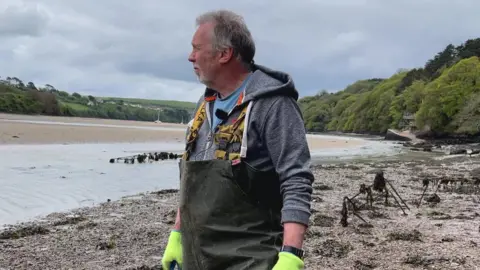
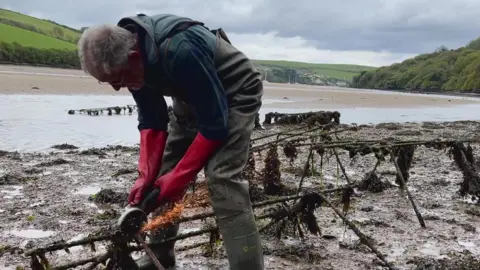
BBCOn a grey stretch of the River Avon in south Devon, Tim Edwards lifts another bag of oysters from the mud.
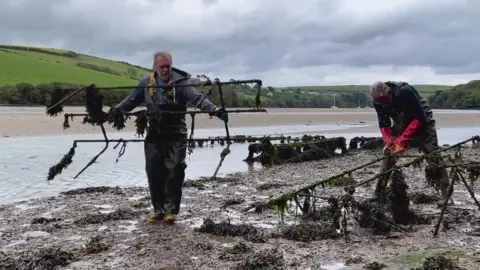
The water is low, the estuary quiet, and the trestles that once held thousands of shellfish now look tired and bare.
After decades of oyster farming here, the job is no longer about growing food. It is about packing up.
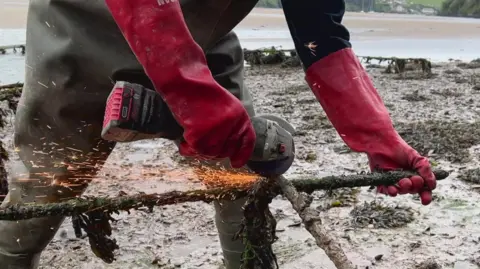
"We are clearing the site," says Edwards as he hauls trestles from the river to be cut up.
"There's been a farm here for 50-odd years. We've now been required to leave, which is a bit of a pill to swallow."
Edwards runs a small Pacific oyster farm on the muddy banks of the Avon as it nears the sea at Bantham. He has worked the site full-time for almost a decade.
Now the operation is being shut down after pressure from the Duchy of Cornwall, the estate that owns the riverbed.
It does not want Pacific oysters, classed as invasive, farmed on its land, saying, after talks with conservation groups, it would only support native oyster farming.
Pacific oysters, also known as rock oysters, are not native to the UK. That label has become central to the dispute.
The duchy, which Edwards says is not renewing his lease, argues they are an invasive species, but he says that does not match the reality he sees every day on the river.
"As far as I can see, the scientific consensus is that they're broadly beneficial," said Edwards, a former fish farmer in Scotland.
He says his stock is triploid, meaning functionally sterile, so it cannot breed in the wild. A habitat regulation assessment found no adverse environmental impact.
"It's beyond any reasonable scientific doubt that we're not having any adverse impact on the environment," he said.
The farm has experimented with native oysters and has helped a restoration project on the nearby Salcombe Estuary, but native oysters could never be farmed commercially on the Avon, said Edwards.
"They don't want to be farmed - it's as simple as that," he says. "They all die."
Other alternatives to oysters such as mussels had not worked either, he said.
What makes the closure of the farm harder to accept, Edwards added, is what is happening beyond the banks of the Avon. Pacific oysters are farmed across Europe on a far larger scale.
"France is doing 100,000 tonnes of oysters," he said. "The UK is producing 2,000 or 3,000 tonnes."
From his point of view, shutting down farms like his achieves little.
"Even if you got rid of all the Pacific oyster farms in this country, you're not going to stop what's happening now anymore," he says. "They're here to stay."
Edwards believes Pacific oysters have become an easy target.
"It's the whole invasive tag I think is what the problem is," he said. "If you look at what the definition of an invasive species is, I'm not sure it really qualifies."
Instead, he sees a missed chance for rural jobs and local food.
"We could be providing jobs in vulnerable rural areas," he says. "Not just for people farming oysters, but for support industries."
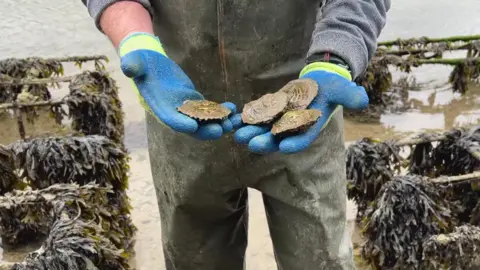
The farm has always been small by design. Edwards says that, even when things were running properly, they produced about 125,000 oysters a year.
"Which isn't a big farm at all, it's a very small farm," he says. "We've deliberately kept it small because it's not a big estuary."
For Edwards, the river has always been more than a workplace.
"People come on holiday here, we're getting paid to be here. To be honest, it's a privilege," he says. "We don't do it for the money."
The oysters are grown slowly, graded by hand and moved around the site as they grow. No feed and no chemicals are used.
"They literally just sit in the water, filter huge amounts of water every day," Edwards says.
The old metal trestles will be removed piece by piece over the coming months.
"Fifty years of this going on and it will be nothing here come September this year, for, as far as I can see, no good reason," he says.
The impact is not just financial.
"There is upset," Edwards says quietly. "Anger, there's a lot of anger."
He pauses, then adds: "It's a huge wrench."
What are Pacific oysters?
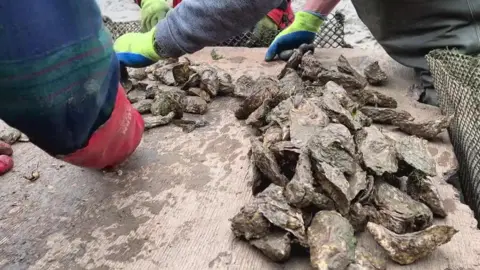
Pacific oysters were originally introduced into Britain as a response to declining, commercially viable, native oyster stocks, according to a report for the Centre for Environment, Fisheries and Aquaculture Science.
The first introduction of Pacific oysters occurred as early as 1890, when oysters from Arcachon, France, were introduced into Poole Harbour.
Pacific oysters' shells are more jagged than the flatter, native oyster and, when they accumulate, can create sharp reefs, such as near Feock in Cornwall.
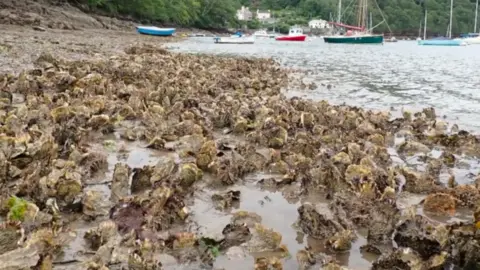
As the tide creeps back in, the estuary looks much as it always has.
What will be missing soon are the rows of oysters, the quiet routine of sorting and grading, and one small farm that, for decades, has fed people far beyond this bend of the Avon.
David Jarrad, chief executive Shellfish Association of Great Britain, said the policy on Pacific Oysters was "absolutely daft".
UK production remained small, said a report by the association, largely because the species was still classed as invasive in England and Wales, discouraging investment, despite the oysters being long established in British waters.
Native oyster fisheries were unlikely to return at scale because of disease, slow growth and historical decline, while Pacific oysters were already present and spreading due to warming seas.
The report concludes that the UK should follow the more pragmatic approach taken by European neighbours by accepting the species as naturalised, supporting responsible aquaculture, and managing local impacts proportionately.
Doing so could boost jobs, strengthen coastal economies and contribute to sustainable food and environmental goals, it says.
The Duchy of Cornwall, currently owned by His Royal Highness Prince William, covers more than 128,000 acres across England and Wales - not just Cornwall - and funds the charitable, private and official lives of the prince, his wife Princess Catherine and their children.
The portfolio of land, property and investments is valued at more than £1bn and provides him with a private income of nearly £23m a year.
A duchy spokesperson said: "The Duchy of Cornwall has a longstanding commitment to responsible land and marine management. By phasing out Pacific oysters in our estuaries, we are acting responsibly, in line with direct discussions with marine conservation societies, government policy, and our own environmental stewardship commitments.
"We have been in conversation with all of our licence-holders on this topic since 2023, and remain willing to work together to support native oyster farming and other forms of environmentally responsible aquaculture."
A spokesperson for the Department for Environment, Food and Rural Affairs (Defra) said Pacific oyster farming was not banned in England, but Pacific oysters were invasive and could displace native species and habitats.
They said: "Defra supports sustainable aquaculture. This includes the farming of Pacific oysters where they do not pose a threat to marine protected sites.
"We continue to work closely with industry to ensure we have the most productive and sustainable sector possible".
Follow BBC Devon on X, Facebook and Instagram. Send your story ideas to spotlight@bbc.co.uk.
