Youth rough sleeping in London falls by 45%

 Getty Images
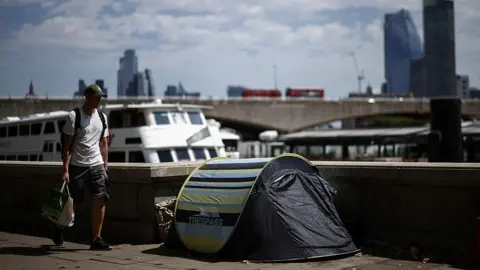
The number of young adults sleeping rough in London has fallen by nearly half, according to official figures published by City Hall.
Quarterly data from the Combined Homelessness and Information Network (Chain) shows that 202 people aged 18 to 25 were recorded sleeping rough in the capital between April and June 2026, making up 5.1% of all cases of rough sleeping.
The figures mark a 45% drop from the 366 young people recorded in the same period last year.
Overall, outreach teams recorded 3,959 individuals on London's streets in this period, representing a 10% annual decrease – which City Hall said proved the mayor's policies were "having an impact".
Sir Sadiq Khan has pledged to end rough sleeping by 2030, while Prime Minister Andy Burnham made the same promise nationally on his first day in office but did not offer a timeline.
Lisa Doyle, head of policy and public affairs at youth homelessness charity Centre Point, said the sharp fall among young people proves "that rough sleeping can be ended".
"London is providing the blueprint for what can be achieved when political leaders has the vision and intent to end street homelessness," she said.
"These figures are a real cause for celebration, but the job is not done. The mayor and the government [must] continue these efforts until rough sleeping is reduced to as close to zero as possible, and anyone forced onto the streets is helped off them quickly."
 Getty Images
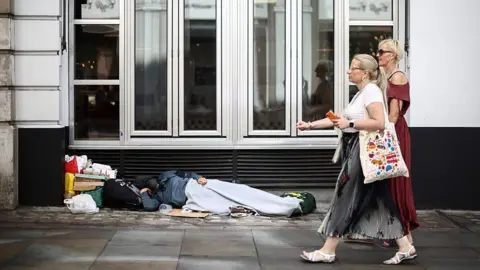
The No Second Night Out initiative was among the interventions highlighted in the Chain report as showing progress with 77% of new rough sleepers (1,300 people) successfully prevented from spending a second night on the streets.
Of the 1,685 individuals seen rough sleeping for the first time this three-month quarter, 3% went on to join the long-term street population.
In total, new rough sleepers accounted for 43% of the overall population seen during the quarter, while intermittent rough sleepers made up 42%, and 17% were sleeping rough long term.
The number of long-term rough sleepers rose by 6% compared to January to March, reaching 680 individuals, but that figure remains 14% lower than in the April to June period last year.
British citizens made up a growing share of London's street population, according to Chain's figures.
'More work to do'
Among those whose nationality was recorded, 54% were UK nationals in the April to June quarter, a rise from 50% in the previous three months, and 48% recorded in October to December 2025.
Nationals from European Union countries made up the next biggest group at 19% in the latest figures, with rough sleepers from Africa and Asia making up the rest at 12% and 10% respectively.
Female rough sleeping fell by nearly 7% to 704 individuals, maintaining a consistent 18% share of London's total recorded cases.
Assessments carried out by outreach workers highlight severe health and institutional vulnerabilities among the population, including addiction, mental health and an experience in care.
A spokesperson for Sir Sadiq said: "It is encouraging to see a further fall in rough sleeping in London. This shows that the mayor's Rough Sleeping Plan of Action, launched last year, is having an impact but we know there is more work to do."
They added he is "focused on doing everything he can to get London on a pathway to ending rough sleeping for good by 2030" including a spend £8m in tackling the issue in City Hall's budget.
Listen to the best of BBC Radio London on Sounds and follow BBC London on Facebook, X and Instagram. Send your story ideas to hello.bbclondon@bbc.co.uk
