The detained anti-colonial activist grabbing attention in West Africa: Who is Kemi Seba?

 AFP via Getty Images
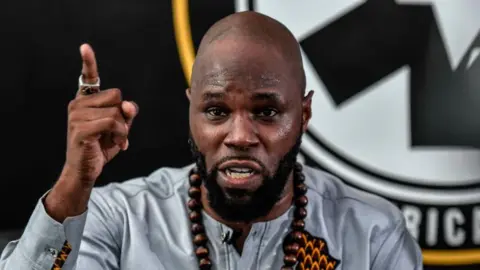
The controversial anti-colonial pan-African activist Kemi Seba is currently in detention in South Africa, days after his arrest while allegedly attempting to flee to Europe via Zimbabwe.
The 45-year-old is currently wanted in Benin for "inciting rebellion" after allegedly supporting the country's foiled coup in December 2025.
Known for his staunch opposition to French influence in Africa, backing of West African military leaders and pro-Russian propaganda, Seba has had multiple skirmishes with the law in several different countries.
Born in the French city of Strasbourg to Beninese parents in 1981, Seba - whose real name is Stellio Gilles Robert Capo Chichi - has made a name for himself as a radical activist, having been arrested many times, including for inciting racial hatred and antisemitism.
In his youth, he travelled to the US, where he was influenced by the black nationalist movement, Nation of Islam (NOI), as he listened to sermons from the organisation where Malcolm X was once a prominent figure.
On his return to France as an 18-year-old, he became an ambassador for NOI.
 Gamma-Rapho via Getty Images
Shortly afterwards, a trip to Egypt made him a follower of kemetism, a belief system based on ancient Egyptian theology.
Inspired by his travels, in 2004 he founded Tribu Ka, a radical black segregationist movement through which he platformed antisemitic sentiments. Two years later, it was banned by the French government and dissolved, and he was sentenced to one month in prison.
On 28 May, 2007, Seba and some of his followers marched through a predominantly Jewish area of Paris to "defend the interests of Black people", French daily newspaper Le Figaro reported at the time.
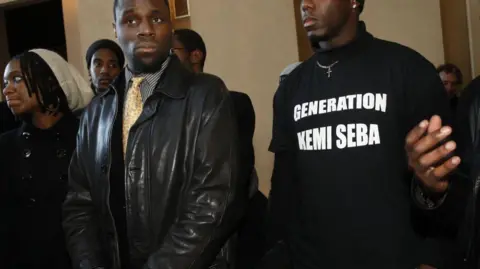
The following year, French courts sentenced him again, this time to six months in prison - four of which were suspended - for relaunching his Tribu Ka movement under a new name, Generation Kemi Seba, the paper added.
Faced with mounting pressure both from civil society activists and law enforcement, he left France for Senegal after his release.
According to French media, he also joined a new group, Movement of the Damned by Imperialism (MDI), and was president when he resigned in 2010. The group described itself as anti-imperialist and focused heavily on online activism.
Paul Melly, a researcher for the Chatham House Africa Programme, said Seba has attracted a lot of attention in recent years with his "very critical" remarks on France and its role in Africa.
"His agenda is very much now focused on this anti-French, what he would call 'anti-colonial pitch', and the resentment of the continued French influence in West Africa," Melly told the BBC, in contrast to his early career 20 years ago, when there were a lot of accusations of antisemitism.
In December 2015, Seba launched the NGO Pan-Africanist Emergency, which he still leads.
The group describes itself as a "black rights organisation with a geopolitical and humanitarian focus, specialising in issues related to sovereignty, neocolonialism, and the promotion of social justice".
As someone who opposes French influence in Africa, he is also critical of African nations which retain close ties with the former colonial power, such as those that continue using the CFA franc as legal tender.
One of Pan-Africanist Emergency's goals is to end the use of the currency.
France created the CFA franc in the late 1940s to serve as a currency in its then African empire and is one of the most prominent signs of continued French influence over its former colonies.
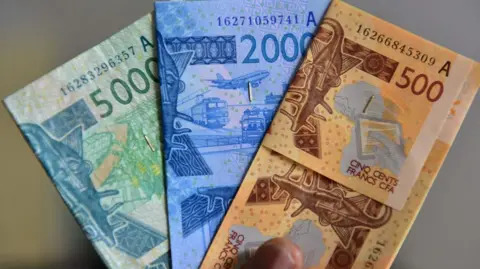
Fourteen African nations including Senegal, Benin and Ivory Coaststill use the currency, which is pegged to the euro with financial backing from the French treasury.
Seba is among many activists calling for the CFA to be abandoned, saying it is a way for France to retain economic control.
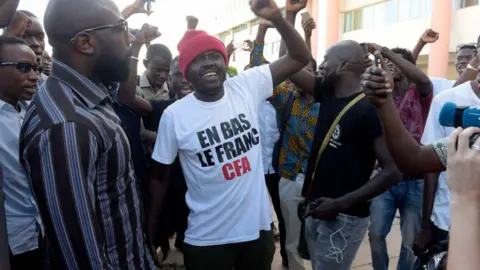
In August 2017, he burned a 5,000 CFA franc note (£6.60; $8.90) during a protest in Senegal, to denounce "Francafrique," a term used to describe France's post-colonial influence in Africa.
He was arrested but acquitted days later on a technicality, according to reports.
 AFP via Getty Images
In an interview with the Ivory Coast-based news website Yeclo in 2019, he named seven reasons for "his fight" against the CFA, including the Bank of France having the "right of veto in your banks".
"With regard to economic orientations," he explained, "the adage clearly states that whoever controls you economically will control you politically."
Criticism of the CFA franc on economic grounds is growing, particularly among "younger urban West Africans", according to Melly. "Kemi Seba is pretty popular, especially in the social media age with lots of young followers in West Africa."
A month after the incident, the self-styled "Afrocentrist" was deported from Senegal to France for posing a "serious threat to public order", French newspaper Le Monde reported, citing the Ministry of the Interior and Public Security in Dakar.
 AFP via Getty Images
He has also faced trouble with the authorities in other Francophone nations.
"He's perceived by West African governments - that have good, close relations with France - as a hostile figure," Melly explained.
In August 2018, Seba was expelled from Togo, months after being kicked out of Guinea, where he was to address a conference.
The following year, he was deported from Ivory Coast to Benin for attempting to hold a rally against French colonialism which the authorities said posed a risk of unrest, and his criticism of the president's defence of the CFA franc.
He is also a staunch critic of outgoing Beninese President Patrice Talon. Upon his arrival in Benin he was briefly arrested. A separate visit to the country in 2023 also saw him arrested and released.
In July 2024, France stripped Seba of his citizenship, to which he responded by burning his passport in public, saying he had been "freed from the burden of French nationality".
A month later, Niger granted him a diplomatic passport, and made him a "special adviser" to junta leader Brig Gen Abdourahmane Tchiani.
Seba has become "very, very prominent in West Africa since the wave of military coups" struck the region, Melly told the BBC.
Niger, and neighbouring Mali and Burkina Faso, have all been taken over by military regimes that are "very hostile" to France, halting their military co-operation with the French in the fight against Islamist militants, and starting to work with Russia instead.
"The Russians have taken advantage of the fact that France is unpopular" in these countries, Melly explained.
In 2023, Thomas Gassilloud, who was the chairman of the French National Assembly's defence committee at the time, accused Seba of acting as a mouthpiece for "Russian propaganda" and serving "a foreign power that fuels anti-French sentiment".
A year later, the activist was detained by French authorities on suspicion of "links" to the Russian paramilitary group Wagner, but later released. At the time, Russia was two years into its war in Ukraine.
 Anadolu Agency via Getty Images
After so many brushes with the law, he is once again in court, this time in South Africa.
Citing his lawyers, AFP news agency said the arrest was made for breaching immigration laws. He and his 18-year-old son, Khonsou Seba Capo Chichi were arrested during a sting operation in Pretoria last week.
A source close to him told AFP he had been living in the country for around five months, overstaying his visa by around two months.
Following the arrest, South African police said: "[Seba] is allegedly a wanted fugitive in France and Benin for criminal activities relating to crimes against the state."
South African authorities said an extradition process was under way but did not specify which country had filed the request.
Benin's special prosecutor Elonmario Metonou said the country was "currently preparing" an extradition request for him.
Benin issued two international warrants for the anti-colonial influencer on 12 December, 2025, after he allegedly supported a coup attempt against the outgoing president. Hours after the attempt, Seba declared it a "day of liberation" for the country in an online video. He is also wanted in the country for "money laundering".
He has not commented on the allegations against him.
However, Hery Djehuty, Pan-Africanist Emergency's international coordinator and second-in-command, told Anadolu news agency that Benin's accusations would not "stand up to scrutiny".
The second-in-command also called the money laundering charges - which he first heard of during the prosecutor's briefing - a set-up aimed at strengthening the request.
Djehuty also denied reports that Seba had applied for asylum in South Africa.
 AFP via Getty Images
Meanwhile, Pan-Africanist Emergency urged its followers to "remain calm" in the face of what it called "numerous fake news stories and other disinformation campaigns spread by the French-African media outlets".
"Far from weakening him, these manoeuvres only strengthen the legitimacy and scope of his commitment to social justice, sovereignty, and African dignity," the group said in a statement.
"History teaches an immutable truth: you cannot silence a people by breaking its bravest voices. There is an eternal Benin, just as there remains an African DNA of insubordination," it added.
South African national Francois van der Merwe - who is the leader of Afrikaner nationalist group Bittereinders - was also taken into custody for helping them.
Seba's bail hearing has been set for 29 April.
 Getty Images/BBC
Go to BBCAfrica.com for more news from the African continent.
Follow us on Twitter @BBCAfrica, on Facebook at BBC Africa or on Instagram at bbcafrica
