How much do Nato members spend on defence?

 EPA-EFE/REX/Shutterstock
President Trump has repeatedly criticised his Nato allies for not spending enough on defence.
Nato is a military alliance of 32 countries including the US, Canada and European nations.
It has significant deployments along its eastern flank, designed to deter Russia following the invasion of Ukraine.
There are signs that Trump's criticisms have had some effect, with significant increases in spending from some members.
Which countries spend most on defence?
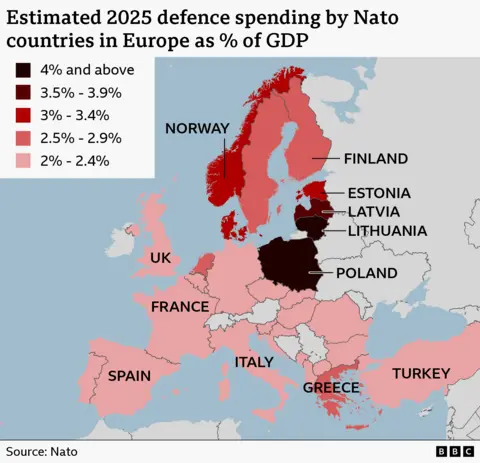
The previous target for Nato members was to spend 2% of the size of their economy (measured by GDP) on defence by 2024.
According to Nato estimates for 2025, every country in the alliance achieved at least 2% last year.
Even Spain, which has been criticised repeatedly by Trump for not spending enough on defence, managed 2%.
Nato members are now committed to spending 3.5% on defence by 2035, with another 1.5% going on things like protecting critical infrastructure and ensuring civil preparedness.
Only three countries: Poland, Lithuania and Latvia, spent more than 3.5% on defence in 2025, although Estonia was close.
In cash terms however, the US is still by far the single biggest spender on defence, spending about $980bn (£720bn) last year, which was 60% of the Nato total.
The US is a global superpower, with military commitments around the world, not just to Nato. It had GDP greater than all the rest of the members of Nato put together in 2025.
US defence spending has come down from 3.6% of GDP in 2020 to an estimated 3.2% in 2025.
Defence spending by the rest of Nato - Canada and the European members - has gone up from 1.7% of combined GDP in 2020 to an estimated 2.3% in 2025.
The UK spent 2.3% of GDP on defence in 2025, making it the 14th biggest spender on that measure.
The government has said it will increase it to 2.5% in 2027 with an "ambition" to raise that to 3% in the next Parliament, which is expected to start in 2029. It is also committed to the Nato target of 3.5% on defence by 2035.
What about the cost of running Nato?
Nato's annual budget and programmes are expected to cost up to €5.3bn (£4.6bn) in 2026 and there's an agreed cost-sharing formula to pay for the running of things such as:
- civilian staff and administrative costs of Nato headquarters
- joint operations, strategic commands, radar and early warning systems, training and liaison
- defence communications systems, airfields, harbours and fuel supplies
The four biggest contributors to this are the US and Germany at 15% and the UK and France at 10%.
The US used to pay more than 22% of these running costs.
But a new payment formula was agreed in 2019 to address complaints by the first Trump administration about the burden to the US of supporting the alliance.
Nato leaders agreed in 2022 to increases in the use of common funding, with the total due to go up each year until 2030.
Update 22 May: This piece has been updated to reflect the latest defence spending figures.

