Simpler, older version of Stonehenge found three miles from famous site

 English Heritage
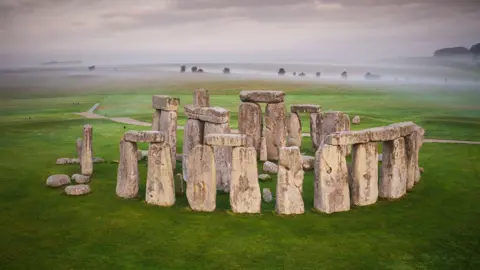
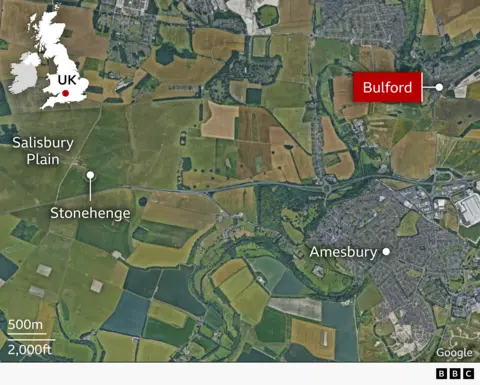
Archaeologists believe they have discovered an earlier, much simpler version of Stonehenge about 3 miles (5km) away from the prehistoric monument.
All that remains of the older structure is two holes in the ground, but the team says they held wooden posts that lined up with the Sun on the summer and winter solstices - the longest and shortest days of the year - in the same way as Stonehenge.
The site has been dated to about 5,000 years old, which predates Stonehenge by 500 years.
Artefacts were also found at the site, including pottery, flint tools and animal bone, suggesting prehistoric people held gatherings there.
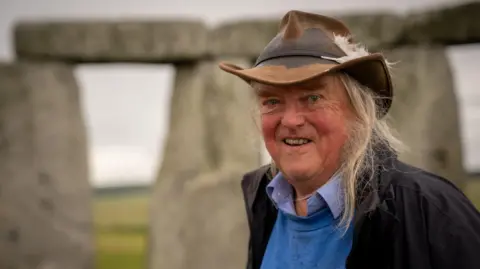
Phil Harding, from Wessex Archaeology, who led the excavation, said it was one of the best finds of his long career.
"Two post pits tell me more about the people 5,000 years ago," he said.
"This tells me about the whole community, this tells me about how they were thinking, how they were behaving, how they were revering the heavens."
 Tony Jolliffe/BBC News
The huge stones at Stonehenge are precisely placed to line up with the Sun.
If you stand in middle of the circle at sunrise on the summer solstice, you will see the Sun come up over a stone called the heel stone to the north east of the circle.
On midwinter, if standing in the centre of the circle, you would see the sun set over an altar stone to the south west of the site.
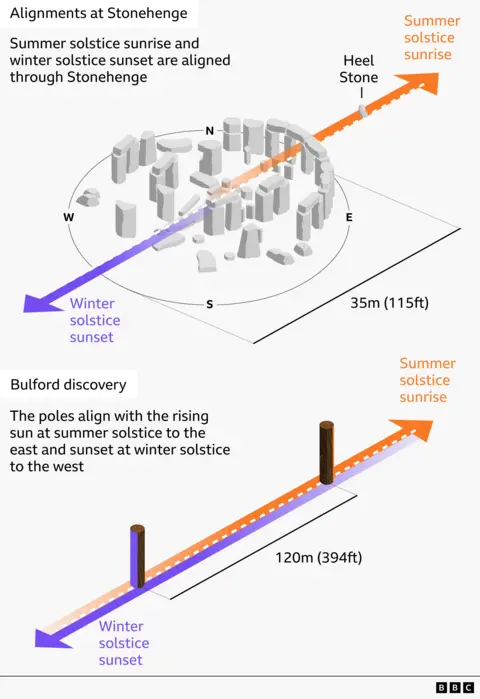
The structure, discovered in the village of Bulford, was a much more simple construction made up of just two wooden posts, which have long since rotted away.
They were positioned 120m (394ft) apart and estimated to be between 2m and 4m high.
When Harding uncovered the intriguing holes, he noticed that they seemed to line up with the Sun, just like Stonehenge located a few miles away.
"I got my pencil and ruler, and I joined them up, and I was aware that they were kind of pointing in the general direction of the sunrise on midsummer," he said.
 Tony Jolliffe/BBC News
 Tony Jolliffe/BBC News
The traces of the earlier structure were found a decade ago in Bulford when the ground was cleared for new army housing.
But it is only now that a detailed analysis of the alignment has been carried out, which involved turning back the celestial clock.
"The sky - the positions of the Sun, Moon, planets and stars - they change very slowly throughout the centuries. We don't really notice it during our lifetimes," said Dr Fabio Silva, an archaeoastronomer from Bournemouth University and the Skyscape Academy.
"So we basically need to reconstruct the sky, what it looked like exactly 5,000 years ago, where the Sun was rising and what time it was rising in those places.
"If you take into account the width of the posts… then the alignment is exactly, exactly right. It's accurately aligned to summer solstice sunrise and winter solstice sunset."
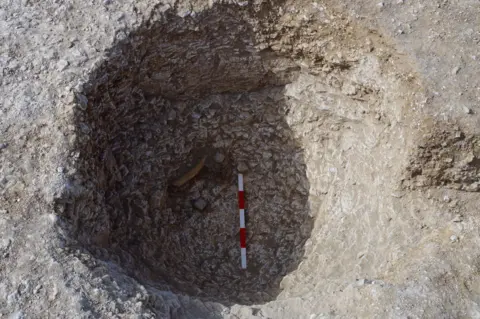
The pits that held these posts were not the only discovery during the excavation, surrounding them were dozens of other holes containing artefacts belonging to the prehistoric people of Bulford village.
These objects have helped to establish the age of the site. The team used radiocarbon dating, which looks at how a special form of carbon changes over time, to work out that the structure was 5,000 years old.
The artefacts included an antler that would have been used for digging, and other carved animal bones, as well as finely decorated fragments of pottery.
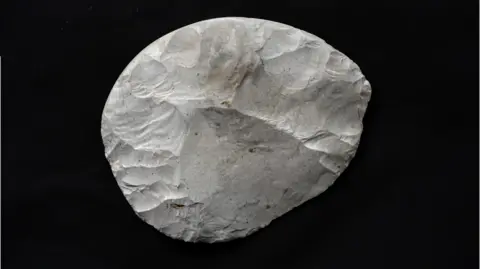
Tools made of flint were also uncovered, including a rare Neolithic knife that has been rounded into a disc-shape (discoidal).
"It was, I think, our star find," said Harding of Wessex Archaeology.
"What is so special about it is the workmanship that's gone into it. That is the work of real craftsmanship."
He said the knife was found in an upright position, like it had been carefully placed, and he wonders if it had a symbolic significance.
"Maybe that discoidal shape is some sort of reference to the Sun, who knows?," he said.
 Wessex Archaeology
The monument at Bulford dates to the same time as the earliest phase of activity at Stonehenge, when the first earthworks were built half a Millennium before the stones were placed.
"The discovery of Bulford actually suggests that maybe the people who built the first stages of Stonehenge were based or living there, or at least gathering seasonally to do the construction work at Stonehenge," said Dr Jennifer Wexler, curator of history at English Heritage.
But why were these prehistoric people so fascinated with the Sun?
"The people who built Stonehenge and the people who were at Bulford were early farmers, and their livelihoods really were connected to the seasons and the Sun doing its job," explained Wexler.
Today, the summer solstice at Stonehenge is the biggest draw, when thousands of people come to witness sunrise at the monument.
But Wexler says 5,000 years ago, the winter solstice - the shortest day of the year -held more significance for the ancient communities.
"Winter might have been particularly important because it's a time of year when the light is literally dying, and maybe you need to do something to evoke that return or mark it, because then it's a return of the spring, when hopefully your crops and your animals will thrive."
