Armed groups launch coordinated attacks across Mali
Explosions and sustained gunfire were reported in Mali's capital, Bamako, as armed groups launched co-ordinated attacks across the country into Sunday.
Mali's military said on Saturday evening that efforts to repel the attacks were under way, and some militants had already fled.
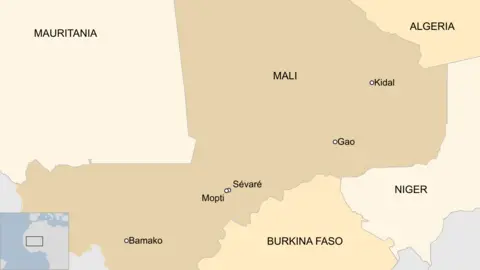
Fighting has also been reported around Kati, home to a major military base outside the capital, as well as in Gao, and the central cities of Sevare and Mopti. On Sunday, gunfire resumed in Kidal in the north, according to reports.
Mali has for years been plagued by insurgencies by groups affiliated with al-Qaeda and the Islamic State group, as well as a separatist movement in the country's north.
Reports suggest the assault by the separatist Azawad Liberation Front (FLA) - which seeks a breakaway ethnic Tuareg state - was primarily focused on northern cities, while the jihadist group Jama'at Nusrat al-Islam wal-Muslimin (JNIM) had staged simultaneous attacks on multiple locations across the country.
One analyst described it as the largest jihadist attack in years.
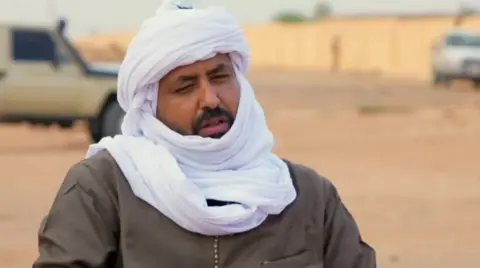
"We had been working on this operation for a long time, in a well-planned manner, and in fact, in alliance with [JNIM]," Mohamed Elmaouloud Ramadane, spokesman for the FLA, told the BBC.
"It is difficult to find any solution without their participation, and there was co-ordination."
Meanwhile, JNIM confirmed in a statement that the attacks had been part of a joint operation with the FLA.

Mali's military said it was fighting what it described as "terrorist groups", which had been "routed" with "several hundred" killed.
The BBC has not been able to independently verify this claim, and there are indications that fighting continues in areas.
"We are in Kidal and it has not fallen completely," Ramadane said. "There are still elements of the Malian army and Russian mercenaries there. All of Gao's gates have fallen, but the camps of the army have not."
He earlier wrote on social media that the FLA's forces had taken control of Kidal and were expanding their presence in the centre of Gao.
Ramadane posted unverified footage purporting to show militants taking over a camp occupied by the Malian army and Russian mercenaries in Kidal, as well as a military helicopter supposedly shot down near Gao.
An FLA field commander involved in the assault on Kidal told the BBC the group had been preparing for the offensive "for months", and was attempting to block the road between the city and Tessalit to prevent army reinforcements arriving.
"Our main goal now is to control Gao and then Timbuktu will be easy to fall," he said.
On Sunday, fighting resumed in the city to "drive out the last Russian fighters", AFP news agency reported, citing Ramadane.
A local official confirmed to AFP that the fighting "between the Malian army, the Russians and the rebels" had continued, with residents hearing gunfire.
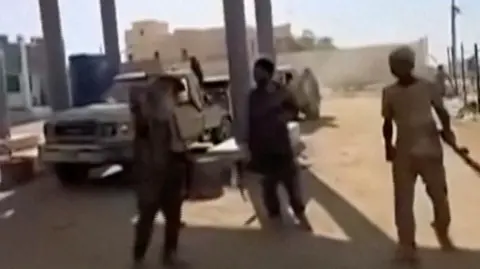
In Bamako, checkpoints have been established on roads leading to the airport and vehicles are being searched, according to reports. A curfew has been imposed from 21:00 to 06:00 local time for the next three nights.
The UK Foreign Office has advised against all travel to Mali following the attacks, adding Bamako International Airport had been temporarily closed.
Ulf Laessing, head of the Sahel programme at the Konrad Adenauer Foundation in Mali, told the BBC the incident appeared to be the "largest co-ordinated jihadist attack on Mali for years".
Mahmoud Ali Youssouf, chair of the African Union Commission, said he was following the situation with "deep concern," adding in a statement on X that he "strongly condemns these acts which risk exposing civilian populations to significant harm".
 Reuters
UN chief Antonio Guterres also condemned the "acts of violence" as he expressed his "solidarity with the Malian people".
According to his spokesman, he called for "coordinated international support to address the evolving threat of violent extremism and terrorism in the Sahel and to meet urgent humanitarian needs".
Similarly, the US State Department's Africa bureau strongly condemned the attacks, adding: "We extend our deepest condolences to the victims, their families, and all those affected, and we stand with the Malian people and government in the face of this violence."
The FLA has for years been fighting for the creation of its own Tuareg homeland in northern Mali, a large swathe of which it has effective control over.
Mali is currently ruled by a military junta led by Gen Assimi Goïta, who first seized power in a coup in 2020, promising to restore security and push back armed groups.
The junta had popular support when it took power, promising to deal with the long-running security crisis prompted by the Tuareg rebellion in the north, which was then hijacked by Islamist militants.
UN peacekeepers and French forces deployed to deal with the escalating insurgency left after the junta took over, and the military government hired Russian mercenaries to help tackle the insecurity.
However, the jihadist insurgency has continued and large parts of the north and east of the country remain outside government control.
