Foil balloon blamed for fire that destroyed homes

 Lee Watson
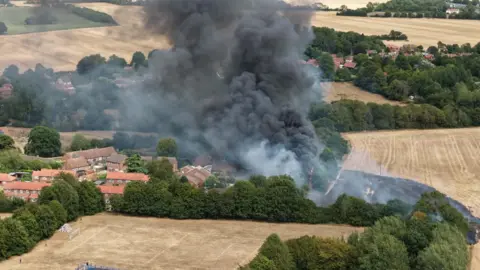
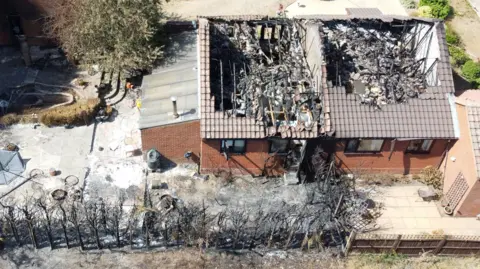
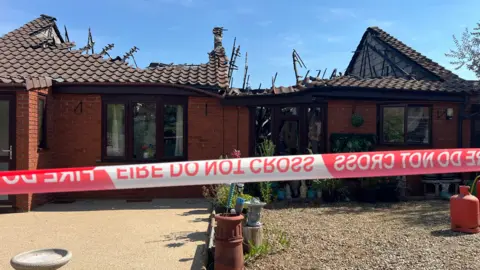
A forensic investigator has blamed a foil balloon coming into contact with power lines for causing a field fire that destroyed neighbouring homes.
UK Power Networks (UKPN) said an independent investigation concluded that a foil helium balloon becoming caught on overhead lines was the likely cause of the blaze in Kenninghall, Norfolk, last month.
In an email to affected residents, seen by the BBC, the forensic investigator said they found debris on equipment attached to a pole in the field next to the properties in Wood Close.
Siobhan Fulcher, whose home of 12 years burnt down, said she was "shocked and disappointed" and wanted more answers.
 John Fairhall/BBC
"If this can happen, perhaps [these] balloons should be banned," she said. "How many more people are going to lose their homes because of this?"
The healthcare worker and her 33-year-old son Aaron Fulcher are currently living in temporary accommodation following the fire on 9 August.
Norfolk Fire and Rescue Service had previously said the blaze was accidental and had been caused by a fault on a power transformer in a field, which caused sparks to land on dry ground before spreading.
More stories from Norfolk
 John Fairhall/BBC
UKPN is responsible for maintaining the electricity networks across London, the South East and East of England.
A spokesperson for the company called the incident "rare" and said its thoughts were with the families affected.
"UK Power Networks was called to the site following a request from the fire service and the network was de-energised as a safety precaution due to the fire," they said.
"No faults or issues have been found with our equipment.
"An independent forensic investigator identified that the most likely cause of the incident was that a third-party foil-coated helium balloon came into contact with the overhead line, causing an electrical arc which ignited the balloon and fell to the field below in dry, windy conditions."
According to the National Fire Protection Association, an electrical arc forms when electric current is sustained outside of its normal conductive pathway, such as through air.
 UK Power Network
Foil balloons caught in electricity lines have caused fires elsewhere in the country.
In July, a field fire in Tithby, Nottinghamshire, was started by a children's balloon coming into contact with a pylon.
It prompted a warning from Nottinghamshire Fire and Rescue Service that helium balloons should never intentionally be released as they can "cause power outages and harm local wildlife and livestock".
It said they should be deflated before being disposed of.
 John Fairhall/BBC
Do you have a story suggestion for Norfolk? Contact us below.
Follow Norfolk news on BBC Sounds, Facebook, Instagram and X.
