Cannabis homes: the future of construction?

 BBC
BBCThousands of homes are being built using plant-based materials that experts say would help reduce carbon emissions in the construction industry.
Hemp was once a staple crop until it was made illegal in the 1920s because of its psychoactive cousin - cannabis.
The woody core of the hemp's stem can be processed into a solid, fireproof and breathable building material.
Ian Wilkinson, the co-founder of FarmED, a West Oxfordshire-based not-for-profit farming education and research centre, said it was a "win-win crop" which farmers could grow to meet the demand for building materials.
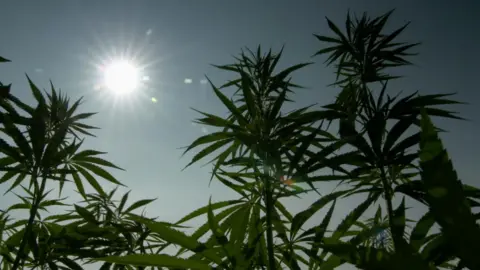
Hemp is a variety of the cannabis plant which contains virtually no tetrahydrocannabinol (THC) the psychoactive compound which produces the cannabis high.
It was a staple crop in Britain for hundreds of years, used to make a wide range of products including sails, rope, clothes, oil and food. Henry VIII fined farmers who did not grow it.
Industrial hemp is more widely used for construction in Europe than it is currently in the UK.
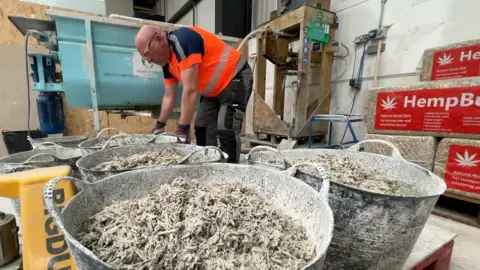
The woody core of the plant's stem is processed into loose chippings called hemp shiv.
This is mixed with lime and water which, when dried, becomes solid, fireproof and breathable hempcrete.
The fibre from the outer part of the stalk can separated and used for insulation.
FarmED is one of 22 partners across the UK working with the Centre for High Carbon Capture Cropping.
That is a £6m, four-year research project sponsored by government agency Innovate UK looking at how crops like hemp can improve the soil, help farmers diversify and tackle climate change.
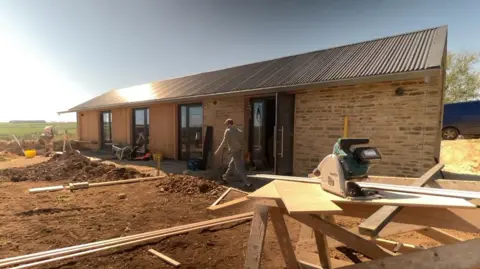
To demonstrate the crop's potential, a barn is being built with hempcrete and hemp blocks in the walls, hempboard for internal walls and hemp fibre for insulation.
Wilkinson said: "This is a win-win crop. We just have to develop markets... so there will be a demand for it, so farmers can grow it."
"It doesn't need much in the way of inputs, it suppresses weeds so it doesn't need much herbicide and it hardly needs any fertiliser."
Architect Tim Tasker said using hemp products in house building locks away carbon compared with traditional, carbon-intensive building products.
"It takes two to three acres of hemp to build a four to five bedroom family house.
"That is grown within a season - within three months. If you were to plant spruce trees on that same acreage... it would take 25 years," he added.
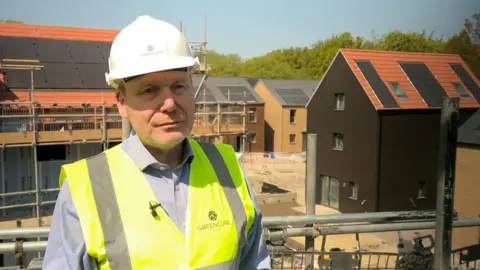
Greencore Homes plans to build 10,000 new homes using hempcrete in the next 10 years.
The Canopies housing development at Milton Heights near Didcot is one of the first to be built using the material.
Co-founder Ian Pritchett said: "We've got the first 3,000 of those in our pipeline already, so that's billions of pounds' worth of development value."
He believes it will be a matter of time before building with hemp becomes much more widespread, but that the government should be doing more to speed-up the transformation.
A licence is currently needed for it to be grown as an industrial crop or a medicinal crop.
"At the moment hemp is classed under the same legislation as narcotics, despite the fact that it doesn't have any drug content," he said.
"It's crazy. It's like putting a chihuahua and a rottweiler in the same category just because they're dogs."
A Home Office spokesperson said, despite the easing of some of the rules around famers growing industrial hemp, it had "no plans to remove the requirement for a licence to grow low-THC cannabis".
You can follow BBC Oxfordshire on Facebook, X, or Instagram.
