Trump administration to shutter historic Border Road between US and Canada

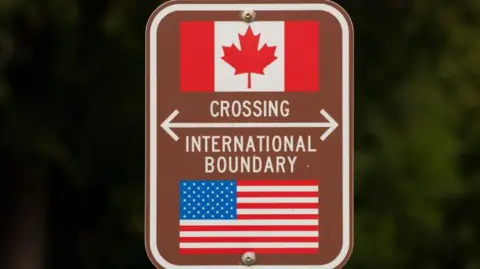 Getty Images
The US government will close a nearly nine-mile (14km) stretch of road from 1 July along its border that runs between Montana and Alberta, citing security concerns.
The closure of the stretch, commonly referred to as Border Road, will end more than eight decades of informal crossings between farming communities on each side of the border.
The Trump administration cites a rise in irregular migration and drug smuggling for the decision.
Although the road lies on the Montana side of the US-Canada border, it is maintained by Alberta's Warner County which has already set aside funds to build a replacement.
Calling the move "unfortunate", Warner County's Chief Administrative Officer Shawn Hathaway told the BBC that Canadian officials were first informed last summer of the US plan to close the road.
The road, accessed freely by both Canadians and Americans since the 1940s, lies within the US.
"Two Canadians actually have to access their houses from it," Hathaway said.
Between 800 and 1,200 trucks traverse the Coutts-Sweet Grass crossing every day, and C$15.9bn ($11.4bn; £8.64bn) worth of "two-way trade" crosses the route each year, according to Canadian Manufacturers & Exporters.
The Alberta government is now spending C$8m ($5.74m; £4.34m) to build a road alongside it for Canadians.
Construction is expected to begin in April, Alberta Transportation Minister Devin Dreeshen told the Canadian Press. It is expected to be completed by summer.
"Regardless of the line on the map, you'll have farmers on both sides of the border, you'll have family friends on both sides of the border," he said. "I think obviously that will continue."
DHS has not immediately responded to the BBC's request for comment.
For locals, it is the end of an era.
Ross Ford, who lives on a farm on the Canadian side of the border, described the move to The Canadian Press as "unfortunate" and said the bond between neighbours has always been close.
"Of course, they live in Montana and that won't change – but we have this new barrier," he told the outlet.
Roger Horgus, who lives on the Montana side of the border, recalled for The Canadian Press a time in his youth when kids would run across the border to ride bikes and play.
"[The road closure is] ridiculous. I hate to see it because the Canadians have taken such good care of us and the road, with grading and all of that," he told the outlet.
"The roads will basically parallel each other for the full length of the road. So we'll have our road, and they'll have their road."
