Inside the 'weird' world of a stink pipe superfan

 Jodie Halford/BBC
On a busy shopping street in a bustling part of south Essex, a woman stands staring across the road.
It's not a person that has caught her eye, nor an unusual sign, nor a cute dog.
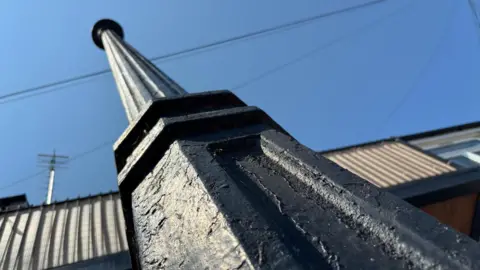
The tall, thin, discreetly decorated black post is what's drawing her closer.
Jenni Kelly has found what she's been looking for – it's a stink pipe.
"I feel a bit like I'm in the Famous Five or something," she says.
"When I post one on the Facebook group and I get a message about it saying, 'Good work. Jenni,' and I think, 'Yeah!'
"I get really excited when I do find one because they're so rare."
 Jodie Halford/BBC
Stink pipes, or stench pipes, served a very important purpose when they were first built in Victorian times.
It's all connected to the large-scale construction of underground sewers, an idea borne out of the Great Stink, an exceptionally smelly summer in the mid-19th Century.
Temperatures in the summer of 1858 hit 30C (86F) and stayed high for weeks, meaning all the waste in the River Thames heated up and filled London with a putrid stench.
Engineer Joseph Bazalgette was hired to address the problem, building a network of underground sewers to connect with drains and send waste downstream.
It's thought Sir Goldsworthy Gurney then went on to introduce sewer ventilation pipes, which allowed gases to vent out and dissipate high above street level where they wouldn't be smelled or inhaled.
Nowadays, thanks to improvements in how we handle sewage, the pipes are mostly no longer in use, but remain dotted around our streets, particularly in older towns and cities.
 Kevin Fuller c/o Stephen Nunn
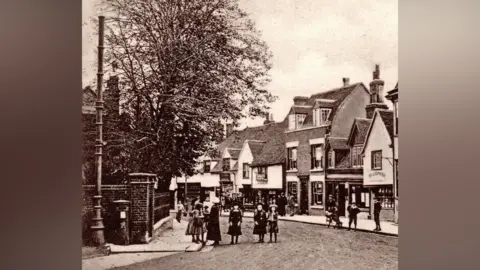
Jenni's stink pipe fascination began as a girl, when her grandmother told her all about them and she began spotting them around Romford in east London where she grew up.
"My friend and I, we used to take it upon ourselves to hunt them out and see the ones that looked really pretty, because some had coronets at the top and looked really nice," she says.
Many years later, Jenni, 75, found a Facebook group for stink pipe fans, where members were documenting potential discoveries and sharing pictures of pipes, ranging from well-preserved and ornate examples through to ones that have been cut in half and forgotten in the weeds.
She's subsequently found stink pipes near her home in Benfleet, as well as in Leigh-on-Sea, Chelmsford and Maldon, delighted to find them hiding in plain sight on journeys she's made dozens of times before.
"When you start looking for them, that's when you see them," she says.
"People who see you looking, they either sort of hurry past and think you're a bit weird, which I am really, or they ask you what it's all about.
"A lot of them just hadn't a clue that such things existed, and they're genuinely interested when they hear what it is."
On Reddit and other forums, those in the know share locations of stink pipes they've spotted, which include dozens in historic cities and towns including London, Cambridge, Norwich and Weston-super-Mare.
The BBC has tried to find out how many still exist, but because there are no longer records of each location, we were not able to establish exact numbers.
However, Anglian Water told us it still operates a number of what it calls "vent columns" across the east of England, with more than 140 sites across Essex and Suffolk that are maintained through site visits.
Stink pipe or lamppost?
Wondering if some street furniture near you might be more than just a run-of-the-mill street light? Here's how you can spot a stink pipe:
- Generally has a broader base than a lamppost
- Always open-ended at the top, or crowned with an ornate coronet or other decoration
- Often relatively elaborate designs
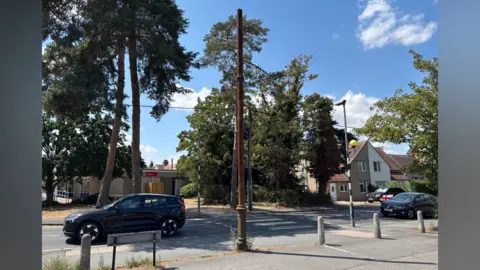
- Sometimes cut off and sealed to look like a bollard
 Jodie Halford/BBC
In April 2023, the government gave a stink pipe in Shifnal, Shropshire, Grade II listed status on the advice of Historic England.
"Aside from the rarity of its survival, the Shifnal pipe... displays a degree of artistic interest, showing it had been designed for public pride and as more than a purely functional structure," Historic England said at the time.
In Maldon, local historian Stephen Nunn would like to see remaining stink pipes preserved for generations to come.
"We've got these redundant pipes that are nevertheless a symbol of Victorian ingenuity to vent the sewers, but also they represent... a lost age of special design and special art form," he says.
"They couldn't just put a straight plain pipe in, they had to have them cast, decorated with all sorts of leaf designs around the top and painted a municipal green."
Anglian Water said there was no general programme to remove historic ventilation pipes where they continued to serve a purpose or did not present any issues.
"While some have been removed over the years, many remain in service today as part of the wider sewer network," a spokesman added.
 Jodie Halford/BBC
For Jenni and her fellow stink pipe fans, the search goes on to find these forgotten gems that once played a vital public role but are now a relic of the past.
"Things like that aren't made any more. They made the most ordinary things look quite special and so they've always felt quite special to me," she smiles.
Following the Historic England listing of Shifnal's pipe, Jenni and some other fans are hoping to get further examples the recognition they believe they deserve.
"A friend of ours in Sutton Coldfield, he's found one up there. Someone else on the page is trying to take steps to make sure it's listed," she says.
"I think it's a bit of a stink pipe revolution, really."
Do you have a story suggestion for Essex? Contact us below.
Follow Essex news on BBC Sounds, Facebook, Instagram and X.
