Meet the 25-year-old who's trying to stop footballers getting dementia

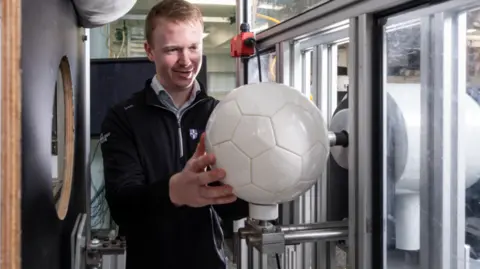 Loughborough University
Aged just 25, Dr Ieuan Phillips discovered something no scientist had previously considered and he hopes it can be "a moment of genuine change" in football.
Shut inside during lockdown, he had been reading studies about the increased risk of neurodegenerative diseases among footballers and he wanted to know what was happening to their brains when they headed the ball.
Phillips began his PhD at Loughborough University and what it revealed five years later shocked experts in the field.
When Phillips and his colleagues began the project, he said there were a lot of questions around the research: "People doubting me is never a barrier, I'm just happy to trust my gut and go and do stuff anyway."
To quote Jürgen Klopp, the former manager of his beloved Liverpool, he enjoyed turning "doubters into believers".
Phillips, who grew up in Brecon Beacons, has always been a fan of sport and believes it enriches people's lives, so was keen to combine his passion with bringing people safely into sports.
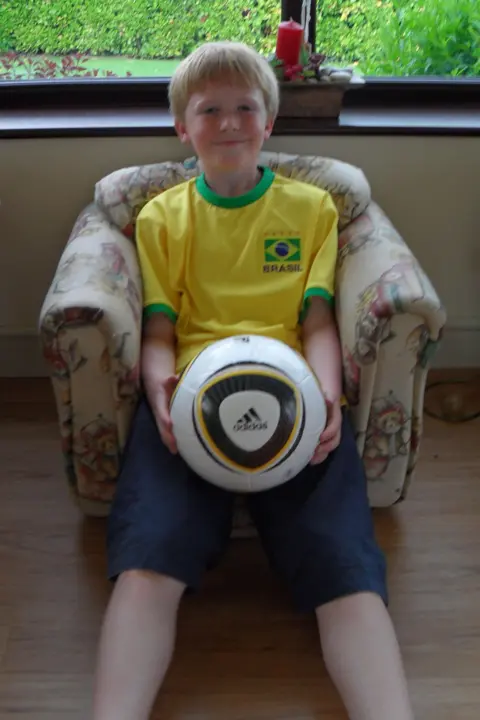 Ieuan Phillips
Heading a football lasts a fraction of a second and rarely causes concussions, but it could also explain why some players develop dementia decades later.
Phillips said the "build up of repetitive lower-level hits over the course of somebody's career accumulate".
Pathology reports have shown that footballers "seem to have a unique distribution of the damage in their brain towards the frontal region", he added.
"So we were curious about whether there might be these pressure waves. Nobody had ever thought about looking at that before."
The research, funded by England's Football Association, examined different balls over the history of the game and whether the risk changed over time.
When Phillips and his colleagues began the project, he said there were a lot of doubters, and well-established researchers in the field had "never come across the concept of pressure waves before" and did not see the value in his work.
"No-one knew they needed a smartphone until someone built one. It's a little bit like that."
To test his theory, the team designed a series of experiments using an advanced head model fitted with pressure sensors before firing footballs at the model skull with "a big ball cannon".
They ranged in speeds from 29mph (47km/h) to simulate softer passes to 40mph (64km/h) for corners and 51mph (82km/h) for shots.
"We see the energy transfer characteristics change with speed so varying this is important," he said.
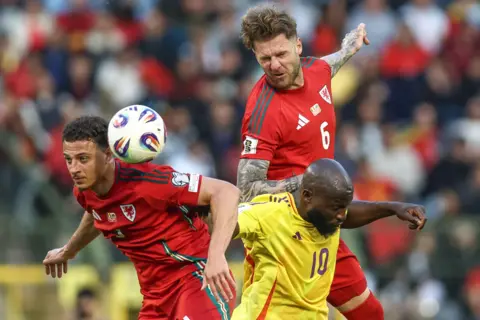 PA Media
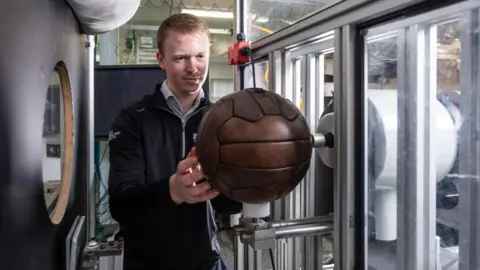
The team tested 20 types of footballs, from old-fashioned leather designs to modern versions.
It had been thought the old, heavy leather balls that absorbed water were likely to have caused long-term damage to footballers' brains.
But this was not backed up by Phillips' results.
Though the impact of wet leather balls increased compared to when they were dry, modern footballs - wet or dry - produced similar or even greater levels of energy transfer.
In dry conditions, leather balls transferred up to 55 times less energy than the highest-impact modern designs.
"For context, I've tested footballs in a number of different tests for a number of years and if you get 10% difference, that's a big difference.
"These balls all pass the laws of the game. So they're all very legitimate footballs."
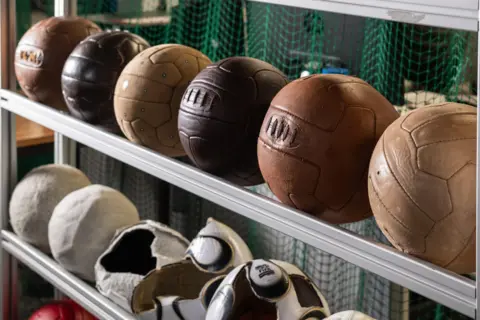 Loughborough University
The reason for such drastic differences is the construction of the balls, rather than brand or era.
Modern balls often have multiple layers, including "a bladder, then a textile layer, then foam and another few layers like that," said Phillips.
"A lot of these layers are laminated together to create quite a stiff structure. Often stiffer than the leather balls that were very simple and just one piece of leather."
To explain what is happening in the experiment, Phillips compared it to hitting a table and seeing ripples in a glass of water on top of it.
The impact of a football on the head is similar to the blast exposure seen in repeated weapon firing, he said.
Crucially, the pressure wave happens almost instantly, before the head even begins to move.
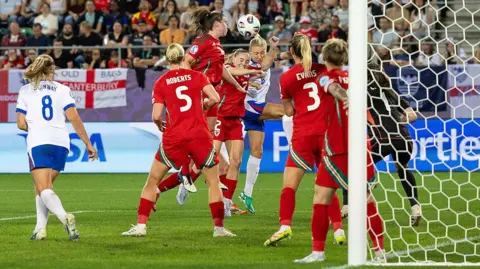
Over the course of a career, a footballer may head the ball thousands of times during training and matches and each impact sends these small pressure waves through their brain.
 Loughborough University
Phillips said: "It weighs on me, I suppose, that perhaps this research has come a little bit too late for some people. We don't know what their neurodegeneration outcome will be.
"But it's that hope for future generations thing that really gives me a lot of heart. And I think it hopefully gives everybody something to focus on and a direction to go with it."
Phillips extols the virtues of football for both physical and mental health, and highlighted that even studies indicating players being at a higher risk of neurodegenerative disease, "the raw numbers are actually quite small, percentage wise".
He said it was an area of science to keep an eye on, but would not want anyone to panic: "There are things that can be can be done about this pressure wave."
Phillips said more work needed to be done now, using this research as a foundation, for real-world application.
"What we do is we measure energy in a lab with dummy heads. What effect that has on the brain remains to be seen," Phillips said.
"But having said that, we know that pressure waves are a well-established cause of brain injury, both short and long-term in other contexts."
Another aspect is the difference between skulls.
In their experiment they used a dummy based on the average MRI data of an adult Japanese man from the university's partners, Tokyo Institute of Science in Japan.
"One of the big things I'm really interested in is the differences between males and females," he said.
"One of the big things with the female skull is that it is anatomically slightly different both in thickness and geometry.
"So that might have an effect, but we haven't studied that yet. I think it is a key thing to look at."
 Getty Images
Phillips would like to collaborate with neuroscientists to examine the trauma side, and establish thresholds for energy that damages the brain.
He also wants to test balls "on a much bigger scale" so parents and teams can know the risk, and maybe even help to develop a ball.
"I hope that people can see the importance of it and don't let the opportunity go," he said.
"We shouldn't assume that change just happens because this hasn't happened yet and it won't happen without people getting involved."
"In the short-to-medium term, I would love to see a football on the market," he said.
He said, ideally, a new ball would need different materials and layers while also retaining its bounce and performance to protect the players while preserving the game.
What this ball would actually look like depends on future work, he said.
"If you strip it right back to the start when I was sat in lockdown during Covid and had the idea if could you make a football that is 'safer to head'. It would be lovely, a really full circle moment.
"I think that would be a really powerful moment and a moment of genuine change.
"If we get this right, we can protect players without changing the game and that's something everyone should be able to get behind."
