One in 16 schoolchildren diagnosed with autism 'not surprising', says mum

 Dorothy Murray
One in 16 schoolchildren in Northern Ireland has a diagnosis of autism, according to new figures published by the Department of Health (DoH).
For parents like Dorothy Murray, the figures reflect a growing awareness of autism but she said there are still difficulties accessing support.
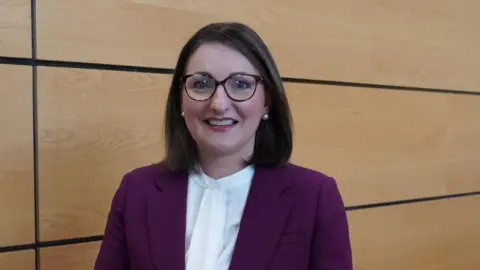
Northern Ireland's independent autism reviewer, Ema Cubitt, said the statistics were important but should be "interpreted carefully".
"Particularly in the context of prolonged diagnostic waiting lists, delayed SEN placements which may not be resolved until after the school census date, and the barriers some children experience in establishing and maintaining regular school attendance," Cubitt said.
Boys are more than twice as likely to have a diagnosis as girls.
The department said that 18,472 school age children up to the age of 16 had a diagnosis of autism in 2025/26.
That is over 3,000 more schoolchildren than three years ago.
"Autism is a lifelong developmental disability that affects how a person communicates with and relates to other people and how they experience the world around them," the DoH said.
However, it is known as a "spectrum disorder" as the condition affects people in different ways and to varying degrees.
At 6.2%, the proportion of autistic schoolchildren in 2025/26 was more than 300% higher than 15 years ago.
The department said that while numbers have risen, the higher overall prevalence rate is also partly due to a decline in the total number of schoolchildren.
The department also cautioned against comparing years due to some changes in the way data has been collected since 2019.
'It's a whole world of difference'
Dorothy said she noticed that during the Covid-19 lockdown, her daughter Sienna, who is now six years old, "wasn't hitting the milestones".
"We weren't sure what was happening," she said.
Due to the pandemic restrictions, the family had to wait until Sienna's two-and-a-half-year review before her needs could be assessed.
"When they came out, they could see quite clearly that Sienna was struggling and needed support," she said.
Sienna was referred to a child development clinic and placed on a priority waiting list because her mum said she had effectively been "missed and overlooked" during Covid-19.
She said the diagnostic process involved assessments by paediatricians, speech and language therapists and play therapists, as well as reports from nursery staff and other healthcare professionals.
"It wasn't just one appointment and then a diagnosis, but another six months after the assessment before we officially got the diagnosis on paper."
By the time Sienna was formally diagnosed, she was almost four.
Dorothy said Sienna initially attended a mainstream nursery because no specialist placements were available, despite being non-verbal and having significant additional needs.
"She was on a reduced timetable for most of the year and I had to go in to change her nappy because they weren't able to do that," she said.
The family then spent two years fighting for a specialist school placement which was "very stressful".
Sienna got a placement in August and is now in her second year at a special school where Dorothy said she is "absolutely thriving".
"It's a whole world of difference."
She said she was "not surprised" by the growing figures and said they are "reflecting the fact that society has moved on and we're doing a whole lot more research.
"We're learning more."
'Autistic people are part of every generation'
 Department of Health
Cubitt had previously raised concerns about the experiences of some autistic children in school.
"Autistic people have always been part of every generation and every community across our society," she said.
"What this school-age prevalence publication reflects is improving visibility, recognition and understanding within education systems that were not historically designed to identify, include or respond consistently to autistic pupils."
She said the DoH statistics were based on the annual school census and linked data, so may not reflect all autistic children.
"Reliable public planning depends not only on collecting data, but on understanding which children may remain least visible within the systems generating that data," Cubitt said.
Figures suggest 8.6% of boys are autistic
While not all autistic children have a statement of Special Educational Needs (SEN), there have been some concerns about planned reforms to the support provided to children with SEN.
Concerns have also been expressed about what further support is in place for autistic young people and others with SEN when they leave school.
A statement of SEN ends with school but in England, a care plan is in place until a young person reaches 25.
The DoH reports each year on the prevalence of autism - including asperger syndrome - in schoolchildren in Northern Ireland.
As well as a rise in the number and proportion of schoolchildren with a diagnosis of autism, the figures suggest that 8.6% of boys are autistic compared to 3.7% of girls.
According to the DoH, there has been a "steady rise" in the proportion of autistic children, but the highest rate is among 12 or 13-year-old children.
In that age group, in year nine of post-primary school, more than one in 12 children has a diagnosis of autism.
Children who live in urban areas like Belfast are more likely to be diagnosed than those who live in rural areas.
Children who live in relatively disadvantaged areas are also more likely to be autistic than those who live in more affluent areas, according to the department.
