'Big step forward' in HIV treatment celebrated

 BBC
BBCA new development in the treatment of HIV has been hailed as a "big step forward" by a London professor who was part of the research team.
Currently, those taking a pill for HIV take the medication daily which is not always easy or practical and leaves some who have not made their diagnosis widely known worried that someone like a parent or housemate could find the pills.
Now, an international clinical trial has found taking it weekly is just as effective.
According to the latest data from the UK Health Security Agency, about 39,750 people in London are living with HIV, of which about 1,250 are undiagnosed.
Stephen Hart from Brixton was diagnosed with HIV in 2006.
He said: "Every time I took my medication, I was reminded that I was living with HIV, and it was something that I was ashamed of.
"I knew other people had a stigma against it.
"So I think taking a tablet once a week instead of taking a tablet seven times a week will make a huge difference to people mentally."
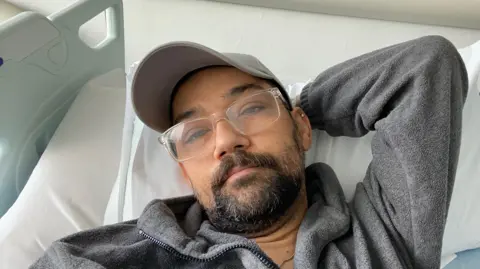 Stephen Hart
HIV medication, known as antiretroviral therapy (ART), uses drugs to stop the virus from multiplying. Treatment typically reduces the viral load to undetectable levels, protecting the immune system and preventing sexual transmission of the virus.
The once-a-week tablet combines two medicines: Islatravir and Lenacapavir.
The trial involved 607 adults across 106 clinical sites in 12 countries, and the findings were presented at the International AIDS Conference in Rio de Janeiro.
Participants will continue to be followed for 96 weeks to assess longer-term safety and effectiveness.
Other than taking medication, there is an option of an injection which is administered six times a year at a clinic. However, not everyone considers that suitable for them.
'Greater flexibility'
Professor Chloe Orkin MBE from Queen Mary University of London, was involved in the new research, and said taking the pill weekly could provide "welcome relief from the burden of taking a pill every single day for the rest of their lives."
She added: "It offers greater flexibility while avoiding the need for injectable therapies.
"This is especially important for those experiencing stigma and for those with other HIV-associated health conditions who are taking many other tablets too."
 Chloe Orkin
"What we've seen in other conditions, like rheumatoid arthritis and osteoporosis, is that giving them a weekly tablet, rather than a daily one, has massively improved their ability to keep taking the pills.
"Now we're in a situation where we can offer such an innovation to help people with HIV stay on their treatment, which helps them to live well, and also prevents them from passing it on."
 Stephen Hart
For Stephen, treatment is only part of the picture, while negative attitudes towards people with the condition remain.
He said in the immediate years after his diagnosis, he felt more comfortable openly living with HIV when he was in New York than when he returned to London.
He says the stigma remains.
"As many advancements as there's been in the drugs, stigma is still the biggest thing for people living with HIV, whether it's from people you meet or on dating websites.
"There's still a lot of misunderstanding about what HIV looks like.
"It's great that we're moving forward but there's also a lot still to do."
Listen to the best of BBC Radio London on Sounds and follow BBC London on Facebook, X and Instagram. Send your story ideas to hello.bbclondon@bbc.co.uk
