UK borrowing lowest for three years but Iran war clouds outlook

 Getty Images
Annual UK government borrowing has fallen to a three-year low, but analysts do not expect the improvement to last because of the impact of the Iran war.
Borrowing, the difference between spending and income from taxes, fell £19.8bn to £132bnin the year to March, the Office for National Statistics (ONS) said,the lowest since 2022-23.
The total was slightly below the £132.7bn that had been predicted by the government's independent forecaster, the Office for Budget Responsibility.
However, analysts say borrowing could worsen this year if inflation picks up and if the government offers to support to some households to cope with higher energy bills.
Ruth Gregory, deputy chief UK economist at Capital Economics, said the full impact from the energy price shock caused by the conflict "is still to come".
Since the outbreak of the US-Israeli war with Iran, energy prices have surged due to the effective closure of the Strait of Hormuz - a key waterway with usually carries about 20% of the world's oil and liquid natural gas supplies.
This has already pushed up petrol and diesel costs, and has started to increase the rate of inflation - the pace at which prices rise.
Last week, the International Monetary Fund (IMF) predicted the energy shock from the Iran war would hit the UK the hardest of the world's advanced economies, and cut its estimate for UK growth this year to 0.8% from its previous prediction of 1.3%.
While the government might gain extra revenues from taxes on petrol and North Sea oil and gas, weaker economic growth is likely to lead to a slower increase in overall revenues from taxes.
In addition, the government has been facing higher borrowing costs since the start of the Iran war, and there is the possibility of future support for household energy bills, although Chancellor Rachel Reeves has said this would target those on lower incomes.
Capital Economics' Gregory said: "We continue to think that the combination of some targeted energy price support, totalling about £20bn, high interest rates and the weakening economy will mean borrowing rises from £132bn in 2025/26 to about £145bn this year."
Elliott Jordan-Doak, senior UK economist at Pantheon Economics, said the chancellor was facing "a more daunting 2026/27 ahead".
He estimated that government is facing an increase of about £12bn in interest payments this year, and "any further fiscal support for households or businesses will require additional borrowing".
The ONS said borrowing in the month of March was £12.6bn, which was higher than analysts had been expecting. However, the figure was £1.4bn less than a year earlier, and the lowest March borrowing since 2022.
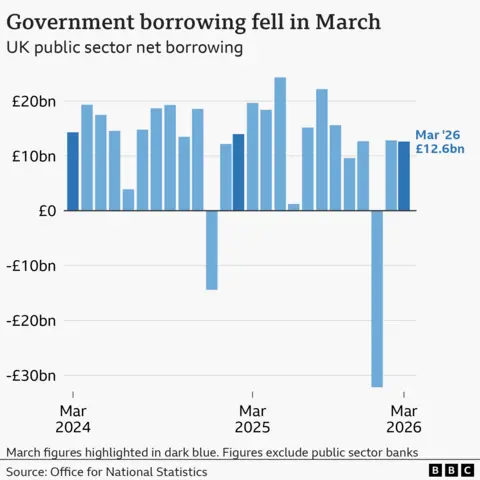
For the year to March, the ONS said borrowing as a proportion of GDP was 4.3% - the lowest since 2019-20, just before the Covid pandemic.
"Although spending has risen this financial year, this was more than offset by increased receipts," said ONS senior statistician Tom Davies.
Nabil Taleb, an economist at PwC UK, said the outlook for the UK was "set to become more challenging" and speculation was "already building" about the impact of weaker growth on the headroom, or buffer, that the chancellor has to meet her financial rules.
In last month's Spring Statement, the OBR forecast that the headroom Reeves has against her rule not to borrow to fund day-to-day spending in five years' time was £23.6bn.
Earlier this week, the Resolution Foundation think tank said that in a "severe but plausible scenario", where the conflict intensifies, could mean borrowing increases by £16bn a year by 2029-30.
Reacting to the latest borrowing figures, Chief Secretary to the Treasury, James Murray, said: "Our deficit is down £19.8bn because of our plan to cut borrowing. In a volatile world the decisions we are taking are the right ones to keep costs down, take back our energy security and cut borrowing and debt."
Shadow chancellor Mel Stride said the annual deficit was "70% higher than was forecast when they [Labour] came to office".
"Labour have left Britain dangerously exposed to economic shocks," he added.
Reform UK's Treasury spokesperson Robert Jenrick said the chancellor was "wasting money" and added: "We should cut the waste and spend money on bringing down people's bills instead."
