Lifeboat crew praised after 60ft cruiser fire

 Pete Hicks
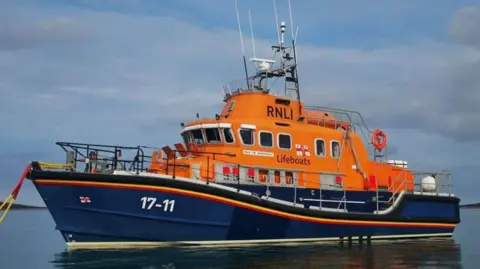
A chief fire officer has praised the actions of lifeboat crew after a motorboat became "completely engulfed in flames".
Chief fire officer for the Isles of Scilly Fire and Rescue Service Phil Martin, said the team had shown "exceptional professionalism" in having considered the risk of a hidden fire, despite an initial assessment indicating the fire had been put out.
"The subsequent report of the vessel being fully involved in fire highlights just how significant the hidden fire risk was," he added.
Martin said the boat fire served as a "timely reminder" that a fire at sea could escalate incredibly quickly, even when it initially appeared to have been extinguished.
He said: "In this case, what appeared to be a controlled situation changed within moments, reinforcing the importance of a cautious, risk-based approach."
He added smoke from an engine space or accommodation could indicate a fire was still developing and restarting machinery could quickly reintroduce oxygen or fuel to a hidden fire.
'Sound operational judgement'
Martin said: "It would have been easy to accept the initial assessment that the fire was out and focus on recovering the vessel.
"The decision not to tow the vessel, despite understandable requests to do so, and the decisive instruction to abandon the vessel when conditions deteriorated, are powerful examples of sound operational judgement under pressure.
"The later report of the vessel being completely engulfed in flames serves only to reinforce how critical the crews' judgement was."
"These are rarely easy decisions to make, but they are exactly the decisions that save lives," he added.
The chief fire officer praised the crew members' training, experience, teamwork and "calm professionalism".
He said the team "should be immensely proud of the part they played" because while "boats can be replaced, lives cannot".
In response to the incident Isles of Scilly Fire and Rescue Service said it advised anyone who sailed boats to:
- Service engines, fuel systems and electrical installations regularly
- Carry suitable, in-date fire extinguishers and ensure any fixed fire suppression systems are properly maintained
- Fit and routinely test smoke alarms and heat detectors within accommodation and machinery spaces
- Keep a grab bag prepared with essential documents, communications equipment, medication, warm clothing and other emergency items
- Discuss and practise emergency procedures before leaving harbour
- Never hesitate to call for assistance
Follow BBC Cornwall on X, Facebook and Instagram. Send your story ideas to spotlight@bbc.co.uk.
