Hospital order for Remembrance Sunday fatal attack

 Met Police
A homeless man who killed a grandfather and stabbed two others with a stolen knife at a south London market on Remembrance Sunday has been given an indefinite hospital order.
Musse Ali, 67, killed Hilkiah McLeggan, 77, and seriously injured two others in East Street market in Walworth on 10 November 2024.
At the Old Bailey, Ali pleaded guilty to manslaughter by diminished responsibility, having an article with a blade, and wounding with intent.
The court heard Ali had been diagnosed with a schizoaffective disorder, but had not taken his medication for three months before the attack. His Honour Judge Nigel Lickley said: "A life was lost and many lives changed as a consequence."
On the day of the incident, Ali travelled to the market by bus, entered a shop and stole a knife, prosecutor Allan Compton told the court.
Ali then stabbed three people in "quick succession".
The first victim, Ho Man Yau, was walking through the market when Ali "stabbed him a number of times", before attacking Baheru Nadew Bartura from behind. Both were taken to hospital with serious injuries.
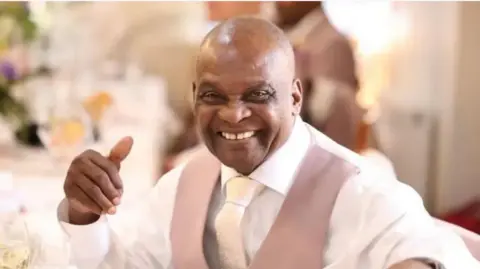
He then attacked McLeggan who died at the scene from a stab wound to the back.
The defendant also lunged at other members of the public with the blade before he was detained and disarmed by members of the public, Compton said.
'Very unwell'
Ali, who was born in Somalia but moved to the UK in 1990 after seeking asylum, had not been taking his medication for his schizoaffective disorder since leaving supported living in August 2024, the court heard.
The responsible clinician for Ali told the court the defendant had a "serious and treatment-resistant" form of the disorder and in his view, Ali would not have offended and the event would not have taken place if he did not have the illness.
The judge said he accepted the evidence of this clinician and another that found the reason Ali "behaved in the very violent way he did was because he was very unwell at the time".
He added Ali's offending caused "serious alarm and distress" and that there was "no doubt" he was a "dangerous" individual.
He was sentenced to a hospital order under Section 37 of the Mental Health Act, with a restriction order under Section 41.
'Stole a precious person'
McLeggan's family told the court Ali had "stolen a precious, courageous, supportive and loving person when he carried out this atrocious and selfish act".
"Our dad was not ready to go, nor were we prepared to lose him in such a cruel way," they added.
"We didn't get to hug him; tell him we loved him one last time or say goodbye.
"He had so much vibrancy, love and life to give, which makes his loss exceptionally hard to bear. We will cherish him in our hearts forever."
In a victim impact statement, Baheru said since the assault, he had become dependent on his wife and children, adding: "Without their support I'm effectively housebound because of the overwhelming anxiety, post-traumatic stress and a constant fear of being attacked again."
Listen to the best of BBC Radio London on Sounds and follow BBC London on Facebook, X and Instagram. Send your story ideas to hello.bbclondon@bbc.co.uk
